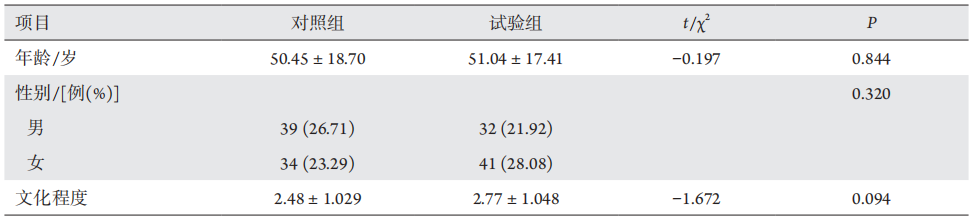
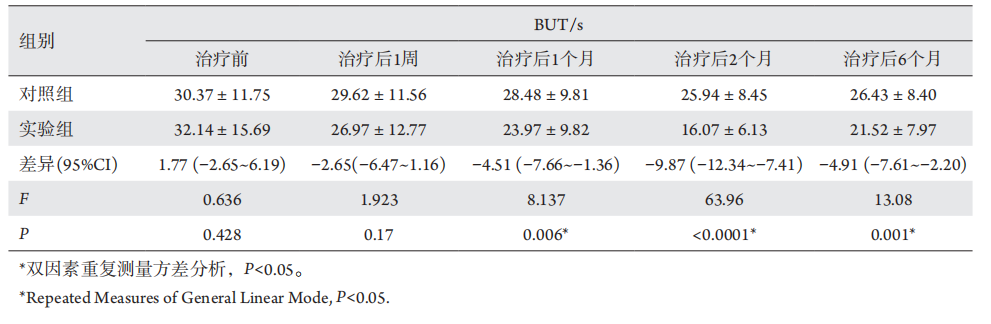
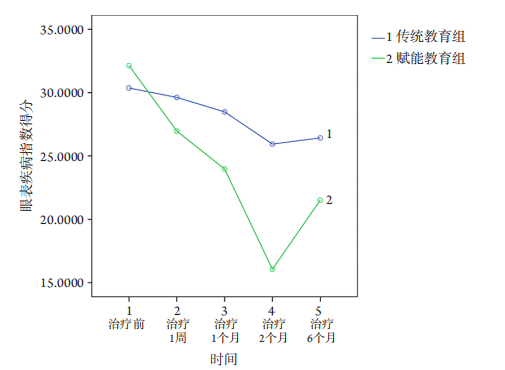
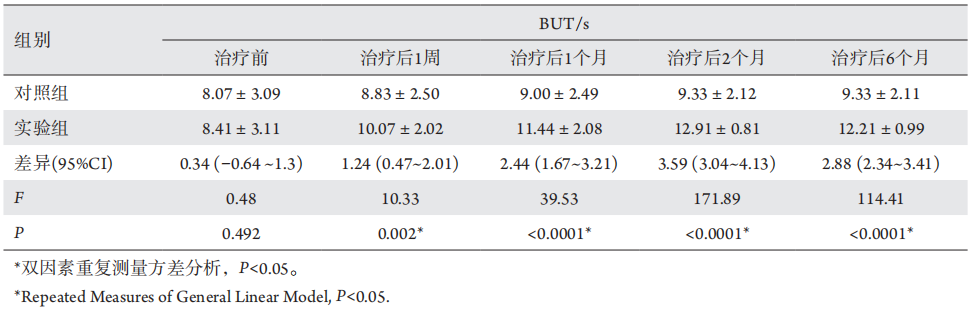
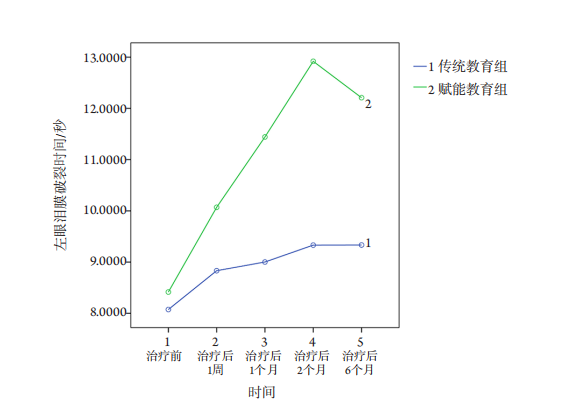
目的:探讨赋能教育模式在干眼患者健康教育中的应用价值。方法:选取2017年6月至12月期间首诊于南方医科大学珠江医院眼科的干眼患者,按照完全随机分配法分为试验组(n=73)及对照组(n=73),试验组采用赋能教育模式,对照组采用传统健康教育方式。经治疗1周、1个月、2个月及6个月后,分别随访并记录每组患者的眼表疾病指数(ocular surface disease index,OSDI)、泪膜破裂时间值(tear film break up time,BUT),同时记录患者家庭护理(清洁睑缘、热敷、睑板腺按摩)频率以及复诊频率。结果:赋能教育组家庭护理频率及复诊频率均优于传统教育组(P<0.05)。治疗前两组OSDI和BUT差异均无统计学意义(P>0.05),但试验组OSDI随时间的推移呈下降趋势,BUT值呈上升趋势;而对照组OSDI以及BUT值的变化均不明显。结论:运用赋能教育模式有助于提高干眼患者治疗的依从性,提高患者的家庭护理频率和复诊频率,显著改善患者的眼表情况,进而提高长期治疗效果。
Table 2 Comparison of the frequency of cleaning palpebral margin, hot compress, palpebral gland massage and the frequency of follow-up between two groups after corresponding treatment (n=73)
1. 南方医科大学护理科研专项项目 (Y2017021)。 This work was supported by Nursing Research Project of Southern
Medical University, China (Y2017021).
参考文献
1. 程燕. 睑板腺功能障碍所致的干眼的诊断与治疗[ J]. 饮食保健,
2017, 4(26): 148.
CHENG Y. Diagnosis and treatment of dry eye caused by meibomian
gland dys-function[ J]. Diet Health, 2017, 4(26): 148.
2. 刘含军, 熊新春. 小梁切除术后持续性浅前房的发生与眼部解
剖因素相关性分析[ J]. 眼科新进展, 2010, 30(4): 381-385.
LIU HJ, XIONG XC. Analysis of the correlation between the
occurrence of persistent shallow anterior chamber after trabeculectomy
and ocular anatomical factors[ J]. New Progress in Ophthalmology,
2010, 30(4): 381-385.
3. St-Cy r Tribble D, Gallagher F, Bell L, et al. Empowerment
interventions, knowledge translation and exchange: perspectives of
home care professionals, clients and caregivers[ J]. BMC Health Serv
Res, 2008, 8: 177.
4. 刘云, 石金涛. 授权理论的研究逻辑——心理授权的概念发展[J].
上海交通大学学报(哲学社会科学版), 2010, 18(1): 54-59.
LIU Y, SHI JT. Approaches to the study of the theory of
empowerment—the concept of psychological empowerment[ J].
Journal of Shanghai Jiaotong University (Philosophy And Social
Sciences), 2010, 18(1): 54-59.
5. Miller KL, Walt JG, Mink DR, et al. Minimal clinically important
difference for the ocular surface disease index[ J]. Arch Ophthalmol,
2010, 128(1): 94-101.
6. Comger JA, Kanungo RN. The empowerment process: integrating
theory and practice[ J]. Acad Manage Rev, 1988(12): 471-482.
7. Maunsell E, Lauzier S, Brunet J, et al. Health-related empowerment
in cancer: validity of scales from the Health Education Impact
Questionnaire[ J]. Cancer, 2014, 120(20): 3228-3236.
8. Zhao J, Hu Y, Zhang X, et al. Efficacy of empowerment strategies for
patients with hypertension: A systematic review and meta-analysis.
Patient Educ Couns, 2020, 103(5): 898-907.
9. 姚燕霞, 王爱民, 叶洪江. 团队式赋能教育在妊娠期糖尿病患者
自我管理中的应用[ J]. 国际呼吸杂志, 2016, 35(7): 952-954.
YAO YX, WANG AM, YE HJ. Application of team-based empowerment education in self-management of patients with
gestational diabetes mellitus[ J]. International Journal of Respiratory
Medicine, 2016, 35(7): 952-954.
10. Faithfull S, Cockle-Hearne J, Khoo V. Self-management after prostate
cancer treatment: evaluating the feasibility of providing a cognitive and
behavioural programme for lower urinary tract symptoms[ J]. BJU Int,
2011, 107(5): 783-790.

'%20fill='white'%20fill-opacity='0.01'/%3e%3cmask%20id='mask0_3477_29692'%20style='mask-type:luminance'%20maskUnits='userSpaceOnUse'%20x='0'%20y='0'%20width='16'%20height='16'%3e%3crect%20id='&%23232;&%23146;&%23153;&%23231;&%23137;&%23136;_2'%20x='16'%20width='16'%20height='16'%20transform='rotate(90%2016%200)'%20fill='white'/%3e%3c/mask%3e%3cg%20mask='url(%23mask0_3477_29692)'%3e%3cpath%20id='&%23232;&%23183;&%23175;&%23229;&%23190;&%23132;'%20d='M14%205L8%2011L2%205'%20stroke='%23333333'%20stroke-width='1.5'%20stroke-linecap='round'%20stroke-linejoin='round'/%3e%3c/g%3e%3c/g%3e%3c/svg%3e)