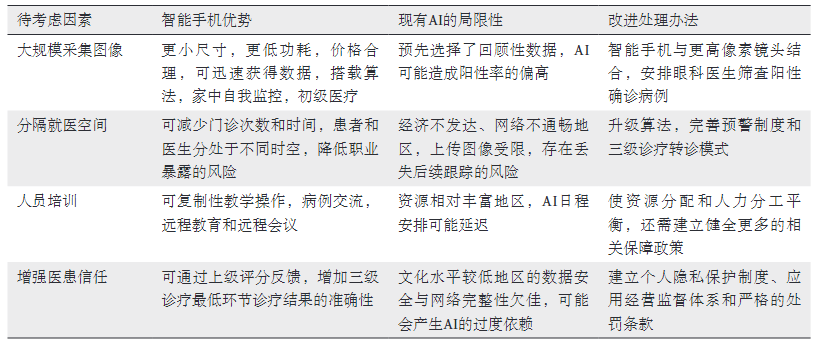
大量研究[10-13]表明:DL可通过眼底彩照高灵敏度地检测DR,但其中大多数研究都是使用回顾性收集的数据。2018年,Abràmoff等[14]招募了900名未经DR初筛的受试者,验证了自主AI系统的诊断性能具有高特异性和高灵敏度。基于此,同年4月,IDx-DR,第一台使用AI检测轻度以上的DR和DM黄斑水肿的医疗设备被美国食品和药物管理局(Food and Drug Administration,FDA)允许上市销售[14-15]。然而,由于疾病患病率和图像质量的变化,当疾病发生率较低时,阳性预测值也将较低,整体性能可能会降低。
iGlaucoma是世界上第一个基于智能手机,能够通过Humphrey VFs的模式偏差概率图(pattern deviation probability plot,PDP)地图检测青光眼的应用程序,在大规模临床部署中都具有巨大价值。2020年9月中山眼科中心发表了一项关于iGlaucoma评估基于VF的多模式DL算法的研究[25]。基于智能手机的增强深度学习系统(deep learning system,DLS),该研究开发了青光眼检测工具iGlaucoma,并评估了中国7个三级青光眼中心超过160万数据点,在2个阶段的青光眼VF检测中,检测出其中的青光眼病例,实现从实验室到临床应用的转换。这种仅根据VFs来判断的性能水平超过6名普通眼科医生,诊断青光眼的速度快5倍。未来还可将虚拟现实(virtual reality,VR)和DL技术结合起来,将Humphrey Field Analyzer移植到VR护目镜中,创造一种智能的VF测试和诊断设备。这表明将DLS并入VF,作为初级眼保健界未来的青光眼诊断工具之一,让机器帮助做出青光眼诊断成为可能[25]。
中国人工智能医学联盟(the Chinese Medical Alliance for Artificial Intelligence,CMAAI)应用Django框架建立了用于白内障诊断的Web平台,远程实时监控患者疾病状况。选择年龄范围和诊断模块后[特别是用于后囊膜浑浊(posterior capsular opacification,PCO)诊断的逆光照明图片],用户可以从文件中选择图像来上传新病例,网站上则提供捕获模式、白内障诊断、严重性评估和转诊建议等。每周医生会根据一般分类标准来评估所有病例,并及时与患者沟通,防止误诊。根据最新的诊断准则来更新逻辑语义,平台的诊断和治疗决策可满足最新的诊断标准,以便随时更新。他们还建立了一种新颖的三级医疗转诊模式,包括家中的自我监控、初级医疗和专业医院服务。与传统方式相比,该平台的眼科医生与人口的服务比例增加了10.2倍[42]。接下来还需要进一步社区筛查的临床试验,如果收效明显,那么未来该智能手机远程诊疗白内障疾病平台将大有可为。
1. 本科教学质量工程项目[教务(2021)93号]。This work was supported by Undergraduate Teaching Quality Engineering Project, China [(2021) No. 93].
2. 本科教学质量工程项目 [ 教务 (2021)93 号 ]。This work was supported by the Undergraduate Teaching Quality Engineering Project, China [(2021) No. 93].
参考文献
1. Statista. Anzahl der Smartphone-Nutzer weltweit von 2016 bis 2019 und Prognose bis 2023[EB/OL]. 2021. [2021-01-14]. https://de.statista.com/statistik/daten/studie/309656/umfrage/prognose-zur-anzahl-der-smartphone-nutzer-weltweit/.
2. Whitehead L, Seaton P. The Effectiveness of self-management mobile phone and tablet apps in long-term condition management: A systematic review[J]. J Med Internet Res, 2016, 18(5): e97.
3. Yang M, Lo ACY, Lam WC. Smart phone apps every ophthalmologist should know about[J]. Int J Ophthalmol, 2020, 13(8): 1329-1333.
4. Cheung N, Mitchell P, Wong TY. Diabetic retinopathy[J]. Lancet, 2010, 376(9735): 124-136.
5. Lee R, Wong TY, Sabanayagam C. Epidemiology of diabetic retinopathy, diabetic macular edema and related vision loss[J]. Eye Vis (Lond), 2015, 2: 17.
6. Rodrigues GB, Abe RY, Zangalli C, et al. Neovascular glaucoma: A review[J]. Int J Retina Vitreous, 2016, 2: 26.
7. Tan CH, Kyaw BM, Smith H, et al. Use of Smartphones to detect diabetic retinopathy: Scoping review and meta-analysis of diagnostic test accuracy studies[J]. J Med Internet Res, 2020, 22(5): e16658.
8. Rajalakshmi R, Subashini R, Anjana RM, et al. Automated diabetic retinopathy detection in smartphone-based fundus photography using artificial intelligence[J]. Eye (Lond), 2018, 32(6): 1138-1144.
9. Natarajan S, Jain A, Krishnan R, et al. Diagnostic accuracy of community-based diabetic retinopathy screening with an offline artificial intelligence system on a smartphone[J]. JAMA Ophthalmol, 2019, 137(10): 1182-1188.
10. Klonoff DC, Schwartz DM. An economic analysis of interventions for diabetes[J]. Diabetes Care, 2000, 23(3): 390-404.
11. Kanagasingam Y, Xiao D, Vignarajan J, et al. Evaluation of artificial intelligence-based grading of diabetic retinopathy in primary care[J]. JAMA Netw Open, 2018, 1(5): e182665.
13. Karakaya M, Hacisoftaoglu RE. Comparison of smartphone-based retinal imaging systems for diabetic retinopathy detection using deep learning[J]. BMC Bioinformatics, 2020, 21(Suppl 4): 259.
14. Abràmoff MD, Lavin PT, Birch M, et al. Pivotal trial of an autonomous AI-based diagnostic system for detection of diabetic retinopathy in primary care offices[J]. NPJ Digit Med, 2018, 1: 39.
15. US Food and Drug Administration. FDA permits marketing of artificial intelligence-based device to detect certain diabetes-related eye problems[EB/OL]. April 12, 2018 (Washington, DC, 2018). https://www.fda.gov/news-events/press-announcements/fda-permits-marketing-artificial-intelligence-based-device-detect-certain-diabetes-related-eye.
16. Osborne NN, Wood JP, Chidlow G, et al. Ganglion cell death in glaucoma: what do we really know?[J]. Br J Ophthalmol, 1999, 83(8): 980-986.
17. Quigley HA. Neuronal death in glaucoma[J]. Prog Retin Eye Res, 1999, 18(1): 39-57.
18. Nicoar? S. The mechanisms of neuronal death in glaucoma[J]. Oftalmologia, 2000, 51(2): 4-6.
19. Tham YC, Li X, Wong TY, et al. Global prevalence of glaucoma and projections of glaucoma burden through 2040: A systematic review and meta-analysis[J]. Ophthalmology, 2014, 121(11): 2081-2090.
21. Jonas JB, Aung T, Bourne RR, et al. Glaucoma[J]. Lancet, 2017, 390(10108): 2183-2193.
22. Mohammadpour M, Heidari Z, Mirghorbani M, et al. Smartphones, tele-ophthalmology, and VISION 2020[J]. Int J Ophthalmol, 2017, 10(12): 1909-1918.
23. Araci IE, Su B, Quake SR, et al. An implantable microfluidic device for self-monitoring of intraocular pressure[J]. Nat Med, 2014, 20(9): 1074-1078.
24. Russo A, Morescalchi F, Costagliola C, et al. A novel device to exploit the smartphone camera for fundus photography[J]. J Ophthalmol, 2015, 2015: 823139.
25. Li F, Song D, Chen H, et al. Development and clinical deployment of a smartphone-based visual field deep learning system for glaucoma detection[J]. NPJ Digit Med, 2020, 3: 123.
26. Ran AR, Tham CC, Chan PP, et al. Deep learning in glaucoma with optical coherence tomography: A review[J]. Eye (Lond), 2021, 35(1): 188-201.
28. Analysis of the development status of cataract medication in China in 2018: Cataract surgery rate (CSR) has been ahead of the 2020 target[Z]. 2008.
29. Moshirfar M, Milner D, Patel BC. Cataract surgery. In: StatPearls. Treasure Island (FL): StatPearls Publishing; November 2, 2021.
33. Cataract in China: Research and development direction and problems encountered[J]. Chinese Journal of Ophthalmology, 2015, 51(4): 241-244.
34. Eppig T, Scholz K, L?ffler A, et al. Effect of decentration and tilt on the image quality of aspheric intraocular lens designs in a model eye[J]. J Cataract Refract Surg, 2009, 35(6): 1091-1100.
35. Baumeister M, Bühren J, Kohnen T. Tilt and decentration of spherical and aspheric intraocular lenses: Effect on higher-order aberrations[J]. J Cataract Refract Surg, 2009, 35(6): 1006-1012.
36. Oshika T, Sugita G, Miyata K, et al. Influence of tilt and decentration of scleral-sutured intraocular lens on ocular higher-order wavefront aberration[J]. Br J Ophthalmol, 2007, 91(2): 185-188.
37. Ashena Z, Maqsood S, Ahmed SN, et al. Effect of intraocular lens tilt and decentration on visual acuity, dysphotopsia and wavefront aberrations[J]. Vision (Basel), 2020, 4(3): 41.
38. Xin C, Bian GB, Zhang H, et al. Optical coherence tomography-based deep learning algorithm for quantification of the location of the intraocular lens[J]. Ann Transl Med, 2020, 8(14): 872.
39. Wu X, Long E, Lin H, et al. Prevalence and epidemiological characteristics of congenital cataract: A systematic review and meta-analysis[J]. Sci Rep, 2016, 6: 28564.
40. Lin D, Chen J, Lin Z, et al. A practical model for the identification of congenital cataracts using machine learning[J]. EBioMedicine, 2020, 51: 102621.
41. Lambert SR, Purohit A, Superak HM, et al. Long-term risk of glaucoma after congenital cataract surgery[J]. Am J Ophthalmol, 2013, 156(2): 355-361.e2.
42. Plager DA, Lynn MJ, Buckley EG, et al. Complications, adverse events, and additional intraocular surgery 1 year after cataract surgery in the Infant Aphakia Treatment Study[J]. Ophthalmology, 2011, 118(12): 2330-2334.
43. Zhang L, Wu X, Lin D, et al. Visual outcome and related factors in bilateral total congenital cataract patients: A prospective cohort study[J]. Sci Rep, 2016, 6: 31307.
44. Long E, Chen J, Wu X, et al. Artificial intelligence manages congenital cataract with individualized prediction and telehealth computing[J]. NPJ Digit Med, 2020, 3: 112.
45. Wu X, Huang Y, Liu Z, et al. Universal artificial intelligence platform for collaborative management of cataracts[J]. Br J Ophthalmol, 2019, 103(11): 1553-1560.
46. Shahid K, Kolomeyer AM, Nayak NV, et al. Ocular telehealth screenings in an urban community[J]. Telemed J E Health, 2012, 18(2): 95-100.
47. Li JO, Liu H, Ting DSJ, et al. Digital technology, tele-medicine and artificial intelligence in ophthalmology: A global perspective[J]. Prog Retin Eye Res, 2021, 82: 100900.
48. Kiage D, Kherani IN, Gichuhi S, et al. The Muranga teleophthalmology study: Comparison of virtual (Teleglaucoma) with in-person clinical assessment to diagnose glaucoma[J]. Middle East Afr J Ophthalmol, 2013, 20(2): 150-157.
49. Rachapelle S, Legood R, Alavi Y, et al. The cost-utility of telemedicine to screen for diabetic retinopathy in India[J]. Ophthalmology, 2013, 120(3): 566-573.
50. Madanagopalan VG, Raman R. Commentary: Artificial intelligence and smartphone fundus photography—Are we at the cusp of revolutionary changes in retinal disease detection?[J]. Indian J Ophthalmol, 2020, 68(2): 396-397.
51. Fischer F, Kleen S. Possibilities, problems, and perspectives of data collection by mobile apps in longitudinal epidemiological studies: Scoping review[J]. J Med Internet Res, 2021, 23(1): e17691.

'%20fill='white'%20fill-opacity='0.01'/%3e%3cmask%20id='mask0_3477_29692'%20style='mask-type:luminance'%20maskUnits='userSpaceOnUse'%20x='0'%20y='0'%20width='16'%20height='16'%3e%3crect%20id='&%23232;&%23146;&%23153;&%23231;&%23137;&%23136;_2'%20x='16'%20width='16'%20height='16'%20transform='rotate(90%2016%200)'%20fill='white'/%3e%3c/mask%3e%3cg%20mask='url(%23mask0_3477_29692)'%3e%3cpath%20id='&%23232;&%23183;&%23175;&%23229;&%23190;&%23132;'%20d='M14%205L8%2011L2%205'%20stroke='%23333333'%20stroke-width='1.5'%20stroke-linecap='round'%20stroke-linejoin='round'/%3e%3c/g%3e%3c/g%3e%3c/svg%3e)