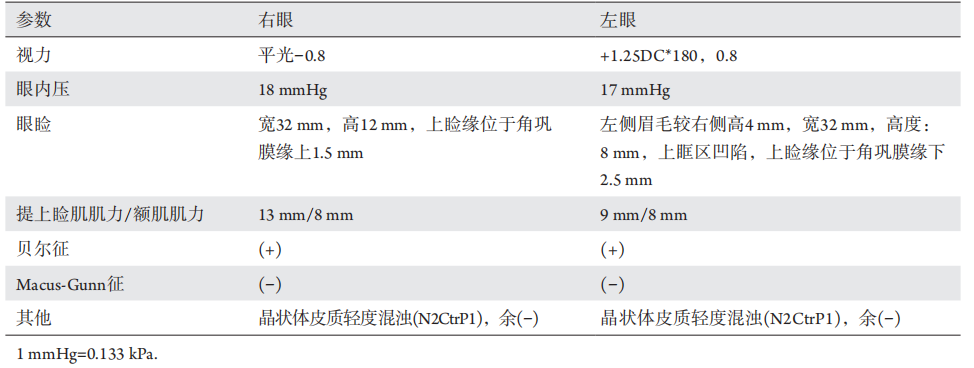
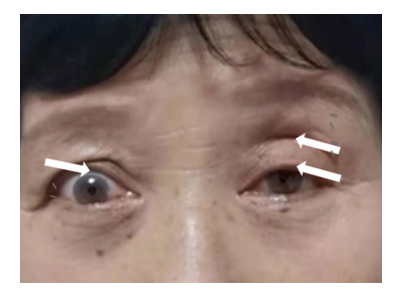
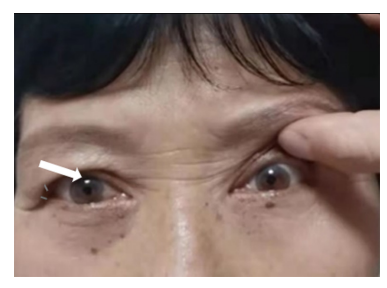
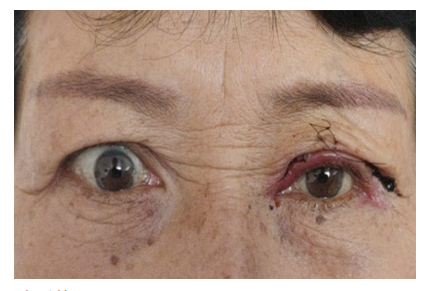
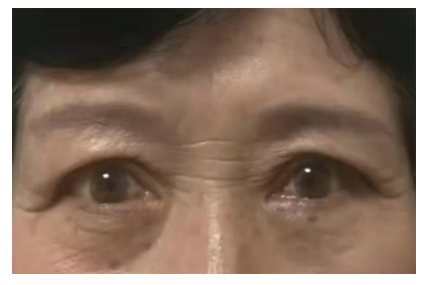
正负眼睑综合征临床体征特殊,比较少见,临床上分真性和假性[1]。真性正负眼睑综合征临床体征表现为一侧上睑提肌肌力相对较弱,导致上睑下垂,继而导致另一侧出现上睑退缩。当肌力相对不佳的眼睑人为抬高一定高度,持续一段时间后,对侧眼睑仍呈现出退缩状态[2]。真性正负眼睑综合征多见于颅内病变如丘脑-中脑梗死[3]、大脑后动脉堵塞[4]、丘脑血肿[5]等疾病引起的动眼神经核和红核旁的后联合核(nucleus of posterior commissure,nPC)受损导致。如果对侧眼出现代偿性的上睑退缩,则为假性正负眼睑综合征[1]。研究[1]表明:假性正负眼睑综合征的病变因素为神经肌肉接头处或者肌肉本身的问题。具体的临床特征性表现为,人为抬高肌力相对较弱呈现上睑下垂的眼睑并持续一段时间后,对侧眼睑的位置会逐渐恢复正常。研究[6]表明这种现象和赫林定律相关,双眼的运动受到的神经支配作用相同,而不是特异的。因此,肌力相对较弱的上睑会导致大脑神经发出超常的神经冲动,致使对侧出现眼睑退缩表现。本例患者自觉右眼突出就诊于宁夏回族自治区人民医院眼科医院眼眶与眼整形美容科,患者原以为右眼突出是由于甲状腺功能亢进导致,而实际上该患者的右眼临床表现为上睑退缩,左眼为上睑下垂,那么这位患者的病变部位是右眼眼睑退缩还是上睑下垂呢?现报告如下。
1. 国家自然科学基金 (81960184)。This work was supported by the National Natural Science Foundation of China (81960184)
参考文献
1. Worley MW, Gal O, Anderson RL, et al. Eye dominance and Hering's law effect on bilateral blepharotosis repair[ J]. Ophthalmic Plast Reconstr Surg, 2013, 29(6): 437-439.
2. Alsherbini K, Kapadia K, Sattin JA. A rare midbrain infarction presenting with plus-minus lid syndrome with ataxia: a case report[ J]. J Med Case Rep, 2011, 5: 525.
3. 庄艾, 孙静, 张硕, 等. 异种脱细胞真皮植入术治疗甲状腺相关眼病眼睑退缩的临床观察[ J]. 中华眼科杂志, 2019, 55(11):821-827.
ZHUANG Ai, SUN Jing, ZHANG Shuo, et al. Acellular xenogenic dermal matrix as a spacer graft for treatment of eyelid retraction related to thyroid associated ophthalmopathy[ J]. Chinese Journal of Ophthalmology, 2019, 55(11): 821-827.
4. 《上睑下垂诊治专家共识》制定专家组. 上睑下垂诊治专家共识[ J]. 中华医学杂志, 2017, 97(6): 406-411.
Expert group for formulating "Expert Consensus on Diagnosis and Treatment of ptosis". Expert consensus on diagnosis and treatment of ptosis[ J]. National Medical Journal of China, 2017, 97(6): 406-411.
5. Zoumalan CI, Lisman RD. Evaluation and management of unilateral ptosis and avoiding contralateral ptosis[ J]. Aesthet Surg J, 2010, 30(3): 320-328.
6. 梅媚. 老年腱膜性上睑下垂的个性化手术治疗[ J]. 临床眼科杂志, 2018, 26(2): 164-165.
MEI Mei. Individualized surgical treatment for senile ptosis[ J]. Journal of Clinical Ophthalmology, 2018, 26(2): 164-165.
7. 祝玮烨, 杨超, 邢新. 正负眼睑综合征[ J]. 中国美容整形外科杂志, 2017, 28(9): 548-550.
ZHU Weihua, YANG Chao, XING Xin. Puls-minus lid syndrome[ J]. Chinese Journal of Aesthetic and Plastic Surgery, 2017, 28(9): 548-550.
8. 庞润晖, 张宏斌, 李妍, 等. 老年性上睑下垂退行性改变个性化治疗临床分析[ J]. 中国实用眼科杂志, 2015, 33(11): 1306-1308.
PANG Runhui, ZHANG Hongbin, LI Yan, et al. Observation of individual therapeutic methods based on degenerative change of levator aponeurosis in patients with senile ptosis[ J]. Chinese Journal of Practical Ophthalmology, 2015, 33(11): 1306-1308.
9. 黄鑫宇, 王星星, 许海涛, 等. 伴假性Graefe征动眼神经麻痹后上睑下垂三例治疗观察[ J]. 中华医学美学美容杂志, 2019, 25(2):193-197.
HUANG Xinyu, WANG Xingxing, XU Haitao, et al. Treatment of blepharoptosis with pseudo-Graefe phenomenon caused by oculomotor nerve paralysis: report of three cases[ J]. Chinese Journal of Medical Aesthetics and Cosmetology, 2019, 25(2): 193-197.
10. 尚巧利, 蒋海越. 先天性上睑下垂的手术治疗[ J]. 中华医学美学美容杂志, 2016, 22(3): 191-192.
SAHNG Qiaoli, JIANG Haiyue. Surgical treatment of congenital ptosis[ J]. Chinese Journal of Medical Aesthetics and Cosmetology, 2016, 22(3): 191-192.
11. 曹琳, 郑仁东, 曹雯,等. 甲状腺相关性眼病治疗新进展[ J]. 国际内分泌代谢杂志, 2019, 39(1): 25-28.
CAO Lin, ZHEGN Rendong, CAO Wen, et al. Update on the management of thyroid-associated ophthalmopathy[ J]. International Journal of Endocrinology and Metabolism, 2019, 39(1): 25-28.
12. 贺姽娟, 翁胜涛, 李华. 改良式上睑提肌缩短术治疗上睑下垂66眼[ J]. 中华整形外科杂志, 2020, 36(3): 308-312.
HE Guijuan, WENG Shengtao, LI Hua. The treatment of 66 ptosis with a modified aponeurosis-resection surgery[ J]. Chinese Journal of Plastic Surgery, 2020, 36(3): 308-312.
13. 唐浚杰, 陈芳圆, 陈剑, 等. 成人重症肌无力眼肌型的临床特征[ J]. 中华眼视光学与视觉科学杂志, 2021, 23(8): 604-609.
TANG Junjie, CHEN Fangyuan, CHEN Jian, et al. Analysis of the clinical features of adult ocular Myasthenia gravis[ J]. Chinese Journal of Optometry Ophthalmology and Visual Science, 2021, 23(8): 604-609.
14. 潘贰, 李勤, 于建刚, 等. 应用赫林定律矫正不对称双侧上睑下垂的临床效果[ J]. 中华医学美学美容杂志, 2017, 23(5): 313-315.
PAN Er, LI Qin, YU Jiangang, et al. Application of the Hering's law in corrective surgery for asymmetric bilateral ptosis[ J]. Chinese Journal of Medical Aesthetics and Cosmetology, 2017, 23(5): 313-315.
15. Sorgun MH, I?ikay CT, Kuzu Z. Plus-minus lid syndrome caused by thalamic hematoma[ J]. Acta Neurol Belg, 2014, 114(2): 151-152.
16. Akdal G, Kutluk K, Men S, et al. Benedikt and "plus-minus lid" syndromes arising from posterior cerebral artery branch occlusion[ J]. J Neurol Sci, 2005, 228(1): 105-107.
17. Randhawa S, Donohue MM, Hamilton SR. Concomitant presentation of three rare mesencephalic syndromes: case report[ J]. Clin Neurol Neurosurg, 2010, 112(8): 697-700.
18. Gaymard B, Lafitte C, Gelot A, et al. Plus-minus lid syndrome[ J]. J Neurol Neurosurg Psychiatry, 1992, 55(9): 846-848.
19. Bandini F. Pseudo plus-minus lid syndrome[ J]. Arch Neurol, 2009, 66(5): 668-669.

'%20fill='white'%20fill-opacity='0.01'/%3e%3cmask%20id='mask0_3477_29692'%20style='mask-type:luminance'%20maskUnits='userSpaceOnUse'%20x='0'%20y='0'%20width='16'%20height='16'%3e%3crect%20id='&%23232;&%23146;&%23153;&%23231;&%23137;&%23136;_2'%20x='16'%20width='16'%20height='16'%20transform='rotate(90%2016%200)'%20fill='white'/%3e%3c/mask%3e%3cg%20mask='url(%23mask0_3477_29692)'%3e%3cpath%20id='&%23232;&%23183;&%23175;&%23229;&%23190;&%23132;'%20d='M14%205L8%2011L2%205'%20stroke='%23333333'%20stroke-width='1.5'%20stroke-linecap='round'%20stroke-linejoin='round'/%3e%3c/g%3e%3c/g%3e%3c/svg%3e)