
Prevalence of intermittent exotropia among primary and secondary school students in Shantou, China
阅读量:2572
DOI:doi: 10.3978/j.issn.1000-4432.2016.03.01
发布日期:2024-11-28
作者:
Shibin Lin ,Weifen Gong ,Bin Chen ,Mingzhi Zhang
展开更多 '%20fill='white'%20fill-opacity='0.01'/%3e%3cmask%20id='mask0_3477_29692'%20style='mask-type:luminance'%20maskUnits='userSpaceOnUse'%20x='0'%20y='0'%20width='16'%20height='16'%3e%3crect%20id='&%23232;&%23146;&%23153;&%23231;&%23137;&%23136;_2'%20x='16'%20width='16'%20height='16'%20transform='rotate(90%2016%200)'%20fill='white'/%3e%3c/mask%3e%3cg%20mask='url(%23mask0_3477_29692)'%3e%3cpath%20id='&%23232;&%23183;&%23175;&%23229;&%23190;&%23132;'%20d='M14%205L8%2011L2%205'%20stroke='%23333333'%20stroke-width='1.5'%20stroke-linecap='round'%20stroke-linejoin='round'/%3e%3c/g%3e%3c/g%3e%3c/svg%3e)
关键词
Intermittent exotropia (IXT)
students
survey
摘要
Background: Few prevalence studies on intermittent exotropia (IXT) based on Chinese populations.
Furthermore, longitudinal change in this pattern within a local setting has not been reported in the past.
This study aims to determine the pro?le of children with IXT in China.
Methods: A total of 7,537 subjects from nine multi-layer primary and secondary schools participated in
this investigation. The position of eyes was examined by using Hirschberg test and alternate cover test. The
obtained results were classi?ed according to respective features and analyzed statistically.
Results: The prevalence of IXT among the participants was 7.98%, accounting for 73.04% of all types
of strabismus. Junior high school students had a lower prevalence of IXT than elementary and senior high
school counterparts. Logistic regression analysis showed that IXT was mainly found in male pupils at high
grades in rural areas and in male secondary students at high grade in urban regions.
Conclusions: IXT was shown to be more prevalent than other types of strabismus in Chinese children.
Furthermore, the distribution and characteristics of IXT greatly varied among participants.
全文
Introduction
Intermittent exotropia (IXT), as a fairly common condition,
is a transition strabismus between exophoria and constant
exotropia (1). It is the most prevalent form of childhood
exotropia and constantly affects binocular vision and
easily evolves into constant exotropia (2). IXT occurs in
approximately 1% of developmentally healthy children in
the United States (2). But few large-scale studies on nonwhite
populations are available.
In this study, children presenting with IXT were assessed.
The types of strabismus and characteristics such as age,
Area of residence, gender, and grade were determined.
Methods
Study subjects
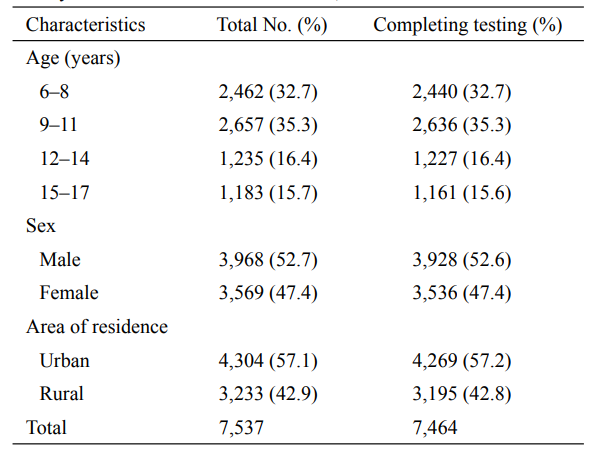
Two categories of schools were identified according to
Shantou Education Bureau: urban and rural (with most
of the population working in agriculture) (Table 1). There
were 302 public schools in Shantou three district (namely:
Jinping, Longhu, Chenghai): 81 elementary, 51 middle,
38 high schools in urban, and 59 elementary, 41 middle,
32 high schools in rural respectively. Five schools (three
primary, one middle and one high school) from urban and
four schools (two primary, one middle and one high school)
from rural were selected randomly for a total of nine schools. School sizes ranged from 800 to 1,000 students for
the primary schools and 500 to 700 students for the middle
and high schools. In China, school attendance is compulsory
for 9 years (6 years of primary school and 3 years of middle
school). Therefore, the sample is likely to be representative
of the population in the age range of 6 to 17 years. Students
provided verbal consent, and their legal guardians provided
written consent. This study was approved by the Ethics
Committee of the Joint Shantou International Eye Center
and was conducted in accordance with the Declaration of
Helsinki.
Table 1 Demographic information of participants in a population study of strabismus in Shantou district, China
Ocular examination
All participants underwent a complete strabismus examination
by certified ophthalmologists who specialize in pediatric
eye care. Ocular alignment was measured by Hirschberg
testing, unilateral cover (cover-uncover) testing (UCT), and
alternate cover testing (ACT) of standardized duration, at
6-m and 40-cm fixation, without correction.
Definitions and criteria for strabismus
The strabismus classification method approved by National Workshop of Prevention and Control of Amblyopia and Strabismus in Children held in 1996 was adopted in this study (1). A patient with strabismus showed constant or intermittent tropia of any magnitude at distance or near fixation. A patient with orthophoria showed no deviation during Hirschberg testing and no eye movement during UCT or ACT. A patient with esophoria or exophoria showed a horizontal shift during ACT and no movement of the uncovered eye during UCT, respectively. A patient with IXT presented no deviation during Hirschberg testing and no eye movement of the uncovered eye during UCT, but exodeviation after prolonged ACT. A patient with exotropia or esotropia exhibited exodeviation or esodeviation, respectively, during Hirschberg testing, as confirmed by UCT and ACT. In no case did the direction of the strabismus change between UCT and ACT or between near and distance.Statistical analysis
Excel software was used to establish the database, SPSS 15.0 statistical software was utilized to analyze data. Unoriginal categorical variables were analyzed by χ 2 test, and χ 2 value was divided from degree of freedom. The probability was calculated by binomial distribution method. Line graph was adopted to represent the change tendency of the prevalence of strabismus as different grades and show the differences between rural and urban students. Multi-factorial logistic regression models were used to analyze the association between confounding factors and IXT; α=0.05 was considered as a level of significance.Results
After informed consents were obtained, a total of 7,464
participants (99.03%), including 3,928 males and 3,536
females, underwent eye examinations. The composition
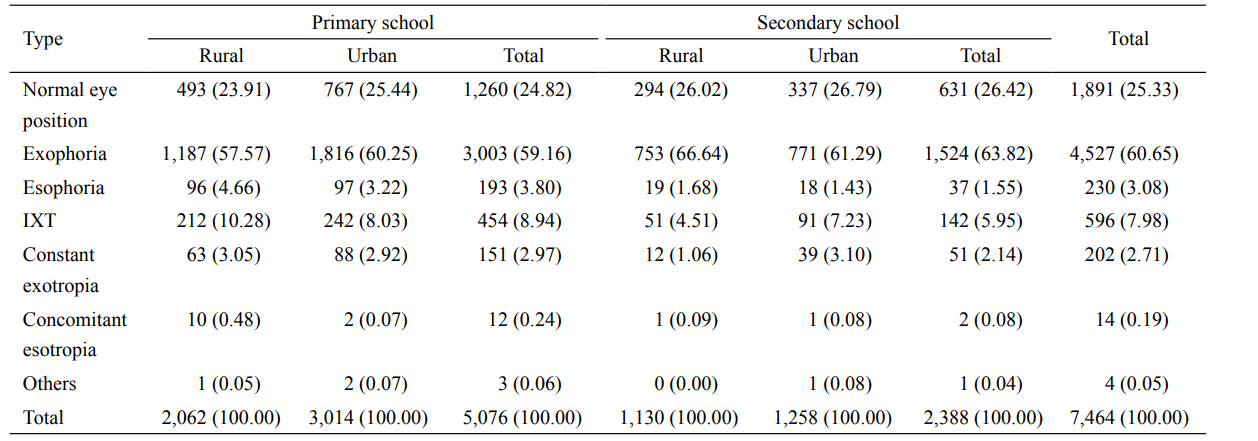
of various types of strabismus among all participants was
shown in Table 2. The prevalence of IXT achieved 7.89% in
this survey, accounting for 73.04% of all types of strabismus.
The results showed that rural pupils had a significantly
higher prevalence of IXT than their counterparts living
in urban areas (χ 2=7.625, P=0.006), while students at rural
senior high schools showed a significantly lower prevalence
of IXT compared with those at urban senior high schools
(χ 2=11.161, P=0.001). No statistical significance was noted
between rural and urban junior high school students
regarding the prevalence of IXT (χ 2=2.243, P=0.134).
Table 2 Composition of various types of strabismus among primary and secondary school students from Shantou
In rural areas, statistical significances were found among students at different grades (χ 2=38.021, P=0.000). Any two types of schools differed in the prevalence of IXT (χ 2=5.951– 35.077; P=0.015–3.17×10 −9 ). The most pronounced difference was noted among primary schools, followed by junior middle and senior middle schools. In urban regions, significant differences were noted among students at various grades (χ2=55.074, P=0.000). Any two types of schools differed in the prevalence of IXT (χ 2=14.365–57.886, P=1.51×10⁻⁴ –2.78×10⁻¹⁴). The most striking difference was observed among junior high schools followed by primary and senior high schools. Among all participants, senior high school students had the highest prevalence of IXT. In rural areas, pupils showed the highest prevalence of IXT.
The prevalence of IXT among all participants differed (χ 2=70.627, P=0.000). Junior high school students differed from those combined from primary and senior high schools regarding the prevalence of IXT (χ2=68.978, P=0.000), suggesting that junior high school students had a lower prevalence of IXT than those at primary and senior high schools, respectively.
Comparison on the prevalence of IXT among primary school students at various grades was shown in Table 3. There was no significant difference among rural primary school students at various grades regarding the prevalence of IXT (P=0.1954–0.2126). In urban regions, primary school students in grade 5 and 6 had a relatively high prevalence of IXT (P=0.0047 and 0.0017), and students at grades 2 and 3 showed a relatively low prevalence of IXT (P=0.0033 and 0.0247). To sum up, the prevalence of IXT in primary students living in rural areas was significantly higher than that of their urban counterparts (χ2=7.625, P=0.006). Table 3 showed the changes of the prevalence of IXT over grades. The prevalence of IXT of pupils in urban areas increased over grade (r=0.869, P=0.025; rs=0.829, P=0.042), while no apparent correlation was noted between the prevalence of IXT and grade in those living in rural parts (r=0.452, P=0.386; rs=0.486, P=0.329).
Table 3 Comparison on the prevalence of IXT in pupils among different areas and grades from Shantou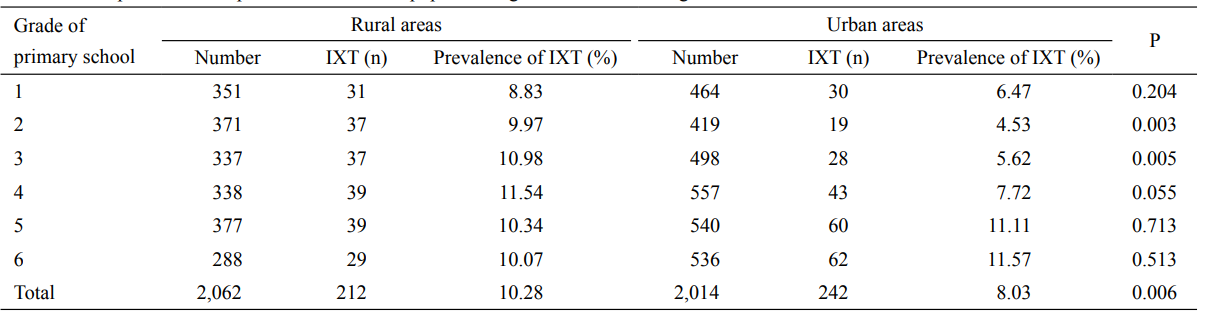
IXT, intermittent exotropia.Comparison of the prevalence of IXT in middle school students at various grades was indicated in Table 4. In rural regions, junior students at different grades had the similar prevalence of IXT (P=0.708). In senior high schools, grades 1 and 2 students had the similar prevalence of IXT (P=1.000). The prevalence of the overall group of grades 1 and 2 students was lower than that of grade 3 students (P=0.012); the prevalence of IXT in junior high school students was lower compared with that of senior high school students (χ2=10.348, P=0.001). In urban areas, the prevalence of IXT among junior students of all grades did not differ significantly (P=0.8441); grade 2 students in senior high schools had a relatively high prevalence of IXT (P=0.0009) and those at grade 3 showed a relatively low prevalence of IXT. However, students at senior high schools had a higher prevalence of IXT than their counterparts at junior high schools (χ2=57.886, P=0.000). No correlation was noted between age and the prevalence of IXT in high school students in urban regions (r=0.633, P=0.178; rs=0.771, P=0.072) while certain correlation was found in those from rural areas (r=0.789, P=0.062; rs=0.829, P=0.042).
Table 4 Comparison on the prevalence of IXT in secondary students among different areas and grades from Shantou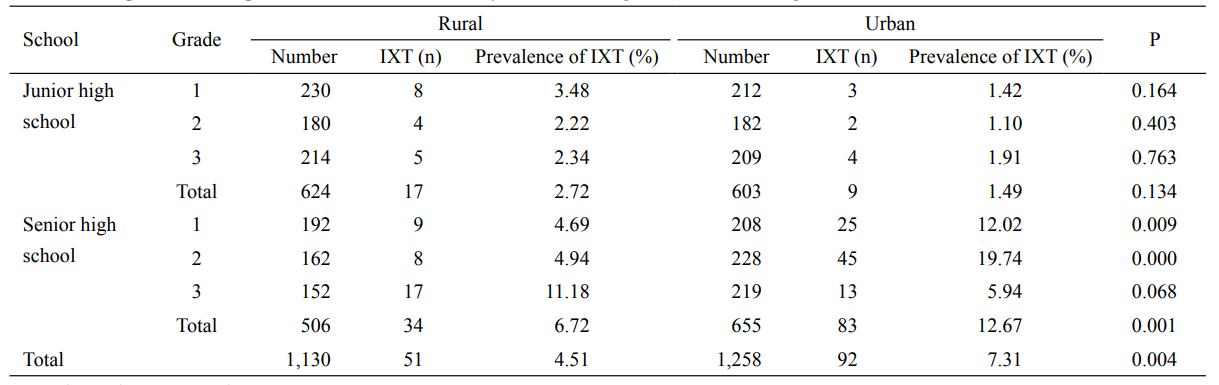
IXT, intermittent exotropia.
Correlation between confounding factors and the
prevalence of IXT was analyzed by Logistic regression
models (Table 5). For pupils, the prevalence of IXT was
correlated with sex, grade, place of origins (urban/rural)
rather than age. The pupils in rural areas had a relatively
high prevalence of IXT. For high school students, similar
results were obtained. The male students at high grade in
urban areas had a relatively high prevalence of IXT.
Table 5 Analysis of the correlation between confounding factors and IXT by logistic regression model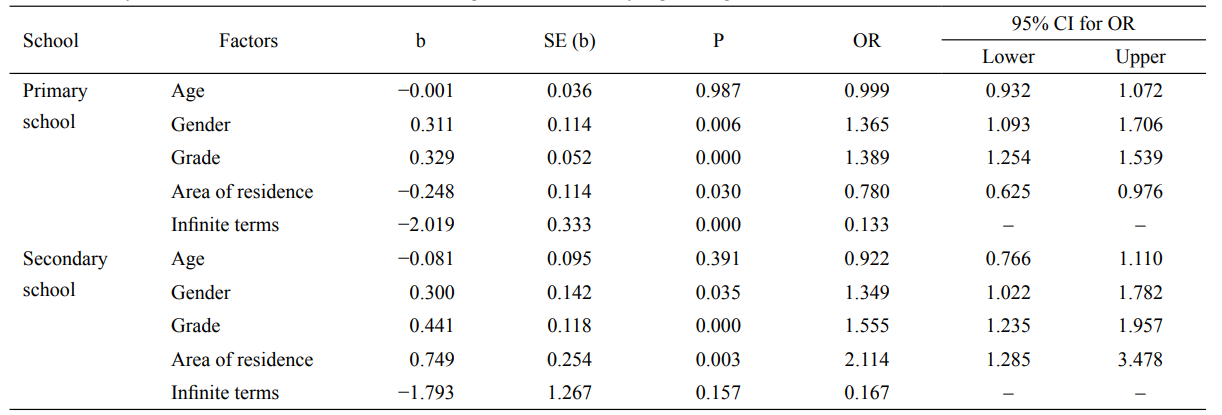
Note: response variable and normal eye position =0; age (year); gender: female =0 and male =1; place of origin: rural areas =0 and
urban areas =1; grade: 1,2,3,4,5,6. IXT, intermittent exotropia; OR, odds ratio; SE, standard error.
Discussion
IXT is a type of strabismus between exophoria and constant
exotropia (1). The patients are able to maintain normal
eye position and binocular vision most of the time, while
present with exotropia when failing to concentrate or seeing
distant objects. As exotropia progresses in the frequency
and duration, along with the decreased fusional and
accommodative capacities, the patients eventually present
with a variety of exotropia symptoms. In most populationbased
strabismus investigations (3-8) by Western countries,
the prevalence of esotropia was twice as high as exotropia.
However, the prevalence of exotropia is twice of that
of esotropia in Asian population (9-11). A retrospective
study from Hong Kong (12), including 2,704 patients with
strabismus reported that 27.4% cases of esotropia, 20.3%
of constant exotropia and 44.9% of IXT. Chia et al. (13) retrospectively analyzed a total of 493 children with
strabismus aged below 16 years and found that 72% cases
were exotropia, 92% of whom developed IXT. However,
there are few population-based studies focusing on the
epidemiology of strabismus in Asia. He et al. (9) conducted
a survey of 4,364 participants aged from 5 to 15 years and
noted that the prevalence of strabismus was 1.9% when
looking at near, 3.0% when looking at distance and 80%
cases were exotropia. Zhao et al. (10) analyzed a total of
5,884 children aged between 5 to 15 years from Shunyi
District, Beijing City and found that the prevalence of strabismus was 2.8% (165/5884). However, both studies did
not analyze the types of strabismus or report the prevalence
of IXT. In current study, 8% of 7,464 participants had
IXT, accounting for 73.04% of all children with strabismus.
The prevalence of IXT was significantly higher than that
of constant strabismus, while IXT mainly arises from the
imbalance between exodeviation and convergence due
to convergence and fusion insufficiency. Especially, the
myopic patients with declined accommodative convergence
are more likely to develop IXT. Therefore, previous
studies (14,15) have confirmed the correlation between the
prevalence of IXT and myopia. The authors will perform
correlation analysis between strabismus and ametropia.
In this survey, the correlation between confounding factors and the prevalence of IXT was investigated. The results showed that, for pupils, the prevalence of IXT was correlated with sex, grade and place of origins rather than age. In addition, male pupils at high grades in rural areas had a relatively high prevalence of IXT. For secondary school students, the prevalence of IXT was not correlated with age, but associated with sex, grade and place of origins. Male secondary students at high grades in urban areas had a relatively higher prevalence of IXT than the other subjects. Logistic regression analysis revealed that IXT had a greater prevalence in males than females. Correlation analysis of grade and place of origins showed that the students at senior high schools in urban areas and the pupils in rural regions had a high prevalence of IXT.
It should be noted that current survey also has certain limitations that the correlation between ametropia/corrected vision and eye position is not analyzed, which is helpful to explain the epidemiological distribution of IXT.
Conclusions
In conclusion, the prevalence of IXT among student
populations were relatively high. The distribution pattern
of IXT greatly varied among primary, junior high and
senior high school students and between those from rural
and urban regions.
基金
暂无基金信息
参考文献
1. Clarke MP. Intermittent exotropia. J Pediatr Ophthalmol Strabismus 2007;44:153-7; quiz 178-9.
2. Govindan M, Mohney BG, Diehl NN, et al. Incidence and types of childhood exotropia: a population-based study. Ophthalmology 2005;112:104-8.
3. Bolger PG, Stewart-Brown SL, Newcombe E, et al. Vision screening in preschool children: comparison of orthoptists and clinical medical offi cers as primary screeners. BMJ
1991;303:1291-4.
4. Cummings GE. Vision screening in junior schools. Public Health 1996;110:369-72.
5. Ip JM, Robaei D, Kifl ey A, et al. Prevalence of hyperopia and associations with eye fi ndings in 6- and 12-year-olds. Ophthalmology 2008;115:678-685.e1.
6. Ip JM, Robaei D, Rochtchina E, et al. Prevalence of eye disorders in young children with eyestrain complaints. Am J Ophthalmol 2006;142:495-7.
7. Junghans B, Kiely PM, Crewther DP, et al. Referral rates for a functional vision screening among a large cosmopolitan sample of Australian children. Ophthalmic Physiol Opt 2002;22:10-25.
8. Junghans BM, Crewther SG. Prevalence of myopia among primary school children in eastern Sydney. Clin Exp Optom 2003;86:339-45.
9. He M, Zeng J, Liu Y, et al. Refractive error and visual impairment in urban children in southern china. Invest Ophthalmol Vis Sci 2004;45:793-9.
10. Zhao J, Pan X, Sui R, et al. Refractive Error Study in Children: results from Shunyi District, China. Am J Ophthalmol 2000;129:427-35.
11. Matsuo T, Matsuo C. Comparison of prevalence rates of strabismus and amblyopia in Japanese elementary school children between the years 2003 and 2005. Acta Med
Okayama 2007;61:329-34.
12. Yu CB, Fan DS, Wong VW, et al. Changing patterns of strabismus: a decade of experience in Hong Kong. Br J Ophthalmol 2002;86:854-6.
13. Chia A, Roy L, Seenyen L. Comitant horizontal strabismus: an Asian perspective. Br J Ophthalmol 2007;91:1337-40.
14. Tanaka A, Ohno-Matsui K, Shimada N, et al. Prevalence of strabismus in patients with pathologic myopia. J Med Dent Sci 2010;57:75-82.
15. Ekdawi NS, Nusz KJ, Diehl NN, et al. The development of myopia among children with intermittent exotropia. Am J Ophthalmol 2010;149:503-7.
相关文章
Xinxing Guo;Michael X. Repka;David S. Friedman;Megan E. Collins,Innovative approaches to vision care delivery in the urban school settingVictoria M. Sánchez;Rafael Iribarren;Santiago G. Latino;Victor E. Torres;Ana L. Gramajo;María N. Artal;María B. Yadarola;Patricia R. Garay;José D. Luna;Claudio P. Juarez,Prevalence of refractive errors in Villa Maria, Córdoba, Argentina赵兰琴;肖薇;王铭薇;杨雅涵;林铎儒;庞健宇;丘蔚晴;吴悦;何雨春;胡建民;林浩添,Lifestyle and myopia among primary school students in urban areas of Fujian following implementation plan for comprehensive prevention and control of myopia of children and dolescents: a cross-sectional study