
Timothy Olsen: epidemiology of age-related macular degeneration
阅读量:1412
DOI: doi: 10.3978/j.issn.1000-4432.2016.09.05
发布日期:2024-11-30
作者:
展开更多 '%20fill='white'%20fill-opacity='0.01'/%3e%3cmask%20id='mask0_3477_29692'%20style='mask-type:luminance'%20maskUnits='userSpaceOnUse'%20x='0'%20y='0'%20width='16'%20height='16'%3e%3crect%20id='&%23232;&%23146;&%23153;&%23231;&%23137;&%23136;_2'%20x='16'%20width='16'%20height='16'%20transform='rotate(90%2016%200)'%20fill='white'/%3e%3c/mask%3e%3cg%20mask='url(%23mask0_3477_29692)'%3e%3cpath%20id='&%23232;&%23183;&%23175;&%23229;&%23190;&%23132;'%20d='M14%205L8%2011L2%205'%20stroke='%23333333'%20stroke-width='1.5'%20stroke-linecap='round'%20stroke-linejoin='round'/%3e%3c/g%3e%3c/g%3e%3c/svg%3e)
关键词
摘要
全文
Introduction
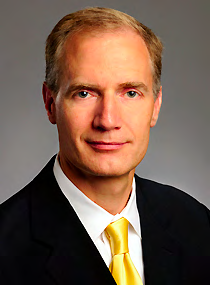
Timothy Olsen (Figure 1), MD, is former chair and
direc tor of Emor y Eye Center. He is a member of
the Vitreoretinal Surgery & Disease service where his
clinical expertise focuses on macular diseases, age-related
macular degeneration (AMD) and macular surgery.
Besides, he holds leadership positions in the American
Ophthalmologic Society (AOS), the American Academy
of Ophthalmology (AAO), the Association for Research
in Vision and Ophthalmology (ARVO) and serves as the
retina chair of the Preferred Practice Patterns (PPP) of
AAO.
Available online: http://www.asvide.com/articles/1156
Figure 1 Dr. Timothy Olsen, M.D
Interview
During the Zhongshan Medical Retina and Epidemiology
Symposium, I was honored to meet Dr. Olsen and invite
him for a brief interview to share his expertise on AMD.
In the interview, Dr. Olsen complimented on this symposium, regarding Zhongshan Ophthalmic Center as a large eye hospital that conducts excellent education and training. When talking about AMD, he claimed that AMD was the primary cause of blindness in many countries. After comparing incidents of aging population in the USA and in China, he found out that there was a dramatic increase in AMD in the population of the individuals over age 50 and 60.
As the chairman of the retina PPP of AAO, he and his group members look at evaluable evidence and give an assessment based on the following process: (I) make judgment about the article type; (II) ranking according to methodology and grading the quality; (III) forming a panel of experts in the field to assess the evidence; (IV) a determination on whether to make a recommendation for treatment is made by the consensus of the group. Therefore, he held the idea that something with high evidence was unlikely to be changed with new study. Dr. Olsen also shared with us how to apply those evidences to current practice, that is, to take these recommendations into consideration and apply the treatment to the individuals given the certain circumstances.
Dr. Olsen said that AMD was a complicated disease with many different pathways involved. He thought that the future for AMD would be the separation of different disorders, with the aims to find out the reasons why particular individuals would suffer from AMD and to explore the best treatment to the individuals. In the end of the interview, Dr. Olsen advised young ophthalmologists to see more patients and read more. He also emphasized the importance of evaluating the quality of literature and being critical to the published articles. For more details about this interview, readers can refer to the following video (Figure 2).
In the interview, Dr. Olsen complimented on this symposium, regarding Zhongshan Ophthalmic Center as a large eye hospital that conducts excellent education and training. When talking about AMD, he claimed that AMD was the primary cause of blindness in many countries. After comparing incidents of aging population in the USA and in China, he found out that there was a dramatic increase in AMD in the population of the individuals over age 50 and 60.
As the chairman of the retina PPP of AAO, he and his group members look at evaluable evidence and give an assessment based on the following process: (I) make judgment about the article type; (II) ranking according to methodology and grading the quality; (III) forming a panel of experts in the field to assess the evidence; (IV) a determination on whether to make a recommendation for treatment is made by the consensus of the group. Therefore, he held the idea that something with high evidence was unlikely to be changed with new study. Dr. Olsen also shared with us how to apply those evidences to current practice, that is, to take these recommendations into consideration and apply the treatment to the individuals given the certain circumstances.
Dr. Olsen said that AMD was a complicated disease with many different pathways involved. He thought that the future for AMD would be the separation of different disorders, with the aims to find out the reasons why particular individuals would suffer from AMD and to explore the best treatment to the individuals. In the end of the interview, Dr. Olsen advised young ophthalmologists to see more patients and read more. He also emphasized the importance of evaluating the quality of literature and being critical to the published articles. For more details about this interview, readers can refer to the following video (Figure 2).
Figure 2 Timothy Olsen: epidemiology of age-related macular degeneration (AMD) (1).
Available online: http://www.asvide.com/articles/1156
基金
暂无基金信息
参考文献
1. Ye A. Timothy Olsen: epidemiology of age-related macular degeneration (AMD). Asvide 2016;3:382. Available online: http://www.asvide.com/articles/1156
相关文章
Alfredo García-Layana;Manuel Saenz-de-Viteri,Individualized treatment with aflibercept in age-related macular degeneration patients with early persistent retinal fluidSALEEMA KHERANI;Roomasa Channa;Adrienne W. Scott;James T. Handa;Akrit Sodhi;Adam S. Wenick;Ingrid Zimmer-Galler;Sharon D. Solomon;Peter Gehlbach;Mira M. Sachdeva;Becky S. Sama;Anam Akhlaq;Olukemi Adeyemo;Mustafa Iftikhar;Peter A. Campochiaro,Regression of choroidal neovascularization often precedes macular atrophy in eyes with neovascular age-related macular degeneration treated with vascular endothelial growth factor neutralizing proteinsJoao Pedro Marques;Rufino Silva,Optical coherence tomography angiography in wet age-related macular degeneration (AMD)