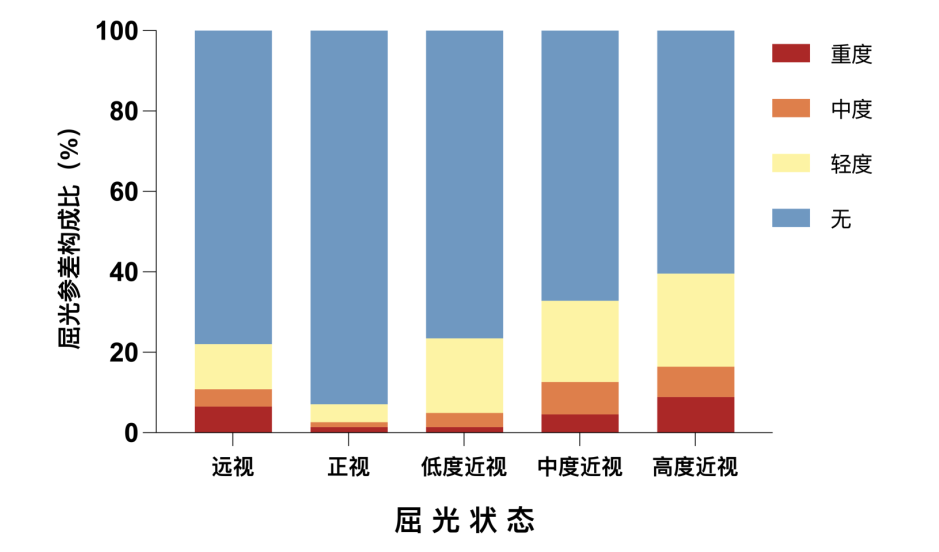
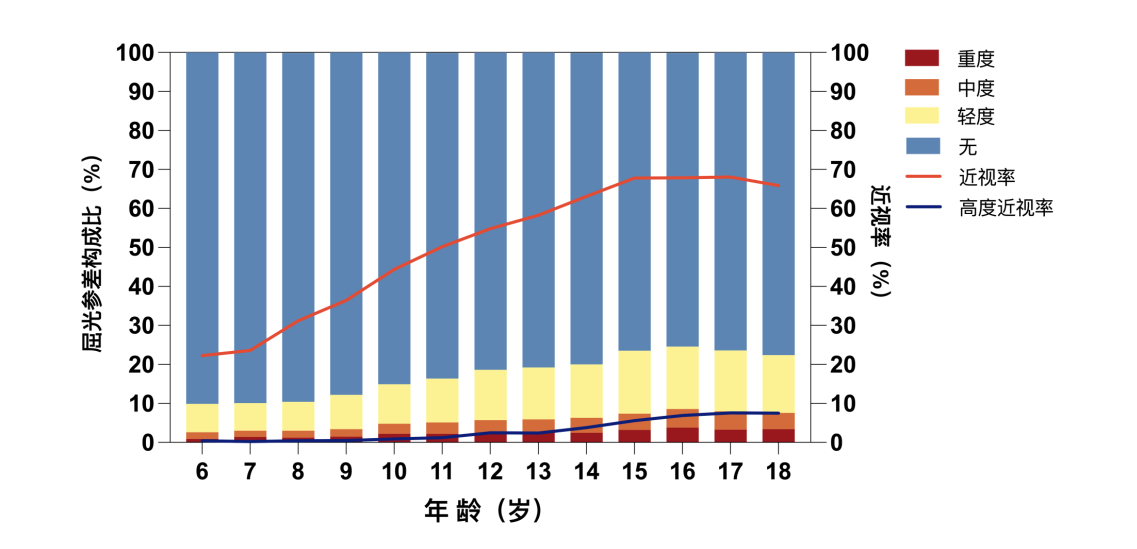
Figure 1 Proportion of anisometropia by severity in different refractive groups
2.2 屈光参差患病率的地域分布特征
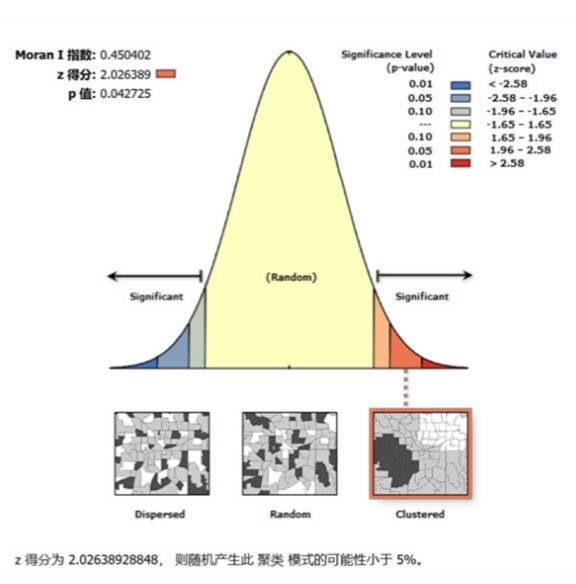
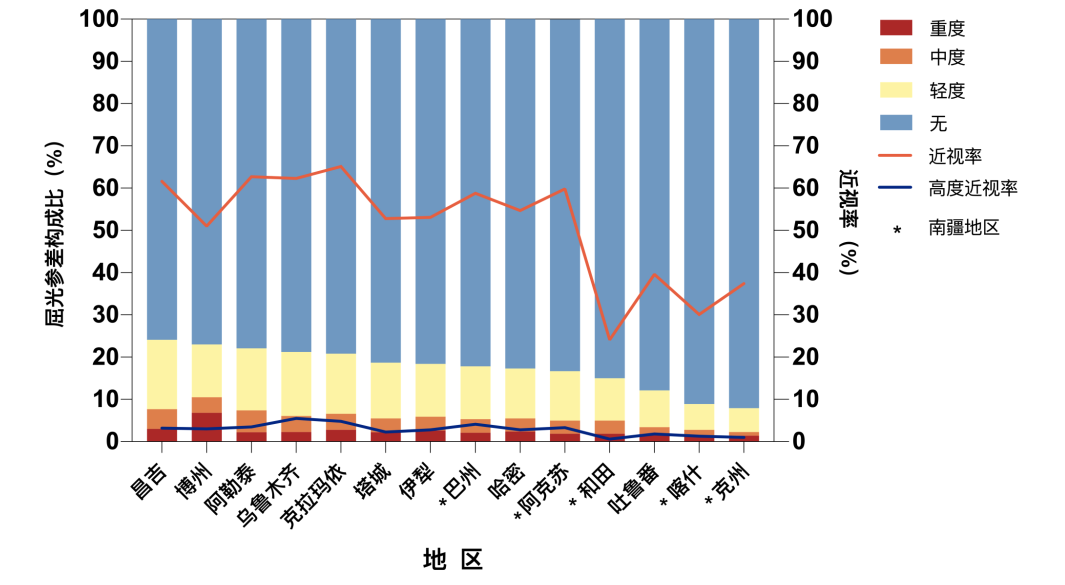
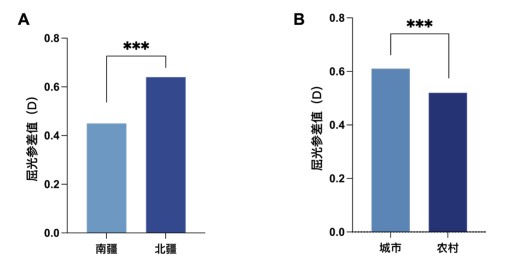
全局空间自相关分析显示,屈光参差患病率的空间分布是聚集而不是随机分布的(Moran's I = 0.450,P = 0.043,Z = 2.026)(图2B)。屈光参差患病率高的地区集中于北疆地区。患病率最高的3个地区为北疆的昌吉(24.1%)、博尔塔拉蒙古自治州(23.0%)和阿勒泰(22.1%),最低的3个地区为北疆的吐鲁番(12.1%)、南疆的喀什(8.9%)和克孜勒苏柯尔克孜自治州(7.9%)。除博州外,其他地区屈光参差程度构成比均表现为轻度>中度>重度,屈光参差变化趋势类似于近视变化趋势(图3)。屈光参差值也存在地域差异,城市地区高于农村地区,北疆地区高于南疆地区(P<0.001),见图4。
图2 屈光参差患病率的全局空间自相关分析
Figure 2 Global spatial autocorrelation analysis of anisometropia prevalence
图3 不同地区屈光参差构成比情况
Figure 3 Composition ratio of anisometropia at different prefectures
图4 地域分布屈光参差值比较
Figure 4 Comparison of anisometropia values across different regions
(A)南北疆的屈光参差值比较;(B)城乡的屈光参差值比较。 *** 代表P<0.001。
(A) Comparison of anisometropia values between northern and southern Xinjiang; (B) Comparison of anisometropia values between urban and rural areas. *** 代表P<0.001.
1. 熊佳伟, 周行涛, 莫晓芬. 儿童屈光参差临床研究进展[J]. 中国眼耳鼻喉科杂志, 2017, 17(4): 288-291. DOI:10.14166/j.issn.1671-2420.2017.04.017.
Xiong JW, Zhou XT, Mo XF. Clinical research progresses of children’s anisometropia[J]. Chin J Ophthalmol Otorhinolaryngol, 2017, 17(4): 288-291. DOI:10.14166/j.issn.1671-2420.2017.04.017.
2. Wang Y, Liu L, Lu Z, et al. Rural-urban differences in prevalence of and risk factors for refractive errors among school children and adolescents aged 6-18 years in Dalian, China[J]. Front Public Health, 2022, 10: 917781. DOI:10.3389/fpubh.2022.917781.
3. Zhou Y, Zhang XF, Chen XJ, et al. Prevalence of anisometropia and influencing factors among school-age children in Nantong, China: a cross-sectional study[J]. Front Public Health, 2023, 11: 1190285. DOI:10.3389/fpubh.2023.1190285.
4. O’Donoghue L, McClelland JF, Logan NS, et al. Profile of anisometropia and aniso-astigmatism in children: prevalence and association with age, ocular biometric measures, and refractive status[J]. Invest Ophthalmol Vis Sci, 2013, 54(1): 602-608. DOI:10.1167/iovs.12-11066.
5. Logan NS, Shah P, Rudnicka AR, et al. Childhood ethnic differences in ametropia and ocular biometry: the Aston Eye Study[J]. Ophthalmic Physiol Opt, 2011, 31(5): 550-558. DOI:10.1111/j.1475-1313.2011.00862.x.
6. Flitcroft DI, He M, Jonas JB, et al. IMI–defining and classifying myopia: a proposed set of standards for clinical and epidemiologic studies[J]. Invest Ophthalmol Vis Sci, 2019, 60(3): M20. DOI:10.1167/iovs.18-25957.
7. 高云仙, 巴提玛·木拉提, 王雁, 等. 新疆阿克陶县柯尔克孜族中小学生近视患病率及眼部生物学参数的流行病学调查[J]. 中国斜视与小儿眼科杂志, 2023, 31(1): 10-13+28. DOI:10.3969/J.ISSN.1005-328X.2023.01.003.
GAO YX, BATIMA MLT, WANG Y, et al. Epidemiological survey on myopia prevalence and ocular biological parameters among primary and secondary school students of Kirgiz nationality in Aktao County, Xinjiang[J]. Chin J Strabismus Pediatr Ophthalmol, 2023, 31(1): 10-13+28. DOI:10.3969/J.ISSN.1005-328X.2023.01.003.
8. 尹晓琳, 金磊, 高蕾, 等. 济南市6~18岁学生屈光参差的流行病学调查[J]. 中华眼外伤职业眼病杂志, 2023, 45(6): 464-469. DOI:10.3760/cma.j.cn116022-20230121-00025.
Yin XL, Jin L, Gao L, et al. Epidemiological investigation of anisometropia among students aged 6-18 in Jinan city[J]. Chin J Ocul Trauma Occup Eye Dis, 2023, 45(6): 464-469. DOI:10.3760/cma.j.cn116022-20230121-00025.
9. Fang XH, Song DS, Jin N, et al. Refractive errors in Tianjin youth aged 6-18 years: exploring urban-rural variations and contributing factors[J]. Front Med, 2024, 11: 1458829. DOI:10.3389/fmed.2024.1458829.
10. Saw SM, Chan YH, Wong WL, et al. Prevalence and risk factors for refractive errors in the Singapore Malay Eye Survey[J]. Ophthalmology, 2008, 115(10): 1713-1719. DOI:10.1016/j.ophtha.2008.03.016.
11. Ramírez-Ortiz MA, Amato-Almanza M, Romero-Bautista I, et al. A large-scale analysis of refractive errors in students attending public primary schools in Mexico[J]. Sci Rep, 2023, 13(1): 13509. DOI:10.1038/s41598-023-40810-5.
12. Galvis V, Tello A, Otero J, et al. Prevalence of refractive errors in Colombia: MIOPUR study[J]. Br J Ophthalmol, 2018, 102(10): 1320-1323. DOI:10.1136/bjophthalmol-2018-312149.
13. Morgan IG, French AN, Ashby RS, et al. The epidemics of myopia: Aetiology and prevention[J]. Prog Retin Eye Res, 2018, 62: 134-149. DOI:10.1016/j.preteyeres.2017.09.004.
14. Lee CW, Chiang CC, Tsai DC, et al. Risk factors for anisometropia in schoolchildren: a population-based, longitudinal cohort study[J]. Ophthalmic Physiol Opt, 2023, 43(6): 1500-1509. DOI:10.1111/opo.13215.
15. Borchert M, Tarczy-Hornoch K, Cotter SA, et al. Anisometropia in Hispanic and African American infants and young children the multi-ethnic pediatric eye disease study[J]. Ophthalmology, 2010, 117(1): 148-153.e1. DOI:10.1016/j.ophtha.2009.06.008.
16. Vincent SJ, Collins MJ, Read SA, et al. Interocular symmetry in myopic anisometropia[J]. Optom Vis Sci, 2011, 88(12): 1454-1462. DOI:10.1097/OPX.0b013e318233ee5f.
17. Linke SJ, Baviera J, Munzer G, et al. Association between ocular dominance and spherical/astigmatic anisometropia, age, and sex: analysis of 10, 264 myopic individuals[J]. Invest Ophthalmol Vis Sci, 2011, 52(12): 9166-9173. DOI:10.1167/iovs.11-8131.
18. Wang J, Li S, He S, et al. Regional disparities in the prevalence and correlated factors of myopia in children and adolescents in Gansu, China[J]. Front Med, 2024, 11: 1375080. DOI:10.3389/fmed.2024.1375080.
19. 肖艳秋, 杨德刚, 张新焕, 等. 新疆区域经济差异时空演变特征分析[J]. 中国沙漠, 2012, 32(1): 244-251.
Xiao YQ, Yang DG, Zhang XH, et al. Spatio-temporal characteristics of regional economic differences in Xinjiang[J]. J Desert Res, 2012, 32(1): 244-251.
20. Hu YY, Wu JF, Lu TL, et al. Prevalence and associations of anisometropia in children[J]. Invest Ophthalmol Vis Sci, 2016, 57(3): 979-988. DOI:10.1167/iovs.15-18647.
21. Xu Z, Wu Z, Wen Y, et al. Prevalence of anisometropia and associated factors in Shandong school-aged children[J]. Front Public Health, 2022, 10: 1072574. DOI:10.3389/fpubh.2022.1072574.
22. Gong W, Zhu Z, Bulloch G, et al. Anisometropia and its association with refraction development in highly myopic children[J]. Clin Exp Optom, 2024, 107(1): 58-65. DOI:10.1080/08164622.2023.2198635.
23. Barrett BT, Bradley A, Candy TR. The relationship between anisometropia and amblyopia[J]. Prog Retin Eye Res, 2013, 36: 120-158. DOI:10.1016/j.preteyeres.2013.05.001.
24. Lee CW, Fang SY, Tsai DC, et al. Prevalence and association of refractive anisometropia with near work habits among young schoolchildren: The evidence from a population-based study[J]. PLoS One, 2017, 12(3): e0173519. DOI:10.1371/journal.pone.0173519.
25. 陈颖, 方静. 儿童屈光参差治疗研究进展[J]. 中国斜视与小儿眼科杂志, 2023, 31(4): 45-46. DOI:10.3969/J.ISSN.1005-328X.2023.04.016.
Chen Y, Fang J. Research progress of anisometropia treatment in children[J]. Chin J Strabismus Pediatr Ophthalmol, 2023, 31(4): 45-46. DOI:10.3969/J.ISSN.1005-328X.2023.04.016.

'%20fill='white'%20fill-opacity='0.01'/%3e%3cmask%20id='mask0_3477_29692'%20style='mask-type:luminance'%20maskUnits='userSpaceOnUse'%20x='0'%20y='0'%20width='16'%20height='16'%3e%3crect%20id='&%23232;&%23146;&%23153;&%23231;&%23137;&%23136;_2'%20x='16'%20width='16'%20height='16'%20transform='rotate(90%2016%200)'%20fill='white'/%3e%3c/mask%3e%3cg%20mask='url(%23mask0_3477_29692)'%3e%3cpath%20id='&%23232;&%23183;&%23175;&%23229;&%23190;&%23132;'%20d='M14%205L8%2011L2%205'%20stroke='%23333333'%20stroke-width='1.5'%20stroke-linecap='round'%20stroke-linejoin='round'/%3e%3c/g%3e%3c/g%3e%3c/svg%3e)