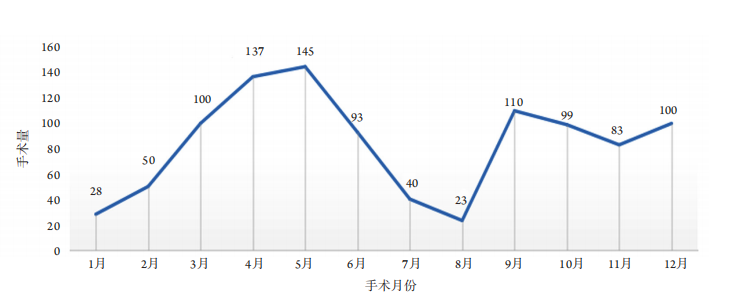
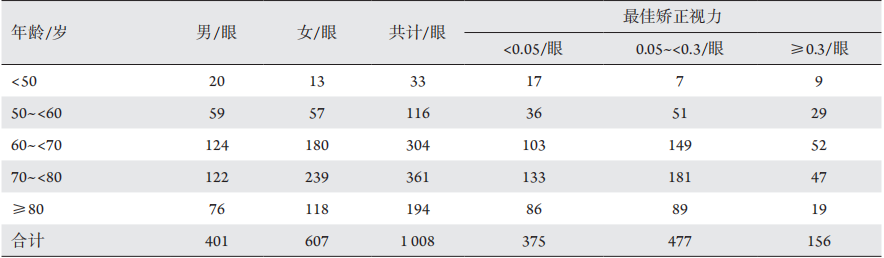
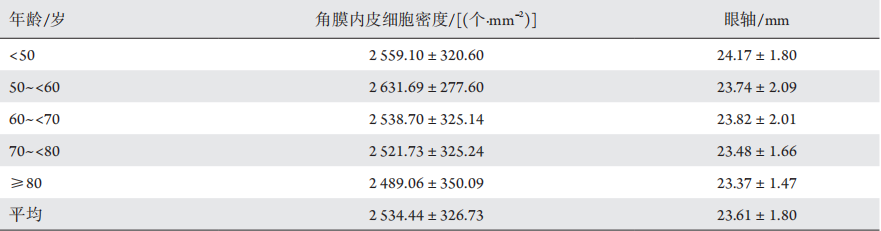
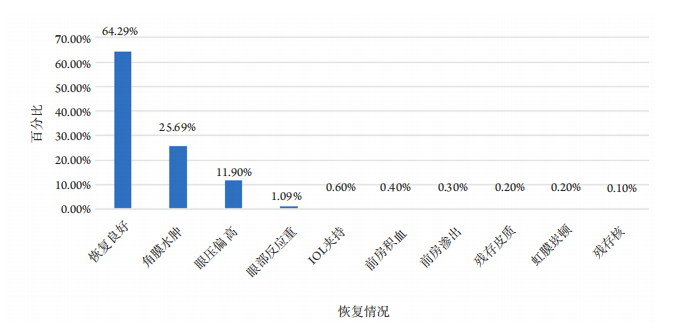
Objective: To understand the clinical distribution characteristics of cataract surgery patients and provide reference for cataract prevention and treatment in primary hospitals. Methods: From January 2019 to December 2019, 892 cataract patients (1 008 eyes) were selected from the Department of Ophthalmology, Third Affiliated Hospital of Jinzhou Medical University. Medical records were collected, including patient’s name, gender, age, surgical eye, admission time and history of diabetes, preoperative vision, corneal endothelial cell density, eye axis, phacoscotasmus type and cataract etiology, surgery method, intraocular lens, intraoperative complications, intraocular pressure, visual acuity and eye recovery on the first day after operation. These data were statistically described and analyzed. Results: A total of 892 cataract patients (1 008 eyes) were included, including 357 males (401 eyes) and 535 females (607 eyes), with the average age of (71.17±10.28) years old. The 90.7% patients cause of disease was age-related cataract. Admission time of all patients was mainly in March–June and September– December. Cataract patients of different ages had their own ocular characteristics. There was a statistically significant difference between the type of cataract and age (P<0.05). Compared with the cortical patients and posterior subcapsular patients, nuclear cataract patients were older at admission. There was no significant difference in the type of cataract between the gender and the patients with diabetes or not (P>0.05). The most frequently selected surgical method for cataract patients was phacoemulsification and intraocular lens implantation, which has the advantages of less intraoperative complications and rapid postoperative recovery. Conclusion: We still have a long way to go in the prevention and treatment of cataract. Most of the operations were performed on age-related cataract patients, and most of them were older and had low vision when they were admitted to hospital, so the optimal timing of the operation was missed. Patients of different age groups and different types of cataract have different characteristics. Phacoemulsification is the first choice because of its own advantages.
郑东星, 赵龙宇. 2015/2017年辽宁省重点眼科住院患者疾病构
成及手术情况分析[ J]. 国际眼科杂志, 2018, 18(11): 2108-2111.
ZHENG Dong x ing , ZHAO Long y u. Ophthalmic inpatients
disease constitution and operation in Liaoning provincial key
ophthalmic hospital from 2015 to 2017[ J]. International Journal of
Ophthalmology, 2018, 18(11): 2108-2111.
Marchini G, Ceruti P, Vizzari G. Management of concomitant cataract
and glaucoma[ J]. Dev Ophthalmol, 2012, 50: 146-156.
祁勇军, 顾敏, 邹玉平, 等. 表面麻醉下白内障超声乳化折叠式
人工晶状体植入术的临床观察[ J]. 中国实用眼科杂志, 2003,
21(9): 663-665.
QI Yongjun, GU Min, ZOU Yuping, et al. Clinical observation of
phacoemulsification and foldable intraocular lens implantation under
topical anesthesia[ J]. Chinese Journal of Practical Ophthalmology,
2003, 21(9): 663-665.
Huang Q, Huang Y, Luo Q, et al. Ocular biometric characteristics
of cataract patients in western China[ J]. BMC Ophthalmol, 2018,
18(1): 99.
Chen CY, Scurrah KJ, Stankovich J, et al. Heritability and shared
environment estimates for myopia and associated ocular biometric
traits: the Genes in Myopia (GEM) family study[ J]. Hum Genet, 2007,
121(3-4): 511-520.
Yu JG, Zhong J, Mei ZM, et al. Evaluation of biometry and corneal
astigmatism in cataract surgery patients from Central China[ J]. BMC
Ophthalmol, 2017, 17(1): 56.
Cui Y, Meng Q, Guo H, et al. Biometry and corneal astigmatism in
cataract surgery candidates from Southern China[ J]. J Cataract Refract
Surg, 2014, 40(10): 1661-1669.
Yeniad B, Corum I, Ozgun C. The effects of blunt trauma and cataract
surgery on corneal endothelial cell density[ J]. Middle East Afr J
Ophthalmol, 2010, 17(4): 354-358.
李盼盼, 管宇, 陈诵惟, 等. 2.4mm透明角膜单切口超声乳化白
内障吸出术对角膜的影响[ J]. 眼科新进展, 2019, 39(1): 53-57.
LI Panpan, GUAN Yu, CHEN Songwei, et al. Effect of 2.4-mm clear
corneal single-incision phacoemulsification on cornea[ J]. Recent
Advances in Ophthalmology, 2019, 39(1): 53-57.
严志强, 陈翠妍, 郑丹露. 佛山市南海区第四人民医院2016年白
内障患者的临床分布特点[ J]. 眼科学报, 2019, 34(1): 32-35.
YAN Zhiqiang, CHEN Cuiyan, ZHENG Danlu. Clinical features of
cataract patients in the Fourth People’s Hospital of Nanhai District,
Foshan City in 2016[ J]. Yan Ke Xue Bao, 2019, 34(1): 32-35.
Zetterberg M, Celojevic D. Gender and cataract—the role of
estrogen[ J]. Curr Eye Res, 2015, 40(2): 176-90.
Mundy KM, Nichols E, Lindsey J. Socioeconomic disparities in cataract
prevalence, characteristics, and management[ J]. Semin Ophthalmol,
2016, 31(4): 358-63.
葛坚, 王宁利. 眼科学[M]. 3版. 北京: 人民卫生出版社, 2005: 237.
GE Jian, WANG Ning Li. Ophthalmology[M]. 3rd edition. Beijing:
People’s Medical Publishing House Co., Ltd., 2005: 237.
Liu YC, Wilkins M, Kim T, et al. Cataracts. Lancet, 2017, 390(10094):
600-612.