Objective: To analyze the advantages and disadvantages of real-time face-to-face online teaching (taking “Tencent Conference” teaching as an example) in medical education and its correlation with ocular surface diseases during
the COVID-19 pandemic, and to provide basis for improving online education programs and preventing dry eye. Methods: The undergraduate students of Xiangya School of Medicine of Central South University were selected
as the research objects. The method of cross-sectional study was used to collect data using questionnaires to study
the effect of real-time face-to-face online teaching and its impact on ocular surface diseases. Results: A total of 131
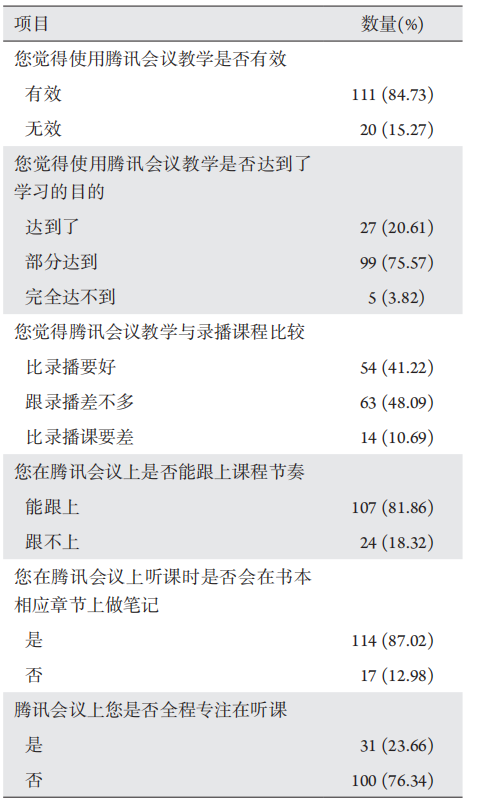
valid data were collected. Among them, the vast majority of students (84.73%) think real time face to face online
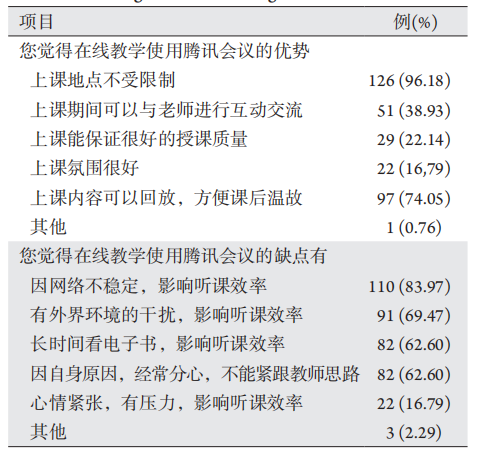
teaching is effective, and 96.18% of the students believe that real-time face-to-face online teaching at least partly
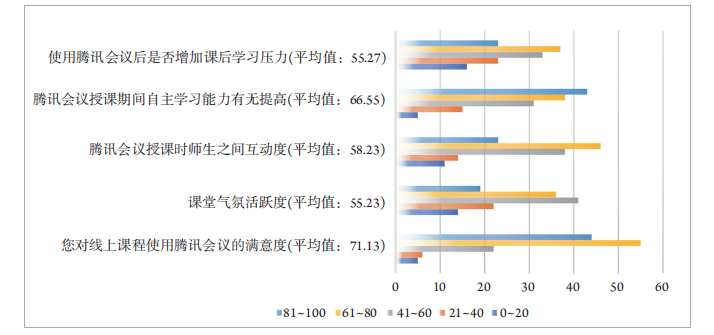
achieved the purpose of learning. However, the interaction between teachers and students and the classroom
atmosphere of real-time face-to-face online teaching needs to be strengthened. In addition, network equipment
is also a problem that real-time face-to-face online teaching needs to face. Meanwhile, the survey showed that
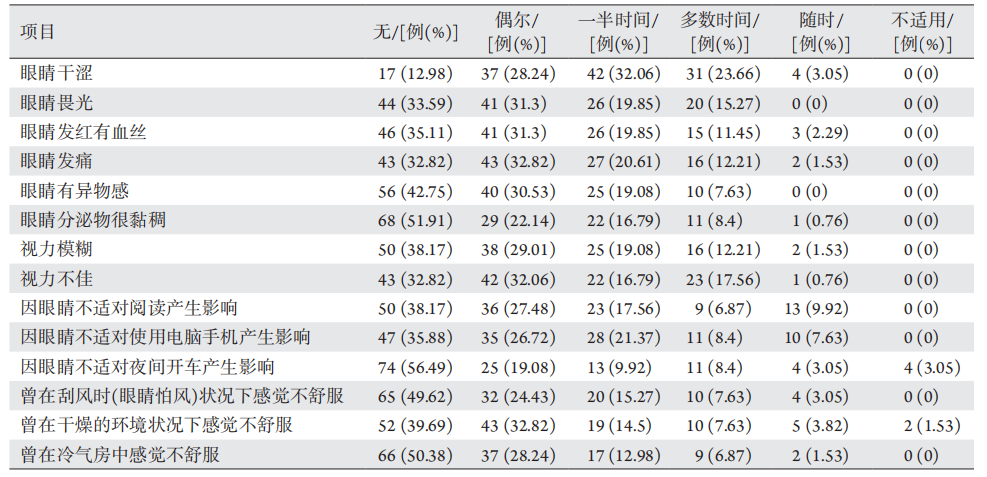
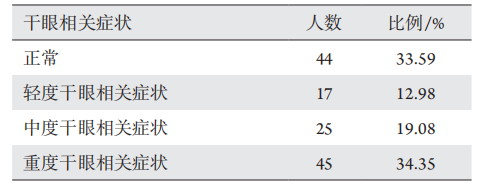
the prevalence rate of dry eye among the students who participated in real-time face-to-face online teaching
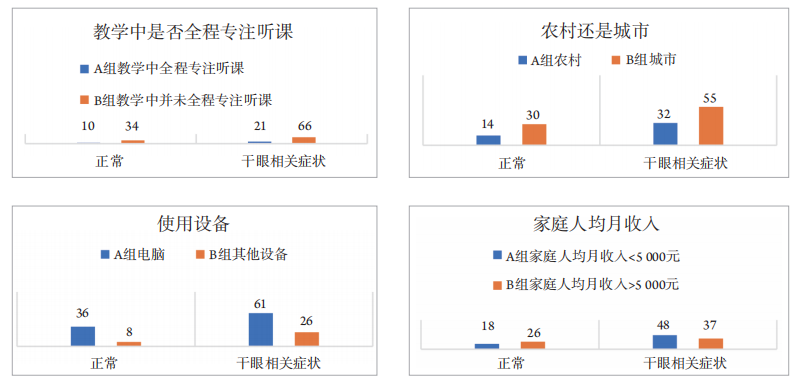
reached 66.41%, and there was no correlation between the incidence rate of dry eye and the location of family,
the per capita monthly income of family, the equipment, and whether they paid full attention to the lectures. Conclusion: Real-time face-to-face online teaching is effective in medical education during COVID-19, but
the main problems are insufficient teacher-student interaction, inactive classroom atmosphere and unstable
Internet connection. In addition, real-time face-to face online teaching will increase the incidence of dry eye, so
it is necessary to improve the awareness of eye protection and actively prevent it.
国家自然科学基金 (81974137);湖南省自然科学基金 (2021JJ41030)。This work was supported by the National Natural Science Foundation (81900893) and the Natural Science Foundation of Hunan Province (2021JJ41030), China
References
Lafosse E, Wolffsohn JS, Talens-Estarelles C, et al. Presbyopia and the aging eye: Existing refractive approaches and their potential impact on dry eye signs and symptoms[ J]. Cont Lens Anterior Eye, 2020, 43(2): 103-114.
卢媛媛, 许璐洁, 蔡龙龙. 西安市某高校大学生干眼调查研究[ J]. 中国地方病防治杂志, 2018, 33(2): 195-197.
LU Yuanyuan, XU Lujie, CAI Longlong. Research on dry eye among college students in Xi’an[ J]. Chinese Journal of Endemic Disease Control, 2018, 33(2): 195-197.
Schlote T, Kadner G, Freudenthaler N. Marked reduction and distinct patterns of eye blinking in patients with moderately dry eyes during video display terminal use[ J]. Graefes Arch Clin Exp Ophthalmol, 2004, 242(4): 306-312.
丁玲玲, 凯文, 王乐三. 中南大学在校生干眼患病现状及相关因素分析[ J]. 实用预防医学, 2017, 24(12): 1534-1538.
DING Lingling, KAI Wen, WANG Lesan. Prevalence of dry eye and its related factors among undergraduates in Central South University[ J]. Practical Preventive Medicine, 2017, 24(12): 1534-1538.
杨永明, 马林昆. 干眼的流行病学进展[ J]. 国际眼科杂志, 2010,10(10): 1944-1946.
YANG Yongming, MA Linkun. Epidemiological progress of dry eye[ J]. International Journal of Ophthalmology, 2010, 10(10): 1944-1946.
Jones L, Downie LE, Korb D, et al. TFOS DEWS II management and therapy report[ J]. Ocul Surf, 2017, 15(3): 575-628.
Messmer EM. The pathophysiology, diagnosis, and treatment of dry eye disease[ J]. Dtsch Arztebl Int, 2015, 112(5): 71-81.
Tavakoli A, Flanagan JL. Dry eye disease: an (in)convenient truth[ J]. Clin Exp Optom, 2022, 105(2): 222-229.
Kojima T, Dogru M, Kawashima M, et al. Advances in the diagnosis and treatment of dry eye[ J]. Prog Retin Eye Res, 2020, [Epub ahead of print]. doi: 10.1016/j.preteyeres.2020.100842.
Schwartz LM, Woloshin S. A clear-eyed view of restasis and chronic dry eye disease[ J]. JAMA Intern Med, 2018, 178(2): 181-182.
中华人民共和国教育部. 教育部应对新型冠状病毒感染肺炎疫情工作领导小组办公室关于在疫情防控期间做好普通高等学校在线教学组织与管理工作的指导意见. [2020-2-24].[2022-04-01]. http://www.moe.gov.cn/srcsite/A08/s7056/202002/
t20200205_418138.html.
People’s Republic of China, Ministry of Education. Guiding Opinions of the MoE’s leading group on responding to the COVID-19 outbreak on the management of higher education online education during the epidemic outbreak period. [24 February 2020]. [1 Apr 2022]. http://www.moe.gov.cn/srcsite/A08/s7056/202002/t20200205_418138.html.
Al Tawil L, Aldokhayel S, Zeitouni L, et al. Prevalence of self-reported computer vision syndrome symptoms and its associated factors among university students[ J]. Eur J Ophthalmol, 2020, 30(1): 189-195.
Rosenfield M. Computer vision syndrome: a review of ocular causes and potential treatments[ J]. Ophthalmic Physiol Opt, 2011, 31(5): 502-515.
邢悦, 张晓梅. 干眼病因的研究进展[ J]. 中国现代医学杂志,2021, 31(18): 49-54.
XING Yue, ZHANG Xiaomei. Research progress of dry eye etiology[ J]. Chinese Journal of Modern Medicine, 2021, 31(18): 49-54.
赵梓岩. 后疫情时期高校线上教学提升策略探析——以广播电视编导专业为例[ J]. 传媒论坛, 2021, 4(19): 153-155.
ZHAO Ziyan. Analysis of strategies for improving online teaching in colleges and universities in the post epidemic period-taking the major of radio and television editing and directing as an example[ J]. Media Forum, 2021, 4(19): 153-155.
Menon A, Klein EJ, Kollars K, et al. Medical students are not essential workers: examining institutional responsibility during the COVID-19 pandemic[ J]. Acad Med, 2020, 95(8): 1149-1151.
Coronavirus Disease 2019 (COVID-19) Situation Report – 77[EB/OL]. World Health Organization. [6 Apr, 2020]. [19 Mar 2022]. www.who.int/docs/default-source/coronaviruse/situation- reports/20200406-sitrep-77-covid-19.pdf?sfvrsn=21d1e632_2.
Pather N, Blyth P, Chapman JA, et al. Forced disruption of anatomy education in Australia and New Zealand: An acute response to the Covid-19 pandemic[ J]. Anat Sci Educ, 2020, 13(3): 284-300.