Opportunities and challenges of artificial intelligence in ophthalmic drug discovery and development
Views:
9253
DOI:
10.3978/j.issn.1000-4432.2022.06.03
Publication Date:
2022/12/26
Author(s):
CHEN Jianqi1, LIU Dong2, LIN Haotian2
CHEN Jianqi1, LIU Dong2, LIN Haotian2
Institution/Unit:
Sun Yat-sen University of Medical Sciences
State Key Laboratory of Ophthalmology, Zhongshan Ophthalmic Center, Sun Yat-sen University, Guangdong Provincial Key Laboratory of Ophthalmology and Visual Science, Guangzhou
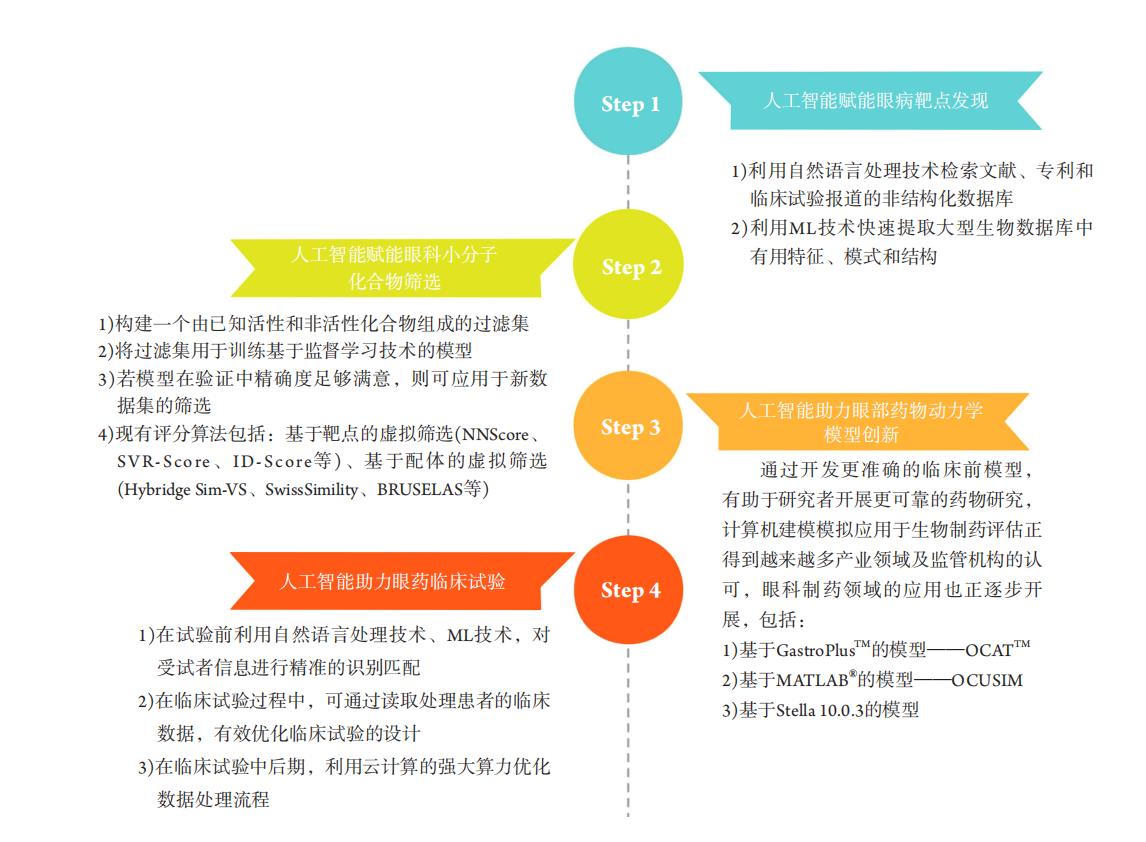
With the change of human lifestyle and overuse of eyes in recent years, the market demand for ophthalmic drugs continues to grow. However, the ocular therapy is still facing the shortage of doctors and drugs. Due to the risk of high cost, long lead time and low success rate, the process of novel ophthalmic drug innovation and iteration is getting slower. As an emerging technology, artificial intelligence is expected to enable the whole process of ophthalmic drug discovery and development, including drug target discovery, compound screening, pharmacokinetic model innovation and clinical trials, thus reducing R&D costs and increase efficiency for ophthalmic drug discovery and development. In addition, with the improvement of big data, hardware calculation and the deep integration of life science and intelligent science, the role of artificial intelligence in ophthalmic drug discovery and development will be significant improved , contributing to achieve the leap from precision to intelligence.
广州市基础研究计划市校 ( 院 ) 联合资助基础与应用基础研究项目 (202102010231)。This work was supported by the Science and Technology Program of Guangzhou, China (202102010231)
References
中华人民共和国教育部. 高等学校人工智能创新行动计划
[EB/OL]. [2018-04-03]. http://www.moe.gov.cn/srcsite/A16/
s7062/201804/t20180410_332722.html?from=groupmessage&isappi
nstalled=0.
Ministry of Education of the People’s Republic of China. Action Plan for
Artifcial Intelligence Innovation in Colleges and Universities[EB/OL].
[2018-04-03]. http://www.moe.gov.cn/srcsite/A16/s7062/201804/
t20180410_332722.html?from=groupmessage&isappinstalled=0.
Gaudana R, Ananthula HK, Parenky A, et al. Ocular drug delivery[ J].
AAPS J, 2010, 12(3): 348-360.
Varela-Fernández R, Díaz-Tomé V, Luaces-Rodríguez A, et al. Drug
delivery to the posterior segment of the eye: biopharmaceutic and
pharmacokinetic considerations[ J]. Pharmaceutics, 2020, 12(3): 269.
Liu C, Tai L, Zhang W, et al. Penetratin, a potentially powerful
absorption enhancer for noninvasive intraocular drug delivery[ J]. Mol
Pharm, 2014, 11(4): 1218-1227.
Ye T, Yuan K , Zhang W, et al. Prodr ugs incor porated into
nanotechnology-based drug delivery systems for possible improvement
in bioavailability of ocular drugs delivery[ J]. Asian J Pharm Sci, 2013,
8(4): 207.
Nagai N, Umachi K, Otake H, et al. Ophthalmic in situ gelling system
containing lanosterol nanoparticles delays collapse of lens structure in
shumiya cataract rats[ J]. Pharmaceutics, 2020, 12(7): 629.
Santos R, Ursu O, Gaulton A, et al. A comprehensive map of molecular
drug targets[ J]. Nat Rev Drug Discov, 2017, 16(1): 19-34.
Walker I, Newell H. Do molecularly targeted agents in oncology have
reduced attrition rates?[ J]. Nat Rev Drug Discov, 2009, 8(1): 15-16.
Deyati A, Younesi E, Hofmann-Apitius M, et al. Challenges and
opportunities for oncology biomarker discovery[ J]. Drug Discov
Today, 2013, 18(13/14): 614-624.
Denniston AK, Dick AD. Systemic therapies for inflammatory eye
disease: past, present and future[ J]. BMC Ophthalmol, 2013, 13: 18.
Deng F, Ranta VP, Kidron H, et al. General pharmacokinetic model for
topically administered ocular drug dosage forms[ J]. Pharm Res, 2016,
33(11): 2680-2690.
Missel PJ, Horner M, Muralikrishnan R. Simulating dissolution of
intravitreal triamcinolone acetonide suspensions in an anatomically
accurate rabbit eye model[ J]. Pharm Res, 2010, 27(8): 1530-1546.
Kovacs K, Wagley S, Quirk MT, et al. Pharmacokinetic study of vitreous
and serum concentrations of triamcinolone acetonide after posterior
sub-tenon's injection[ J]. Am J Ophthalmol, 2012, 153(5): 939-948.
Gukasyan HJ, Hailu S, Karami TK, et al. Ocular biopharmaceutics:
impact of modeling and simulation on topical ophthalmic formulation
development[ J]. Drug Discov Today, 2019, 24(8): 1587-1597.
Kostewicz ES, Aarons L, Bergstrand M, et al. PBPK models for the
prediction of in vivo performance of oral dosage forms[ J]. Eur J Pharm
Sci, 2014, 57: 300-321.
Jiang W, Kim S, Zhang X, et al. The role of predictive biopharmaceutical
modeling and simulation in drug development and regulatory
evaluation[ J]. Int J Pharm, 2011, 418(2): 151-160.
Bouzom F, Ball K , Perdaems N, et al. Physiologically based
pharmacokinetic (PBPK) modelling tools: how to fit with our
needs?[ J]. Biopharm Drug Dispos, 2012, 33(2): 55-71.
Bennani YL. Drug discovery in the next decade: innovation needed
ASAP[ J]. Drug Discov Today, 2011, 16(17/18): 779-792.
Singh M, Murriel CL, Johnson L. Genetically engineered mouse
models: closing the gap between preclinical data and trial outcomes[ J].
Cancer Res, 2012, 72(11): 2695-700.
宋硕, 王若男, 钱仪敏, 等. 眼科药物的药动学研究策略[ J]. 中国
新药杂志, 2021, 30(18): 1668-1674.
SONG Shuo, WANG Ruonan, QIAN Yimin, et al. Pharmacokinetic
research strategy of ophthalmic drugs[ J]. Chinese Journal of New
Drugs, 2021, 30(18): 1668-1674.
Lin X, Duan X, Jacobs C, et al. High-throughput brain activity
mapping and machine learning as a foundation for systems
neuropharmacology[ J]. Nat Commun, 2018, 9(1): 5142.
Banegas-Luna AJ, Cerón-Carrasco JP, Puertas-Martín S, et al.
BRUSELAS: HPC generic and customizable software architecture for
3D ligand-based virtual screening of large molecular databases[ J]. J
Chem Inf Model, 2019, 59(6): 2805-2817.
Zoete V, Daina A, Bovigny C, et al. SwissSimilarity: a web tool for low
to ultra high throughput ligand-based virtual screening[ J]. J Chem Inf
Model, 2016, 56(8): 1399-404.
Shang J, Dai X, Li Y, et al. HybridSim-VS: a web server for large-scale
ligand-based virtual screening using hybrid similarity recognition
techniques[ J]. Bioinformatics, 2017, 33(21): 3480-3481.
Li GB, Yang LL, Wang WJ, et al. ID-Score: a new empirical scoring
function based on a comprehensive set of descriptors related to protein-
ligand interactions[ J]. J Chem Inf Model, 2013, 53(3): 592-600.
Brylinski M, Lee SY, Zhou H, et al. The utility of geometrical and
chemical restraint information extracted from predicted ligand-binding
sites in protein structure refinement[ J]. J Struct Biol, 2011, 173(3):
558-569.
Durrant JD, McCammon JA. NNScore: a neural-network-based scoring
function for the characterization of protein-ligand complexes[ J]. J
Chem Inf Model, 2010, 50(10): 1865-71.
Gupta R, Srivastava D, Sahu M, et al. Artificial intelligence to deep
learning: machine intelligence approach for drug discovery[ J]. Mol
Divers, 2021, 25(3): 1315-1360.
Tsang AC, Roth J, Gottlieb C. Tocilizumab for severe chronic anterior
uveitis associated with juvenile idiopathic arthritis in a pediatric
patient[ J]. Ocul Immunol Inflamm, 2014, 22(2): 155-157.
Oshitari T, Kajita F, Tobe A, et al. Refractory uveitis in patient with
castleman disease successfully treated with tocilizumab[ J]. Case Rep
Ophthalmol Med, 2012, 2012: 968180.
Hirano T, Ohguro N, Hohki S, et al. A case of Beh?et’s disease treated
with a humanized anti-interleukin-6 receptor antibody, tocilizumab[ J].
Mod Rheumatol, 2012, 22(2): 298-302.
Tappeiner C, Heinz C, Ganser G, et al. Is tocilizumab an effective
option for treatment of refractory uveitis associated with juvenile
idiopathic arthritis?[ J]. J Rheumatol, 2012, 39(6): 1294-5.
Letko E, Yeh S, Foster CS, et al. Efficacy and safety of intravenous
secukinumab in noninfectious uveitis requiring steroid-sparing
immunosuppressive therapy[J]. Ophthalmology, 2015, 122(5): 939-948.
Mesquida M, Leszczynska A, Lloren? V, et al. Interleukin-6 blockade
in ocular inflammatory diseases[ J]. Clin Exp Immunol, 2014, 176(3):
301-309.
Amadi-Obi A, Yu CR, Liu X, et al. TH17 cells contribute to uveitis and
scleritis and are expanded by IL-2 and inhibited by IL-27/STAT1[ J].
Nat Med, 2007, 13(6): 711-718.
Sams-Dodd F. Is poor research the cause of the declining productivity
of the pharmaceutical industry? An industry in need of a paradigm
shift[ J]. Drug Discov Today, 2013, 18(5/6): 211-217.
Swinney DC, Anthony J. How were new medicines discovered?[ J]. Nat
Rev Drug Discov, 2011, 10(7): 507-519.
Wong CH, Siah KW, Lo AW. Estimation of clinical trial success rates
and related parameters[ J]. Biostatistics, 2019, 20(2): 273-286.
Chen H, Engkvist O, Wang Y, et al. The rise of deep learning in drug
discovery[ J]. Drug Discov Today, 2018, 23(6): 1241-1250.
Yang X, Wang Y, Byrne R, et al. Concepts of artificial intelligence for
computer-assisted drug discovery[ J]. Chem Rev, 2019, 119(18):
10520-10594.
梁礼, 邓成龙, 张艳敏, 等. 人工智能在药物发现中的应用与挑
战[ J]. 药学进展, 2020, 44(1): 18-27.
LIANG Li, DENG Chenglong, ZHANG Yanmino, et al. Application
and challenges of artificial intelligence in drug discovery[ J]. Progress in
Pharmaceutical Sciences, 2020, 44(1): 18-27.
Yang WH, Zheng B, Wu MN, et al. An evaluation system of fundus
photograph-based intelligent diagnostic technology for diabetic
retinopathy and applicability for research[ J]. Diabetes Ther, 2019,
10(5): 1811-1822.
Li F, Song D, Chen H, et al. Development and clinical deployment of
a smartphone-based visual field deep learning system for glaucoma
detection[ J]. NPJ Digit Med, 2020, 3: 123.
Lin H, Li R, Liu Z, et al. Diagnostic efficacy and therapeutic decision-
making capacity of an artificial intelligence platform for childhood
cataracts in eye clinics: a multicentre randomized controlled trial[ J].
EClinicalMedicine, 2019, 9: 52-59.
Zhang K, Zhang L, Weinreb RN. Ophthalmic drug discovery: novel
targets and mechanisms for retinal diseases and glaucoma[ J]. Nat Rev
Drug Discov, 2012, 11(7): 541-559.
刘晓凡, 孙翔宇, 朱迅. 人工智能在新药研发中的应用现状与挑
战[ J]. 药学进展, 2021, 45(7): 494-501.
LIU Xiaofan, SUN Xiangyu, ZHU Xun. Current situation and
challenges facing artificial intelligence in its application in new drug
research and development[ J]. Progress in Pharmaceutical Sciences,
2021, 45(7): 494-501.
Gower N, Barr y R J, Edmunds MR , et al. Drug discover y in
ophthalmology: past success, present challenges, and future
opportunities[ J]. BMC Ophthalmol, 2016, 16: 11.
王若男, 钱仪敏, 宋硕, 等. 眼底疾病治疗药物非临床研究策
略[ J]. 中国新药杂志, 2020, 29(15): 1723-1728.
WANG Ruonan, QIAN Yimin, SONG Shuo, et al. Non-clinical
research strategy for the treatment of fundus diseases[ J]. Chinese
Journal of New Drugs, 2020, 29(15): 1723-1728.