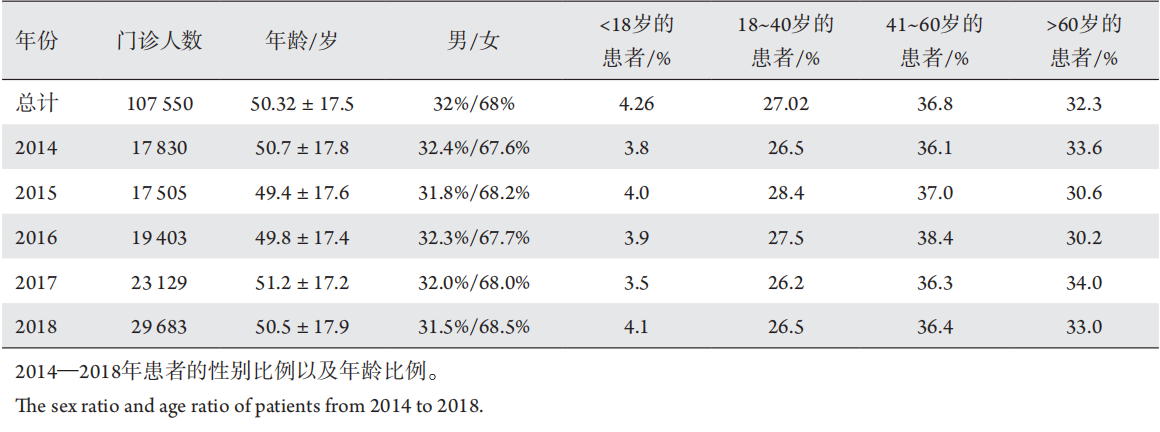
Table 1 Descriptive statistics of outpatients in gender and age groups
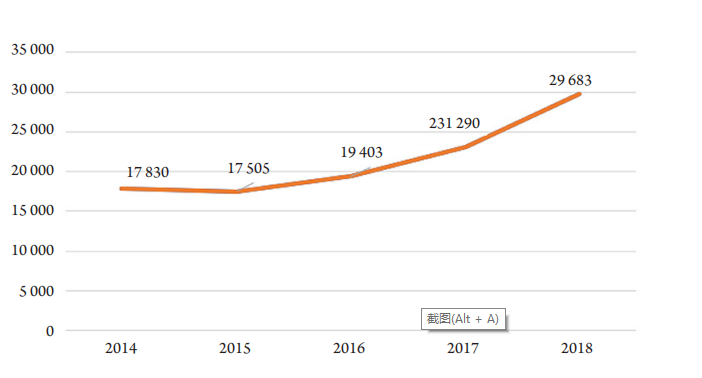
图1 2014—2018年门诊就诊人数
Figure 1 The number of outpatient visits from 2014 to 2018
2014—2018年干眼门诊人数呈逐年上升趋势。
From 2014 to 2018, the number of dry eye outpatients has been increasing year by year.
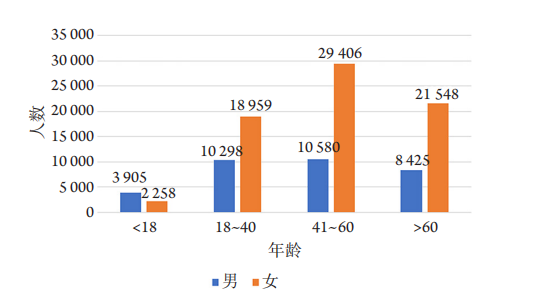
图2 门诊患者数的年龄分布
Figure 2 Age distribution of the number of outpatients
5年中各年龄分段的干眼患者数,41~60岁患者最多,<18岁患者最少,男性患者总数少于女性患者。
In 5 years, the number of patients with dry eye in different age segments is the highest in patients aged 41 to 60 years old. The fewest patients are under 18 years old and the total number of male patients is less than that of female patients.
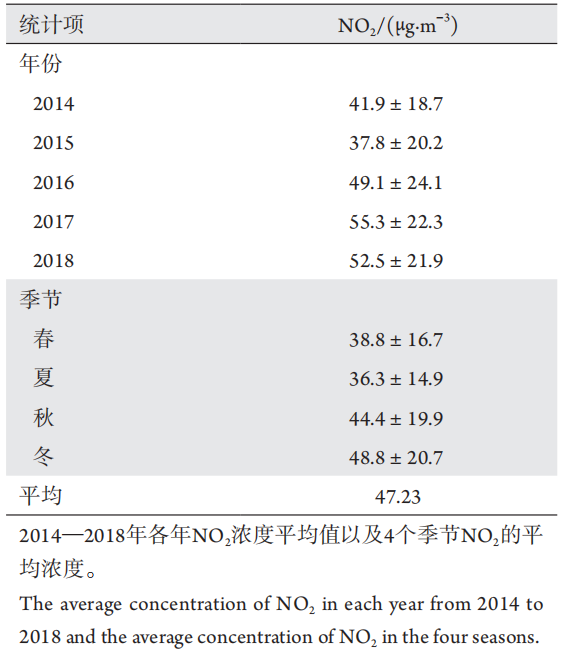
表2 2014~2018年的空气污染和气候的描述性统计
Table 2 Descriptive statistics of air pollution and climate from 2014 to 2018
图3 2014—2018年空气污染物的变化
Figure 3 Changes in air pollutants from 2014 to 2018
图所示为2014—2018年261周每周NO2的平均浓度,有明显的周期性。
The figure shows the average weekly NO2 concentration for 261 weeks from 2014 to 2018, with obvious periodicity.
2.2 干眼患者与环境污染物NO2的相关性分析
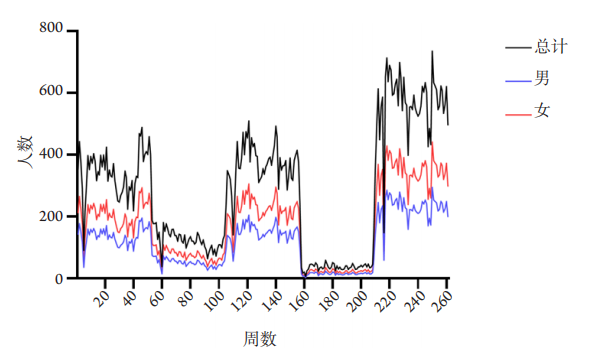
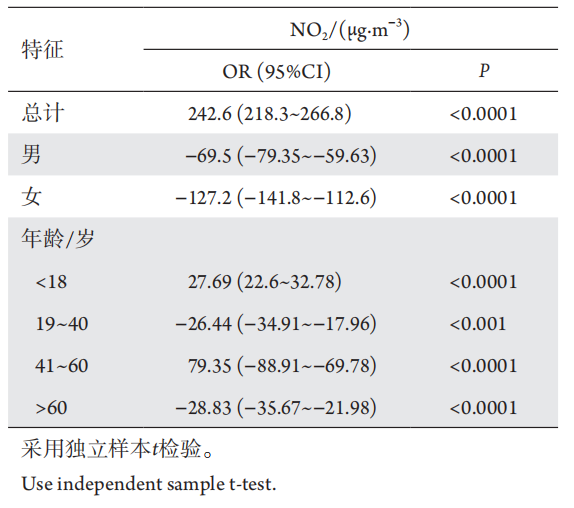
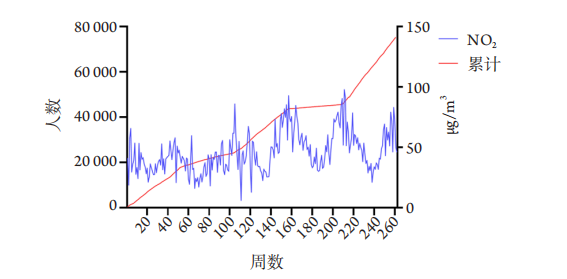
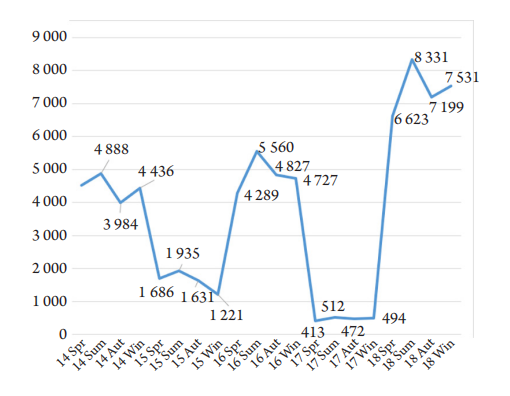
将门诊患者的检查从每日转换为每周1次,由于人口的工作时间,门诊患者按周显示出强烈的周期性。转换后,门诊访问量为每周7~735例(图4 )。干眼的门诊就诊与NO2水平相关,95%CI为218.3~266.8,差异有统计学意义(P <0.0001)。通过计算其相关性系数为0.388,95%CI为0.298~0.479 ,差异有统计学意义( P < 0.0001),NO2水平和患病人数有显著相关性。在本研究评估的污染物中,每增加10 μg/m3的NO2暴露导致每周7 0次门诊就诊。暴露于NO2的单位增量提高了门诊访问次数(表3)。提示NO2的影响因素均对性别无特异性。对于年龄各年龄段干眼患者,NO2是环境污染造成干眼的主要因素(表3)。 本研究还考虑可能是由于空气污染物对干眼的患者数量有累加效应,因此又计算出每周患者累计人数与该周的空气污染物水平的相关性,结果如图5。提示NO2与干眼患者的门诊数增多呈显著正相关。本研究发现夏季的干眼门诊就诊次数明显多于其他季节(图6),但性别和年龄没有改变这种效果。
图4 2014—2018年门诊诊所干眼的变化
Figure 4 Changes in dry eye in outpatient clinics from 2014 to 2018
图所示为2014—2018年261周每周患者的平均数。
The figure shows the average number of patients per week for 261 weeks from 2014 to 2018.
表3 变量变化对不同人群干眼诊门诊就诊的影响
Table 3 The impact of variable changes on dry eye clinic visits in difffferent populations
图5 干眼门诊就诊时空气污染物累积次数和天气变化的趋势图
Figure 5 Trend char t of the cumulative number of air
pollutants and weather changes during dry eye clinic visits
图所示为2014—2018年261周每周NO2的平均浓度和每周累计患者数。
The figure shows the average concentration of NO2 per week and the cumulative number of patients per week for 261 weeks from 2014 to 2018.
图6 门诊患者干眼的季节性变化
Figure 6 Seasonal changes of dry eye in outpatients
图所示为每年每个季节患者数量,夏天患病人数最多。
Spr:春,Sum:夏,Aut:秋,Win:冬。
The figure shows the number of patients in each season of the year,with the largest number of patients in summer. Spr: spring, Sum:summer, Aut: autumn, Win: winter.
1. 国家自然科学基金 (81660158);江西省重点研发项目 (20181BBG70004);江西省杰出青年人才计划
(20192BCBL23020); 江西省基层卫生适宜技术“星火推广计划”项目(20188003);江西省卫计委科技计划面上项目 (20175116,
20201032);江西省卫计委中医药科技计划项目 (2018A060)。 This work was supported by the National Natural Science Foundation (81660158), Key
Research Foundation of Jiangxi Province (20181BBG70004), Excellent Talents Development Project of Jiangxi Province (20192BCBL23020), Grassroots Health
Appropriate Technology “Spark Promotion Plan” Project of Jiangxi Province (20188003), Health Development Planning Commission Science Foundation of
Jiangxi Province (20175116, 20201032), and Health Development Planning Commission Science TCM Foundation of Jiangxi Province (2018A060),
参考文献
1. 阐海东, 陈秉衡. 我国大气颗粒物暴露与人群健康效应的关
系[ J]. 环境与健康, 2002, 19(6): 422-424.
CHAN HD , CHEN BH. The relationship between
atmospheric particulate matter exposure and population health effects
in China[ J]. Environment and Health, 2002, 19(6): 422-424.
2. Chang CJ, Yang HH, Chang CA, et al. Relationship between air
pollution and outpatient visits for nonspecific conjunctivitis[ J]. Invest
Ophthalmol Vis Sci, 2012, 53(1): 429-433.
3. Gao ZX, Song XL, LI SS, et al. Assessment of DNA damage and cell
senescence in corneal epithelial cells exposed to airborne particulate
matter (PM2.5) collected in Guangzhou, China[ J]. Invest Ophthalmol
Vis Sci, 2016, 57(7): 3093-3102.
4. Hong J, Zhong T, Li H, et al. Ambient air pollution, weather changes,
and outpatient visits for allergic conjunctivitis: A retrospective registry
study[ J]. Sci Rep, 2016(6): 23858.
5. Liu ZG, Peng J. Normalization of diagnosis and management of dry
eye[ J]. Chin J Exp Ophthalmol Res, 2008, 26(3): 161-164.
6. Kanangara JP, Galor A, Levitt RC, et al. Characteristics of ocular pain
complaints in patients with idiopathic dry eye symptoms[ J]. Eye
Contact Lens, 2016, 43(3): 192.
7. Sullivan BD, Crews LA, Messmer EM, et al. Correlations between
commonly used objective signs and symptoms for the diagnosis of dry
eye disease: clinical implications[ J]. Acta Ophthalmol, 2016, 92(2):
161-166.
8. Schaumberg DA, Sullivan DA, Dana MR. Epidemiology of dry eye
syndrome[ J]. Adv Exp Med Biol, 2002, 506: 989-998.
9. Moss SE, Klein R, Klein BE. Prevalence of and risk factors for dry eye
syndrome[ J]. Arch Ophthalmol, 2000, 118(9): 1264-1268.
10. Schein OD, Munoz B, Tielsh JM, et al. Prevalence of dry eye among the
elderly[ J]. Am J Ophthalmol, 1997, 124: 723-728.
11. Franck C, Palmvang IB, Boge I. Break-up time and lissamine green
epithelial damage in office eye syndrome[ J]. Acta Ophthalmol, 1993,
71: 62-64.
12. Citterio A, Sinforiani E, Verri A, et al. Neurological symptoms of the
sick building syndrome: analysis of a questionnaire[ J]. Funct Neurol,1998, 13: 225-230.
13. Tsubota K, Nakamori K. Effects of ocular surface area and bl ink rate on
tear dynamics[ J]. Arch Ophthalmol, 1995, 113: 155-158.
14. Toda I, Fujishima H, Tsubota K. Ocular fatigue is the major symptom
of dry eye[ J]. Acta Ophthalmol, 1993, 71: 347-352.
15. Schein OD, Tielsch JM, Munoz B, et al. Relation between signs and
symptoms of dry eye in the elderly[ J]. Ophthalmology, 1997, 104:
13951401.
16. Matsuda M, Bonatti R, Marquezini MV, et al. Lacrimal cytokines
assessment in subjects exposed to different levels of ambient air
pollution in a large metropolitan area[ J]. PLoS One, 2015, 10(11):
e0143131.
17. Wakamatsu TH, Dogru M, Matsumoto Y, et al. Evaluation of lipid
oxidative stress status in Sjogren syndrome patients[ J]. Invest
Ophthalmol Vis Sci, 2013, 54(1): 201-210.
18. Thomas J, Jacob GP, Abraham L, et al. The effect of smoking on the
ocular surface and the precorneal tear film[ J]. Australas Med J, 2012,
5(4): 221-226.
19. Ward SK, Dogru M, Wakamatsu T, et al. Passive cigarette smoke
exposure and soft contact lens wear[ J]. Optom Vis Sci, 2010, 87(5):
367-372.
20. Yao XL, Peng QH, Peng J, et al. Effects of extract of Buddleja officinalis
on partial inflammation of lacrimal gland in castrated rabbits with dry
eye[ J]. Int J Ophthalmol, 2010, 3(2): 114-119.
21. Sang BH, Yang HK, Hyon JY, et al. Association of dry eye disease with
psychiatric or neurological disorders in elderly patients[ J]. Clin Interv
Aging, 2017, 12: 785-792.
22. Samet JM, Zeger SL, Dominici F, et al. The national morbidity,
mortality, and air pollution study. Part II: morbidity and mortality
from air pollution in the United States[ J]. Res Rep Health Eff Inst,
2000, 94: 5-70.

'%20fill='white'%20fill-opacity='0.01'/%3e%3cmask%20id='mask0_3477_29692'%20style='mask-type:luminance'%20maskUnits='userSpaceOnUse'%20x='0'%20y='0'%20width='16'%20height='16'%3e%3crect%20id='&%23232;&%23146;&%23153;&%23231;&%23137;&%23136;_2'%20x='16'%20width='16'%20height='16'%20transform='rotate(90%2016%200)'%20fill='white'/%3e%3c/mask%3e%3cg%20mask='url(%23mask0_3477_29692)'%3e%3cpath%20id='&%23232;&%23183;&%23175;&%23229;&%23190;&%23132;'%20d='M14%205L8%2011L2%205'%20stroke='%23333333'%20stroke-width='1.5'%20stroke-linecap='round'%20stroke-linejoin='round'/%3e%3c/g%3e%3c/g%3e%3c/svg%3e)