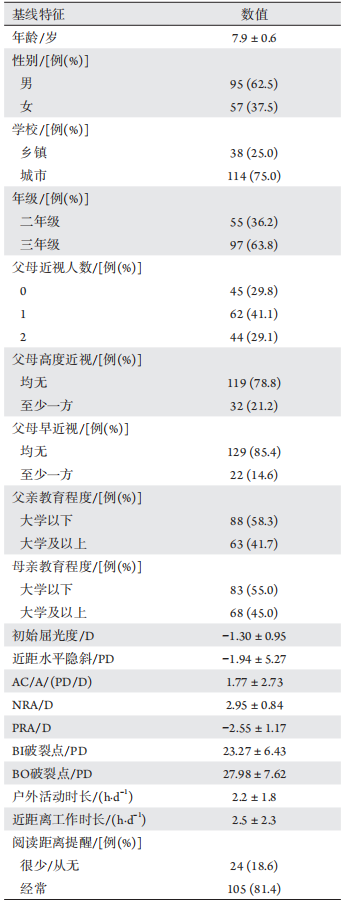
非睫状肌麻痹主觉验光:在昏暗照明条件下,由视光医生采用检影验光(YZ24系列带状光检影镜,苏州六六视觉科技股份有限公司)+主觉插片法测定儿童双眼屈光度数。结果用等效球镜度(spherical equivalent refraction,SER)表示,等效球镜度=球镜度数+(1/2)×柱镜度数。近视标准为SER≤-0.50 D,其中-3.00 D
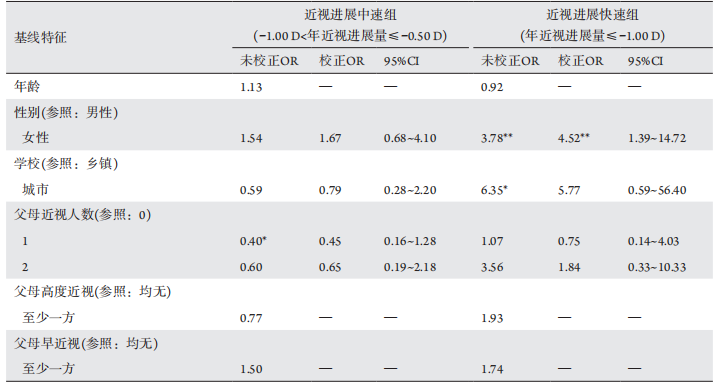
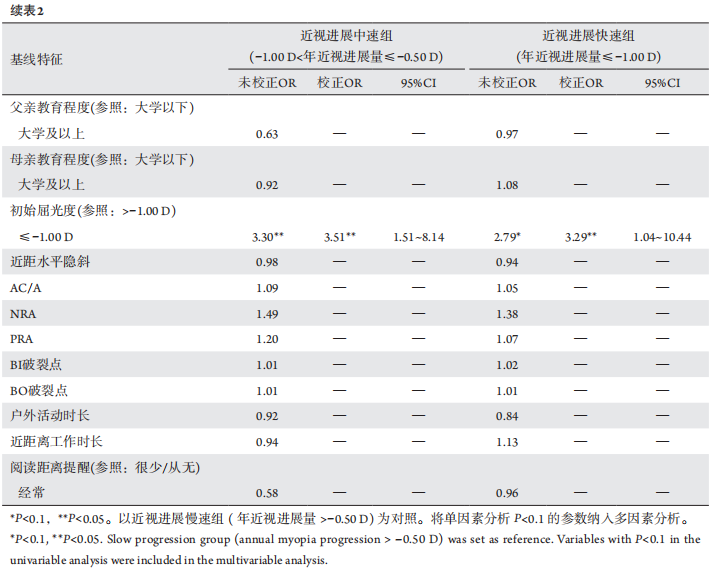
所有纳入儿童的初始屈光度为-1.30±0.95 D(屈光度范围为-5.00 D~-0.50 D),年近视进展量为-0.68±0.35 D,其中初始屈光度>-1.00 D组的儿童(n=75)年近视进展量为-0.63±0.37 D,初始屈光度≤-1.00 D组的儿童(n=77)年近视进展量为-0.73±0.32 D。根据近视进展速度快慢对纳入儿童进行分组后发现:慢速组儿童37名(24.3%),年近视进展量为-0.23±0.21 D;中速组儿童91名(59.9%),年近视进展量为-0.74±0.14 D;快速组儿童24名(15.8%),年近视进展量为-1.18±0.20 D。无序多分类logistic回归分析发现:和近视进展慢速组相比,近视进展中速组和快速组中初始屈光度≤-1.00 D的儿童占比均更大(中速组vs慢速组:58.2% vs 29.7%,OR=3.51,95% CI:1.51~8.14,P=0.003;快速组vs慢速组:54.2% vs 29.7%,OR=3.29,95% CI:1.04~10.44,P=0.044);近视进展快速组中女性占比更大(快速组 vs 慢速组:58.3% vs 27.0%,OR=4.52,95% CI:1.39~14.72,P=0.012);基线双眼视功能参数在不同近视进展速度组间差异均无统计学意义(均P>0.05,表2)。
2.3 近视进展和双眼视功能变化关系
相比基线,纳入儿童毕业当年随访时的近视程度加剧(基线vs毕业:-1.30±0.95 D vs -3.93±1.70 D,P<0.001),AC/A比率增大(1.64±2.75 PD/D vs 3.06±2.67 PD/D,P<0.001),NRA范围变小(2.98±0.84 D vs 2.35±0.64 D,P<0.001),PRA范围变小(-2.55±1.18 D vs ?2.07±1.04 D,P<0.001),BI破裂点范围变小(23.06±6.27 PD vs 19.83±5.87 PD,P<0.001),BO破裂点范围变小(28.07±7.35 PD vs 24.13±6.88 PD,P<0.001),而近距水平隐斜情况无显著变化(-1.82±5.21 PD vs -2.87±8.46 PD,P=0.147)。Pearson相关分析结果表明近视进展和双眼视功能参数变化之间均不存在相关性(均P>0.05)。
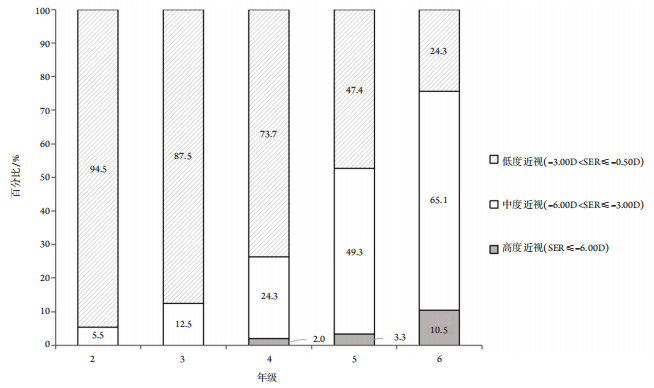
图1不同年级低、中、高度近视占比
Figure 1 Proportions of low myopia, moderate myopia and high myopia by school grades
二、三年级均无高度近视儿童。
There was no prevalent high myopia in grade 2 and grade 3.
表2 采用无序多分类logistic回归分析近视进展速度的危险因素
Table 2 Factors associated with various myopia progression speeds by multinomial logistic regression analysis
本研究还存在一定不足。首先,本研究的屈光度结果是基于非睫状肌麻痹状态下的主觉验光,测得的近视度数可能偏高。但是,相比非近视儿童,近视儿童调节紧张的情况较少,并且本研究的主觉验光是由经验丰富的眼科医生在保留检影验光后的+2.00 D工作镜的基础上进一步插片获得。因此,相比非睫状肌麻痹电脑验光,本研究所用方法测得的屈光度结果具有更高的可信度。其次,本研究中关于近距离工作情况、户外活动时长信息是通过对家长进行问卷调查获得,既往研究[27]发现问卷可能存在回忆偏倚,父母和孩子的报告结果之间也可能存在差异[28],后续研究或可采用客观、便携的可穿戴式设备进一步提高信息的准确性。此外,本研究发现随访时户外活动、近距离工作情况存在一定变化(户外活动时长,2014年 vs 2015年:2.1±0.2 h/d vs 1.4±0.1 h/d,P=0.004;近距离工作时长2.4±0.3 h/d vs 3.3±0.4 h/d,P=0.007),但为了尽早进行危险提示,我们仅纳入基线问卷数据进行近视进展的危险因素分析。
2. 温州医科大学-依视路国际联合研究中心(95013006, 95016010)。This work was supported by the International S&T Cooperation Program of China (2014DFA30940) and Wenzhou Medical University-Essilor International Research Center (95013006, 95016010), China.
3. 国 家 国 际 科 技 合 作 专 项 项 目 (2014DFA30940); 温 州 医 科 大 学 - 依 视 路 国 际 联 合 研 究 中 心 (95013006,95016010)。This work was supported by the International S&T Cooperation Program of China (2014DFA30940) and Wenzhou Medical University-Essilor International Research Center (95013006, 95016010), China.
参考文献
1. Rudnicka AR, Kapetanakis VV, Wathern AK, et al. Global variations and time trends in the prevalence of childhood myopia, a systematic review and quantitative meta-analysis: implications for aetiology and early prevention[J]. Br J Ophthalmol, 2016, 100(7): 882-890.
4. Ikuno Y. Overview of the complications of high myopia[J]. Retina, 2017, 37(12): 2347-2351.
5. Saw SM, Gazzard G, Shih-Yen EC, et al. Myopia and associated pathological complications[J]. Ophthalmic Physiol Opt, 2005, 25(5): 381-391.
6. Wong YL, Sabanayagam C, Ding Y, et al. Prevalence, risk factors, and impact of myopic macular degeneration on visual impairment and functioning among adults in Singapore[J]. Invest Ophthalmol Vis Sci, 2018, 59(11): 4603-4613.
7. Sankaridurg P, Tahhan N, Kandel H, et al. IMI impact of myopia[J]. Invest Ophthalmol Vis Sci, 2021, 62(5): 2.
8. Naidoo KS, Fricke TR, Frick KD, et al. Potential lost productivity resulting from the global burden of myopia: systematic review, meta-analysis, and modeling[J]. Ophthalmology, 2019, 126(3): 338-346.
9. Donovan L, Sankaridurg P, Ho A, et al. Myopia progression rates in urban children wearing single-vision spectacles[J]. Optom Vis Sci, 2012, 89(1): 27-32.
10. Rozema J, Dankert S, Iribarren R, et al. Axial growth and lens power loss at myopia onset in singaporean children[J]. Invest Ophthalmol Vis Sci, 2019, 60(8): 3091-3099.
11. Lanca C, Foo LL, Ang M, et al. Rapid myopic progression in childhood is associated with teenage high myopia[J]. Invest Ophthalmol Vis Sci, 2021, 62(4): 17.
12. Hsu CC, Huang N, Lin PY, et al. Risk factors for myopia progression in second-grade primary school children in Taipei: a population-based cohort study[J]. Br J Ophthalmol, 2017, 101(12): 1611-1617.
13. Saw SM, Tong L, Chua WH, et al. Incidence and progression of myopia in Singaporean school children[J]. Invest Ophthalmol Vis Sci, 2005, 46(1): 51-57.
14. Tricard D, Marillet S, Ingrand P, et al. Progression of myopia in children and teenagers: a nationwide longitudinal study[J/OL]. Br J Ophthalmol, 2021, [Epub ahead of print].
15. Jones-Jordan LA, Sinnott LT, Cotter SA, et al. Time outdoors, visual activity, and myopia progression in juvenile-onset myopes[J]. Invest Ophthalmol Vis Sci, 2012, 53(11): 7169-7175.
16. Li SM, Li H, Li SY, et al. Time outdoors and myopia progression over 2 years in Chinese children: the Anyang childhood eye study[J]. Invest Ophthalmol Vis Sci, 2015, 56(8): 4734-4740.
17. Wolffsohn JS, Jong M, Smith EL 3rd, et al. IMI 2021 reports and digest - reflections on the implications for clinical practice[J]. Invest Ophthalmol Vis Sci, 2021, 62(5): 1.
18. Chen Y, Drobe B, Zhang C, et al. Accommodation is unrelated to myopia progression in Chinese myopic children[J]. Sci Rep, 2020, 10(1): 12056.
19. Berntsen DA, Sinnott LT, Mutti DO, et al. Accommodative lag and juvenile-onset myopia progression in children wearing refractive correction[J]. Vision Res, 2011, 51(9): 1039-1046.
20. Weizhong L, Zhikuan Y, Wen L, et al. A longitudinal study on the relationship between myopia development and near accommodation lag in myopic children[J]. Ophthalmic Physiol Opt, 2008, 28(1): 57-61.
21. Goss DA, Jackson TW. Clinical findings before the onset of myopia in youth: 2. Zone of clear single binocular vision[J]. Optom Vis Sci, 1996, 73(4): 263-268.
22. Goss DA, Jackson TW. Clinical findings before the onset of myopia in youth: 3. Heterophoria[J]. Optom Vis Sci, 1996, 73(4): 269-278.
23. Wong YL, Yuan Y, Su B, et al. Prediction of myopia onset with refractive error measured using non-cycloplegic subjective refraction: the WEPrOM Study[J]. BMJ Open Ophthalmol, 2021, 6(1): e000628.
24. French AN, Morgan IG, Burlutsky G, et al. Prevalence and 5- to 6-year incidence and progression of myopia and hyperopia in Australian schoolchildren[J]. Ophthalmology, 2013, 120(7): 1482-1491.
25. Mutti DO, Mitchell GL, Jones-Jordan LA, et al. The response AC/A ratio before and after the onset of myopia[J]. Invest Ophthalmol Vis Sci, 2017, 58(3): 1594-1602.
26. Huang J, Wen D, Wang Q, et al. Efficacy comparison of 16 interventions for myopia control in children: a network Meta-analysis[J]. Ophthalmology, 2016, 123(4): 697-708.
28. Investigation of risk factors for myopia development in children[J]. Yan Ke Xue Bao, 2019, 34(2): 74-79.
29. Rah MJ, Mitchell GL, Mutti DO, et al. Levels of agreement between parents’ and children’s reports of near work[J].Ophthalmic Epidemiol, 2002, 9(3): 191-203.
30. Wen L, Cheng Q, Cao Y, et al. The Clouclip, a wearable device for measuring near-work and outdoor time: validation and comparison of objective measures with questionnaire estimates[J]. Acta Ophthalmol, 2021, 99(7): e1222-e1235.

'%20fill='white'%20fill-opacity='0.01'/%3e%3cmask%20id='mask0_3477_29692'%20style='mask-type:luminance'%20maskUnits='userSpaceOnUse'%20x='0'%20y='0'%20width='16'%20height='16'%3e%3crect%20id='&%23232;&%23146;&%23153;&%23231;&%23137;&%23136;_2'%20x='16'%20width='16'%20height='16'%20transform='rotate(90%2016%200)'%20fill='white'/%3e%3c/mask%3e%3cg%20mask='url(%23mask0_3477_29692)'%3e%3cpath%20id='&%23232;&%23183;&%23175;&%23229;&%23190;&%23132;'%20d='M14%205L8%2011L2%205'%20stroke='%23333333'%20stroke-width='1.5'%20stroke-linecap='round'%20stroke-linejoin='round'/%3e%3c/g%3e%3c/g%3e%3c/svg%3e)