"S-", "M-", and "L-" refers to the corresponding prediction performance of the short, medium, and long AL subgroups, respectively. Orange boxes represent the second quartile, blue boxes represent the third quartile; Figure 1 excludes extreme values outside the upper and lower quartiles to visually demonstrate differences in median levels across groups and the degree of dispersion of data in the middle 50% of absolute prediction errors.
图2 在忽略部分可选参数或不忽略时,预测误差在指定屈光度范围内的累计频率堆叠柱状图
Figure 2 When ignoring some optional parameters or not, stacked histogram comparing the percentage of eyes with a given prediction error
图中列出了总体与各眼轴亚组中的分布。
The figure shows the distribution overall and in each AL subgroup.
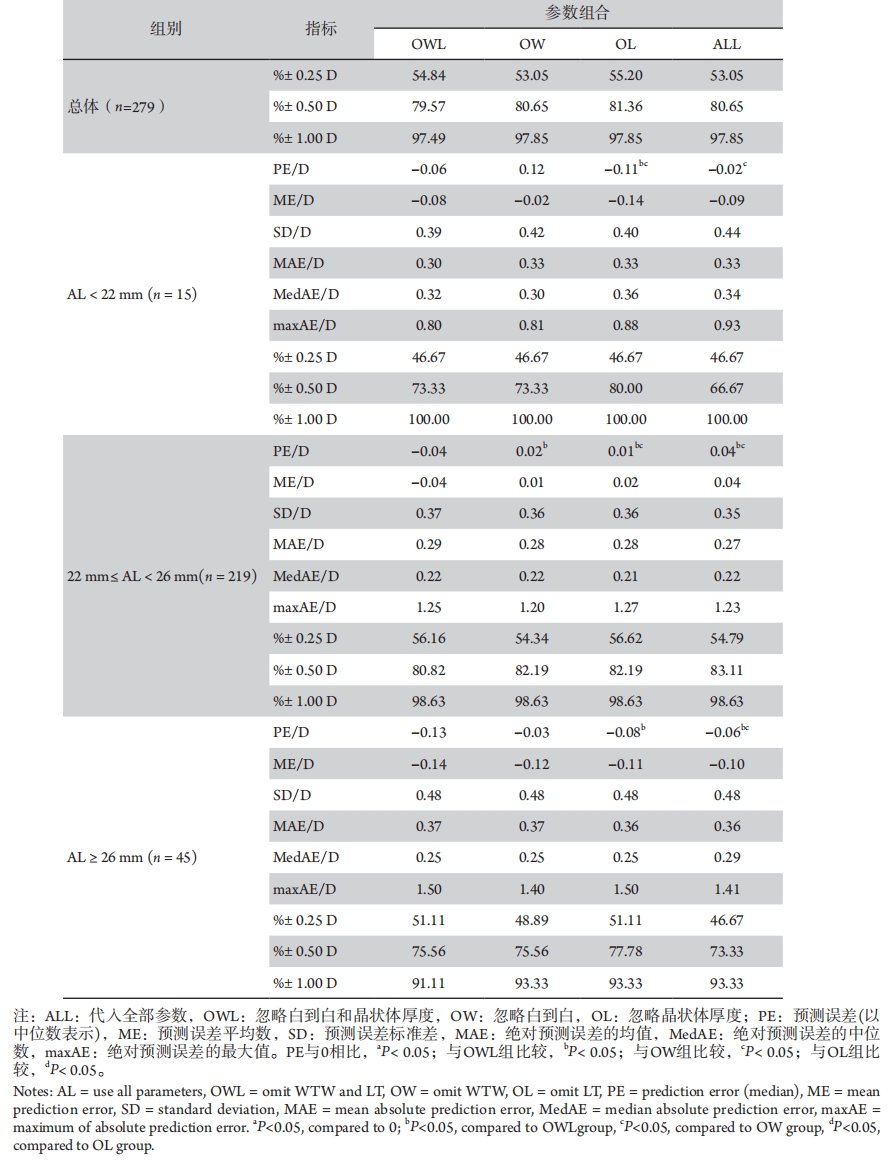
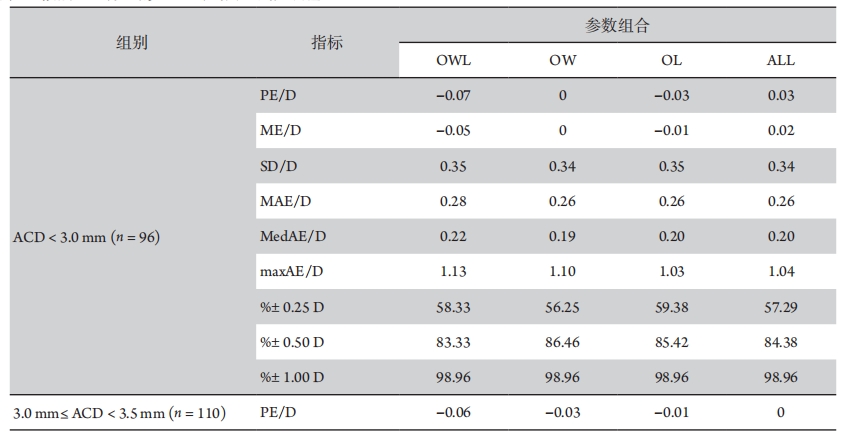
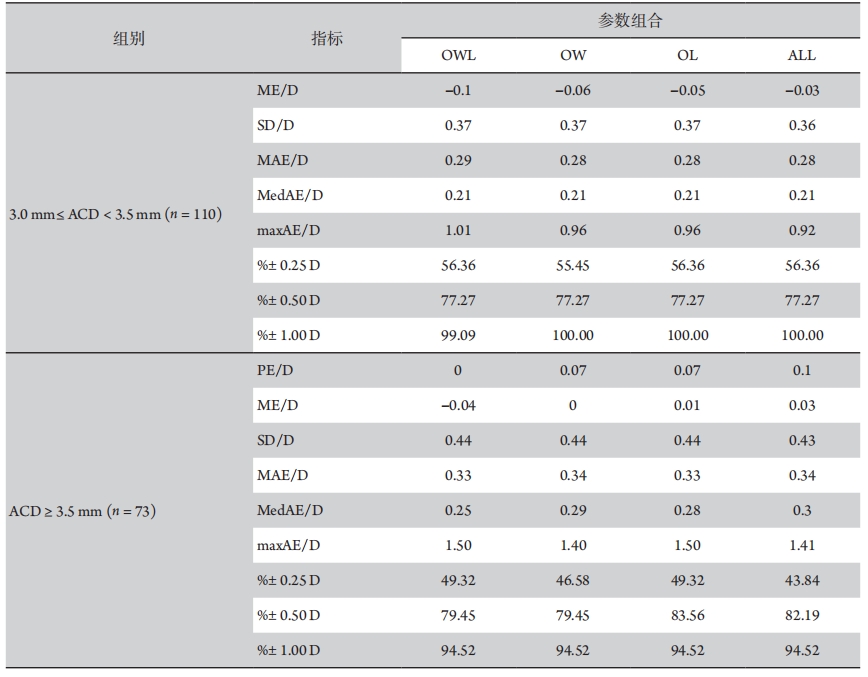
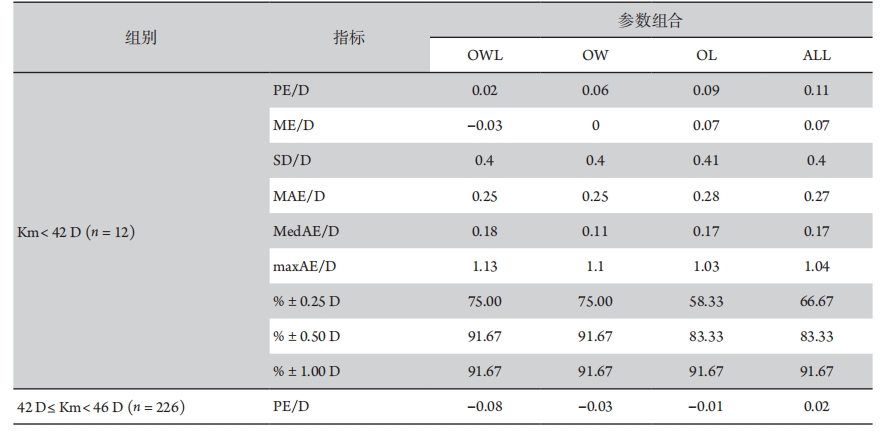
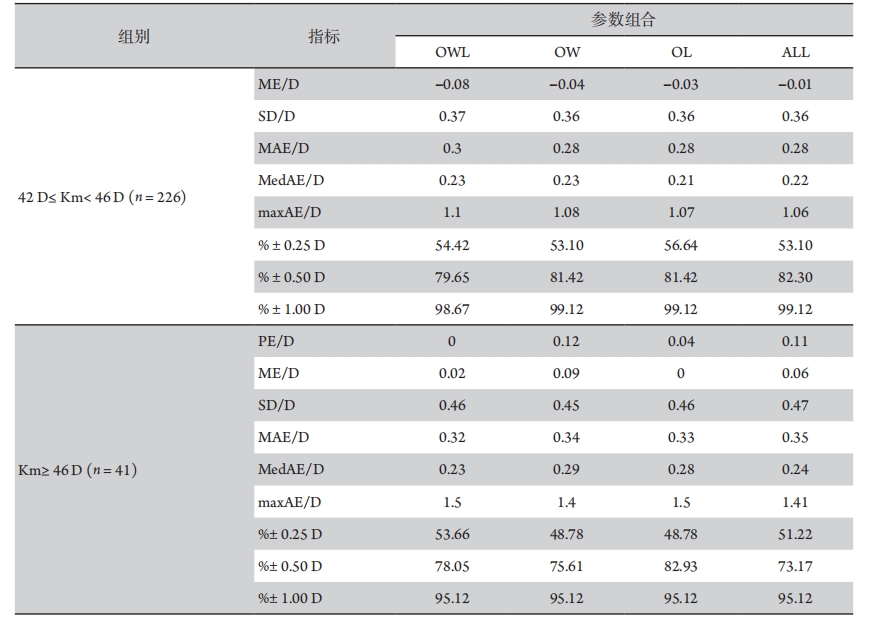
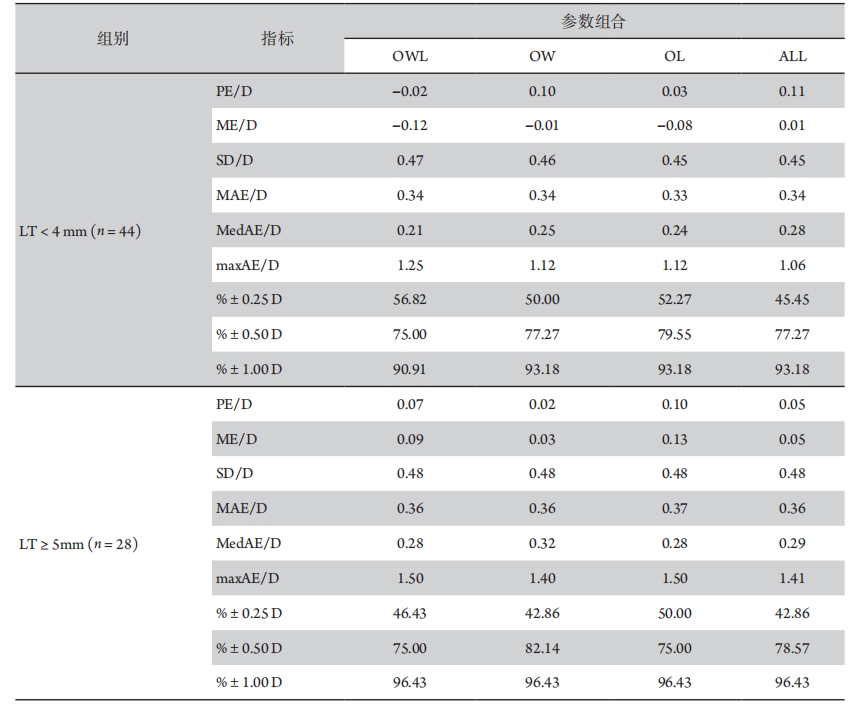
总体上,BUⅡ公式预测准确性较高(AE ≤ 0.50 D眼百分比:79.57%~81.36%),同时忽略LT和WTW计算使PE增加(P=0.011),而忽略LT、WTW之一或代入全部参数的PE与0比较差异无统计学意义(P> 0.05);MAE、MedAE和± 0.25、± 0.50、± 1.00 D范围内的PE累计频率在BUⅡ公式的各参数组合间比较差异无统计学意义(P> 0.05)。虽然差异无统计学意义,但PE ± 0.50 D百分比在忽略LT时略高于其他参数组合的预测效果(81.36% vs. 79.57%~80.65%),这一现象同样出现于AL < 22 mm(80% vs. 66.67%~73.33%)和AL ≥26 mm亚组(77.78% vs. 73.33%~75.56%);在22 mm ≤ AL< 26 mm亚组中,PE ± 0.50 D百分比代入全部参数时略高(83.11% vs. 80.82%~82.19%),忽略WTW + LT计算时较低(80.82%)。
总计有2.15%(6/279)患者术后AE > 1.00 D(表3),其中短眼轴亚组0例、中等眼轴亚组2例、长眼轴亚组4例,中等眼轴亚组2例患者术前角膜散光较大(患者1:2.17 D,患者2:1.2 D,均为OA-2000测量K2?K1的结果),患者1角膜散光不规则,未植入散光矫正型IOL,术后主觉验光:+0.25 DS /-2.50 DC ×105°→0.9,患者2手术切口位置135°,陡峭轴位置171°,术后主觉验光为-0.75 DS /-1.25 DC ×95→1.0。这6例患者均同时在四种参数组合中呈现较大的预测误差,而不同参数组合本身引起误差波动较小,提示误差为公式系统误差引起。
表3 AE> 1.00 D眼数组间分布
Table 3 Distribution of the number of eyes with AE > 1.00 D between groups
1. Darcy K, Gunn D, Tavassoli S, et al. Assessment of the accuracy of new
and updated intraocular lens power calculation formulas in 10 930 eyes
from the UK National Health Service[ J]. J Cataract Refract Surg, 2020,
46(1): 2-7.
2. Rong X, He W, Zhu Q, et al. Intraocular lens power calculation in eyes
with extreme myopia: comparison of Barrett Universal II, Haigis, and
Olsen formulas[ J]. J Cataract Refract Surg, 2019, 45(6): 732-737.
3. Kane JX, Van Heerden A, Atik A, et al. Intraocular lens power formula
accuracy: comparison of 7 formulas[ J]. J Cataract Refract Surg, 2016,
42(10): 1490-1500.
4. Carmona-González D, Castillo-Gómez A, Palomino-Bautista C, et al.
Comparison of the accuracy of 11 intraocular lens power calculation
formulas[ J]. Eur J Ophthalmol, 2021, 31(5): 2370-2376.
5. Shrivastava AK, Behera P, Kumar B, et al. Precision of intraocular
lens power prediction in eyes shorter than 22 mm: an analysis of 6
formulas[ J]. J Cataract Refract Surg, 2018, 44(11): 1317-1320.
6. Gökce SE, Zeiter JH, Weikert MP, et al. Intraocular lens power
calculations in short eyes using 7 formulas[ J]. J Cataract Refract Surg,
2017, 43(7): 892-897.
7. Wang L, Koch DD, Hill W, et al. Pursuing perfection in intraocular lens
calculations: III. Criteria for analyzing outcomes[ J]. J Cataract Refract
Surg, 2017, 43(8): 999-1002.
8. Kane JX, Chang DF. Intraocular lens power formulas, biometry,
and intraoperative aberrometry: a review[ J]. Ophthalmology, 2021,
128(11): e94-e114.
9. Pereira A, Popovic MM, Ahmed Y, et al. A comparative analysis of 12
intraocular lens power formulas[ J]. Int Ophthalmol, 2021, 41(12):
4137-4150.
10. Shammas HJ, Taroni L, Pellegrini M, et al. Accuracy of newer
intraocular lens power formulas in short and long eyes using sum-of-segments biometry[ J]. J Cataract Refract Surg, 2022, 48(10): 1113-
1120.
11. Kansal V, Schlenker M, Ahmed IIK. Interocular axial length and corneal
power differences as predictors of postoperative refractive outcomes
after cataract surgery[ J]. Ophthalmology, 2018, 125(7): 972-981.
12. Gaurisankar ZS, van Rijn GA, Lima JEE, et al. Correlations between
ocular biometrics and refractive error: a systematic review and meta-analysis[ J]. Acta Ophthalmol, 2019, 97(8): 735-743.
14. SShrivastava AK, Nayak S, Mahobia A, et al. Accuracy of intraocular lens power
calculation formulae in short eyes: a systematic review and meta-analysis[ J]. Indian J Ophthalmol, 2022, 70(3):740-748.
15. Reitblat O, Gali HE, Chou L, et al. Intraocular lens power calculation
in the elderly population using the Kane formula in comparison with
existing methods[ J]. J Cataract Refract Surg, 2020, 46(11): 1501-1507.
16. Bernardes J, Raimundo M, Lobo C, et al. A comparison of intraocular
lens power calculation formulas in high myopia[ J]. J Refract Surg,
2021, 37(3): 207-211.
17. Chen Y, Wei L, He W, et al. Comparison of Kane, hill-RBF 2.0, barrett
universal II, and emmetropia verifying optical formulas in eyes with
extreme myopia[ J]. J Refract Surg, 2021, 37(10): 680-685.
18. Guo C, Yin S, Qiu K, et al. Comparison of accuracy of intraocular lens
power calculation for eyes with an axial length greater than 29.0 mm[ J].
Int Ophthalmol, 2022, 42(7): 2029-2038.
19. Taroni L, Hoffer KJ, Lupardi E, et al. Accuracy of new intraocular lens
power calculation formulas: a lens thickness study[ J]. J Refract Surg,
2021, 37(3): 202-206.
20. Vega Y, Gershoni A, Achiron A, et al. High agreement between barrett
universal II calculations with and without utilization of optional
biometry parameters[ J]. J Clin Med, 2021, 10(3): 542.
21. Wendelstein JA, Rothbächer J, Heath M, et al. Influence and predictive
value of optional parameters in new-generation intraocular lens
formulas[ J]. J Cataract Refract Surg, 2023, 49(8): 795-803.
22. Srivannaboon S, Chirapapaisan C, Chirapapaisan N, et al. Accuracy of
Holladay 2 formula using IOLMaster parameters in the absence of lens
thickness value[ J]. Graefes Arch Clin Exp Ophthalmol, 2013, 251(11):
2563-2567.
23. Li XY, Liao X, Lin J, et al. Effect of optional biometric parameters in
the Kane formula on intraocular lens power calculation[ J]. PLoS One,
2023, 18(8): e0289033.
24. Lam S. Comparison of age-derived lens thickness to optically measured
lens thickness in IOL power calculation: a clinical study[ J]. J Refract
Surg, 2012, 28(2): 154-155.
25. Wei L, He W, Meng J, et al. Evaluation of the white-to-white distance in
39, 986 Chinese cataractous eyes[ J]. Invest Ophthalmol Vis Sci, 2021,
62(1): 7.
26. Meng J, Wei L, He W, et al. Lens thickness and associated ocular
biometric factors among cataract patients in Shanghai[ J]. Eye Vis,
2021, 8(1): 22.
27. Hipólito-Fernandes D, Luís ME, Serras-Pereira R , et al. Anterior
chamber depth, lens thickness and intraocular lens calculation formula
accuracy: nine formulas comparison[ J]. Br J Ophthalmol, 2022,
106(3): 349-355.
28. Yang J, Wang X, Zhang H, et al. Clinical evaluation of surgery-induced
astigmatism in cataract surgery using 2.2 mm or 1.8 mm clear corneal
micro-incisions[ J]. Int J Ophthalmol, 2017, 10(1): 68-71.
29. Conrad-Hengerer I, Al Sheikh M, Hengerer FH, et al. Comparison
of visual recovery and refractive stability between femtosecond laser-assisted cataract surgery and standard phacoemulsification: six-month
follow-up[ J]. J Cataract Refract Surg, 2015, 41(7): 1356-1364.
30. Dzhaber D, Mustafa OM, Alsaleh F, et al. Visual and refractive
outcomes and complications in femtosecond laser-assisted versus
conventional phacoemulsification cataract surgery: findings from
a randomised, controlled clinical trial[ J]. Br J Ophthalmol, 2020,
104(11): 1596-1600.

'%20fill='white'%20fill-opacity='0.01'/%3e%3cmask%20id='mask0_3477_29692'%20style='mask-type:luminance'%20maskUnits='userSpaceOnUse'%20x='0'%20y='0'%20width='16'%20height='16'%3e%3crect%20id='&%23232;&%23146;&%23153;&%23231;&%23137;&%23136;_2'%20x='16'%20width='16'%20height='16'%20transform='rotate(90%2016%200)'%20fill='white'/%3e%3c/mask%3e%3cg%20mask='url(%23mask0_3477_29692)'%3e%3cpath%20id='&%23232;&%23183;&%23175;&%23229;&%23190;&%23132;'%20d='M14%205L8%2011L2%205'%20stroke='%23333333'%20stroke-width='1.5'%20stroke-linecap='round'%20stroke-linejoin='round'/%3e%3c/g%3e%3c/g%3e%3c/svg%3e)