Historical advancement and current challenges in whole eye transplantation
Views:10762
DOI:10.12419/25060501
Publication Date:2025-09-23
Author(s):
PENG Jingyi ,ZHONG Liuxueying
View More
Author(s):
PENG Jingyi ,ZHONG Liuxueying
Institution/Unit:
1.State Key Laboratory of Ophthalmology, Zhongshan Ophthalmic Center, Sun Yat-sen University, Guangdong Provincial Key Laboratory of Ophthalmology and Visual Science, Guangzhou 510060, China.
Keywords
whole eye transplantation
animal models
blood circulation
optic nerve regeneration
immune rejection
non-human primates
Abstract
Whole eye transplantation (WET) is a potential definitive treatment for irreversible ocular damage and permanent blindness caused by conditions like trauma or tumors. The success of WET depends not only on the complete anatomical restoration of the transplanted eye but, more critically, on the recovery of functional vision. Key challenges in this field include optimizing surgical strategies to re-establish ocular blood circulation, achieving functional neural integration between the donor optic nerve and the recipient's visual centers, and developing precise and effective immunomodulation strategies to strike a balance between transplant tolerance and infection risk. This review provides a systematic review of the research progress and developmental challenges in the field of WET. Early studies primarily utilized poikilothermic animal models, which demonstrated a certain degree of plasticity in the visual pathway following transplantation. However, due to significant anatomical differences compared to humans and the lack of sophisticated vascular and neural anastomosis in experimental designs, the clinical translatability of these studies remained constrained. With the progress in microvascular techniques, preliminary explorations in mammalian models and human eye transplantation have achieved significant breakthroughs in microsurgical vascular anastomosis, enabling the short-term reestablishment of retinal blood perfusion in transplanted eyes. Nonetheless, persistent obstacles include inadequate optic nerve regeneration and poor long-term functional maintenance. Currently, research bottlenecks mainly focus on three aspects: optimizing surgical techniques for blood circulation reconstruction, precisely regenerating nerve axons, and regulating the immune microenvironment. Establishing standardized non-human primate models that closely mimic humans and conducting systematic experimental studies will furnish crucial evidence and novel insights to overcome existing technical hurdles and propel WET toward clinical application.
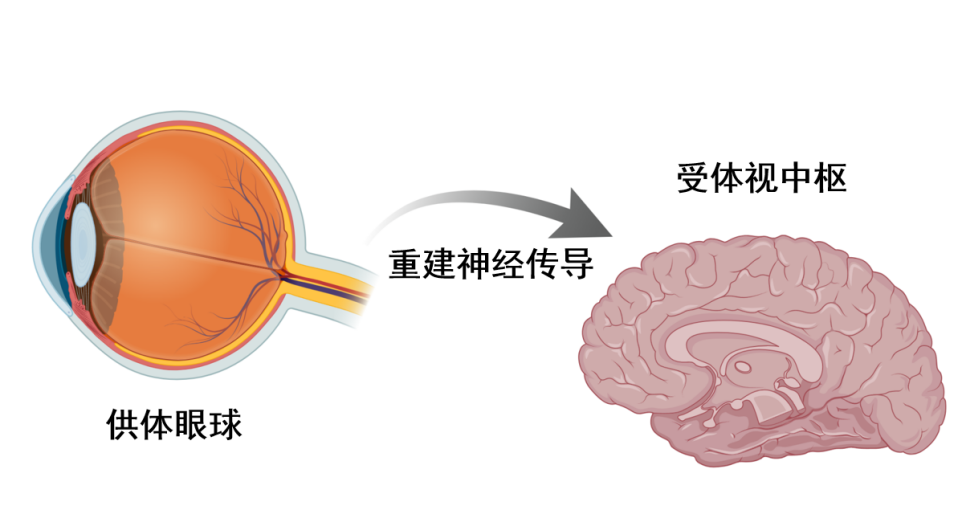
图 1 全眼球移植后视觉恢复的关键-重建视网膜至大脑视中枢的视觉连接 Figure 1 The key to visual restoration after whole eye transplantation — reestablishing the retinal-brain visual pathway
1. This work was supported by Guangdong Provincial Medical Science and Technology Research Fund (A2024491), Guangzhou Municipal Basic Research Program Jointly Funded by the Municipality and Universities (Institutes) (SL2024A03J00533).
References
1. Katayama A, Patel P, Pianelli A, et al. Abdominal organ transplantation: noteworthy literature in 2024[J]. Semin Cardiothorac Vasc Anesth, 2025, 29(2): 147-158. DOI:10.1177/10892532251328204.
2. Chen B, Zhang H, Zhai Q, et al. Traumatic optic neuropathy: a review of current studies[J]. Neurosurg Rev, 2022, 45(3): 1895-1913. DOI:10.1007/s10143-021-01717-9.
3. Gu L, Poddar S, Lin Y, et al. A biomimetic eye with a hemispherical perovskite nanowire array retina[J]. Nature, 2020, 581(7808): 278-282. DOI:10.1038/s41586-020-2285-x.
4. Lu Y, Brommer B, Tian X, et al. Reprogramming to recover youthful epigenetic information and restore vision[J]. Nature, 2020, 588(7836): 124-129. DOI:10.1038/s41586-020-2975-4.
5. Lee J, Nguyen S, Bhattacharya S. Optic nerve regeneration: Potential treatment approaches[J]. Curr Opin Pharmacol, 2024, 74: 102428. DOI:10.1016/j.coph.2023.102428.
6. Bekono-Nessah I, Duah-Asante KA, Poku D, et al. Whole-eye transplantation: how far are we from a breakthrough[J]. Ophthalmic Plast Reconstr Surg, 2024, 40(6): 597-602. DOI:10.1097/IOP.0000000000002738.
7. Bourne D, Li Y, Komatsu C, et al. Whole-eye transplantation: a look into the past and vision for the future[J]. Eye, 2017, 31(2): 179-184. DOI:10.1038/eye.2016.272.
8. Gokoffski KK, Washington KM, Chuck RS. Clinical and scientific considerations for whole eye transplantation: an ophthalmologist’s perspective[J]. Transl Vis Sci Technol, 2025, 14(2): 13. DOI:10.1167/tvst.14.2.13.
9. The latest surgical triumph - the transplantation of eye from rabbit to man[J]. Daniels Tex Med J, 1885, 1(1): 27.
10. Stone LS, Cole CH. Grafted eyes of young and old adult salamanders (amblystoma punctatum) showing return of vision[J]. Yale J Biol Med, 1943, 15(5): 735-754.2.
11. Pietsch P, Schneider CW. Transplanted eyes of foreign donors can reinstate the optically activated skin camouflage reactions in bilaterally enucleated salamanders (Ambystoma)[J]. Brain Behav Evol, 1988, 32(6): 364-370. DOI:10.1159/000116563.
12. Sperry RW. Restoration of vision after crossing of optic nerves and after contralateral transplantation of eye[J]. J Neurophysiol, 1945, 8(1): 15-28. DOI:10.1152/jn.1945.8.1.15.
13. Sher H. Revascularization of autotransplanted ovine eyes by microsurgical anastomosis[J]. J Microsurg, 1981, 2(4): 269-272. DOI:10.1002/micr.1920020408.
14. Shi J, Ellenberg D, Kim JY, et al. Restoration of electroretinogram activity in exenterated swine eyes following ophthalmic artery anastomosis[J]. Restor Neurol Neurosci, 2009, 27(4): 351-357. DOI:10.3233/RNN-2009-0485.
15. Sher H, Cohen RJ. Revascularization of isolated extracorporeal canine eyes by direct microsurgical anastomosis[J]. J Microsurg, 1980, 1(5): 399-402. DOI:10.1002/micr.1920010512.
16. Zor F, Polat M, Kulahci Y, et al. Demonstration of technical feasibility and viability of whole eye transplantation in a rodent model[J]. J Plast Reconstr Aesthet Surg, 2019, 72(10): 1640-1650. DOI:10.1016/j.bjps.2019.05.042.
17. Ceradini DJ, Tran DL, Dedania VS, et al. Combined whole eye and face transplant: microsurgical strategy and 1-year clinical course[J]. JAMA, 2024, 332(18): 1551-1558. DOI:10.1001/jama.2024.12601.
19. López-Martínez S, Simón C, Santamaria X. Normothermic machine perfusion systems: where do we go from here?[J]. Transplantation, 2024, 108(1): 22-44. DOI:10.1097/TP.0000000000004573.
20. Chen C, Singh G, Madike R, et al. Central retinal artery occlusion: a stroke of the eye[J]. Eye, 2024, 38(12): 2319-2326. DOI:10.1038/s41433-024-03029-w.
21. Sousa Da Silva RX, Weber A, Dutkowski P, et al. Machine perfusion in liver transplantation[J]. Hepatology, 2022, 76(5): 1531-1549. DOI:10.1002/hep.32546.
22. Ellenberg D, Shi J, Jain S, et al. Impediments to eye transplantation: ocular viability following optic-nerve transection or enucleation[J]. Br J Ophthalmol, 2009, 93(9): 1134-1140. DOI:10.1136/bjo.2008.155267.
23. Ellenberg D, Shi J, Jain S, et al. Impediments to eye transplantation: ocular viability following optic-nerve transection or enucleation[J]. Br J Ophthalmol, 2009, 93(9): 1134-1140. DOI:10.1136/bjo.2008.155267.
24. Zhang J, Wang N. Current challenges of retinal ganglion cell regeneration[J]. Regen Med, 2022, 17(4): 199-201. DOI:10.2217/rme-2022-0006.
25. Wang X, Sun L, Han X, et al. The molecular mechanisms underlying retinal ganglion cell apoptosis and optic nerve regeneration in glaucoma (Review)[J]. Int J Mol Med, 2025, 55(4). DOI:10.3892/ijmm.2025.5504. DOI:10.3892/ijmm.2025.5504.
26. Yang SG, Li CP, Peng XQ, et al. Strategies to promote long-distance optic nerve regeneration[J]. Front Cell Neurosci, 2020: 119. DOI:10.3389/fncel.2020.00119.
27. de Lima S, Habboub G, Benowitz LI. Combinatorial therapy stimulates long-distance regeneration, target reinnervation, and partial recovery of vision after optic nerve injury in mice[J]. Int Rev Neurobiol, 2012, 106: 153-172. DOI:10.1016/B978-0-12-407178-0.00007-7.
28. Zhang Q, Tang J, Liu L, et al. Emerging therapeutic strategies for optic nerve regeneration[J]. Trends Pharmacol Sci, 2025, 46(1): 45-61. DOI:10.1016/j.tips.2024.11.008.
29. Liu ZG, Zhou LY, Sun YQ, et al. Unlocking the potential for optic nerve regeneration over long distances: a multi-therapeutic intervention[J]. Front Neurol, 2025: 1526973-1526973. DOI:10.3389/fneur.2024.1526973.
30. Kaplan HJ. Anatomy and function of the eye[J]. Chem Immunol Allergy, 2007, 92: 4-10. DOI:10.1159/000099236.
31. Hori J, Kunishige T, Nakano Y. Immune checkpoints contribute corneal immune privilege: implications for dry eye associated with checkpoint inhibitors[J]. Int J Mol Sci, 2020, 21(11): 3962. DOI:10.3390/ijms21113962.
32. Scarabosio A, Surico PL, Tereshenko V, et al. Whole-eye transplantation: Current challenges and future perspectives[J]. World J Transplant, 2024, 14(2): 95009. DOI:10.5500/wjt.v14.i2.95009.
33. Zor F, Karagoz H, Kapucu H, et al. Immunological considerations and concerns as pertinent to whole eye transplantation[J]. Curr Opin Organ Transplant, 2019, 24(6): 726-732. DOI:10.1097/MOT.0000000000000713.
34. Kumar A, Yun H, Funderburgh ML, et al. Regenerative therapy for the cornea[J]. Prog Retin Eye Res, 2022, 87: 101011. DOI:10.1016/j.preteyeres.2021.101011.
35. Li B, Wang Y, Owens CR, et al. Immune responses in rodent whole eye transplantation: elucidation and preliminary investigations into rejection diagnosis and monitoring[J]. Front Immunol, 2025, 16: 1475055. DOI:10.3389/fimmu.2025.1475055.
36. Parlakpinar H, Gunata M. Transplantation and immunosuppression: a review of novel transplant-related immunosuppressant drugs[J]. Immunopharmacol Immunotoxicol, 2021, 43(6): 651-665. DOI:10.1080/08923973.2021.1966033.
37. Peng J, Zhong L, Ma L, et al. Comparison of vascular parameters between normal cynomolgus macaques and healthy humans by optical coherence tomography angiography[J]. BMC Ophthalmol, 2019, 19(1): 204. DOI:10.1186/s12886-019-1207-x.
38. Wozar F, Seitz I, Reichel F, et al. Importance of nonhuman Primates as a model system for gene therapy development in ophthalmology[J]. Klin Monbl Augenheilkd, 2022, 239(3): 270-274. DOI:10.1055/a-1777-5033.
39. Seah I, Goh D, Chan HW, et al. Developing non-human primate models of inherited retinal diseases[J]. Genes, 2022, 13(2): 344. DOI:10.3390/genes13020344.