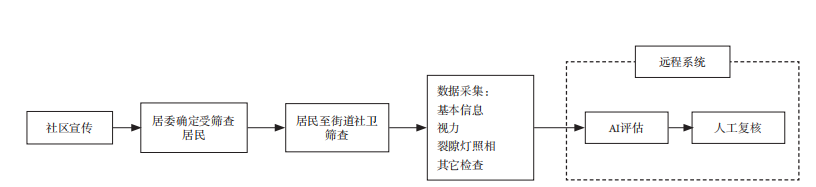
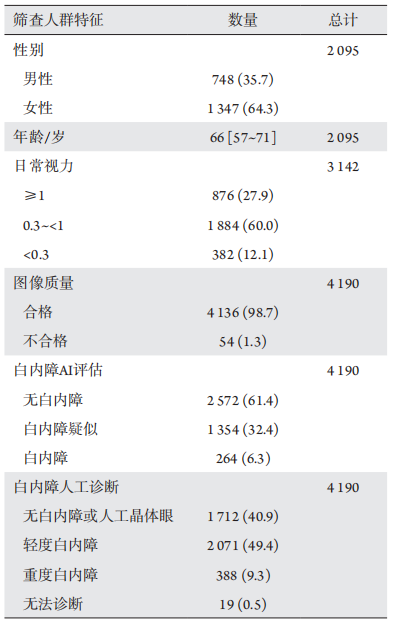
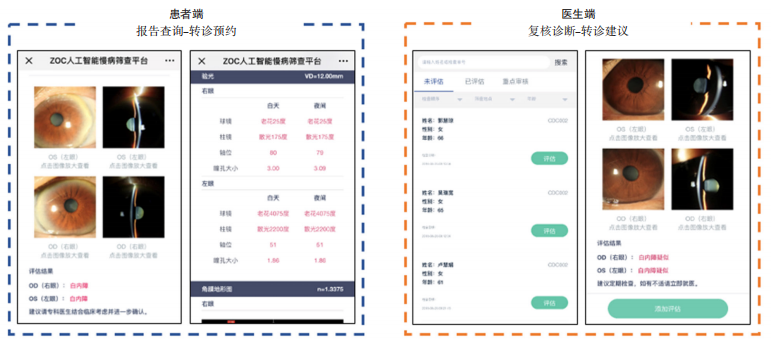
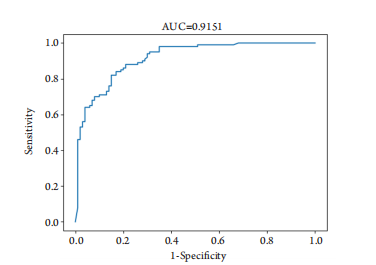
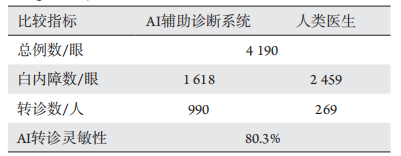
Objective: To evaluate the effectiveness of an artificial intelligence-assisted diagnostic system for cataract screening in community. Methods: A prospective observational study was carried out based on a telemedicine platform. Patient history, medical records and anterior ocular segment images were collected and transmitted from community healthcare centers to Zhongshan Ophthalmic Center for evaluation by both ophthalmologists and artificial intelligence-assisted cataract diagnostic system. Results: Of all enumerated subjects, 35.7% were male and the median age was 66 years old. Of all enumerated slit-lamp images, 98.7% met the requirement of acceptable quality. This artificial intelligence-assisted diagnostic system achieved an AUC of 0.915 for detection of severe cataracts in the external validation dataset. For subjects who were advised to be referred to tertiary hospitals by doctors, 80.3% of them received the same suggestion from this artificial intelligence-assisted diagnostic system.Conclusion: This artificial intelligence-assisted cataract diagnostic system showed high applicability and accuracy in community-based cataract screening and could be a potential model of care in community-based disease screening.
Continuous variables that do not conform to normal distribution will be represented as median [25th percentile, 75th percentile]. Categorical variables are represented as the number of each category and their percentage in parentheses.
Lin H, Li R, Liu Z, et al. Diagnostic efficacy and therapeutic decision-
making capacity of an artificial intelligence platform for childhood
cataracts in eye clinics: a multicentre randomized controlled trial[ J].
EClinicalMedicine, 2019, 9: 52-59.
Abramoff MD, Lavin PT, Birch M, et al. Pivotal trial of an autonomous
AI-based diagnostic system for detection of diabetic retinopathy in
primary care offices[ J]. NPJ Digit Med, 2018, 1: 39.
Gulshan V, Peng L, Coram M, et al. Development and validation of a
deep learning algorithm for detection of diabetic retinopathy in retinal
fundus photographs[ J]. JAMA, 2016, 316(22): 2402-2410.
Chylack LT Jr, Wolfe JK, Singer DM, et al. The Lens Opacities
Classification System III. The longitudinal study of cataract study
group[ J]. Arch Ophthalmol, 1993, 111(6): 831-836.
Long E, Lin H, Liu Z, et al. An artificial intelligence platform for the
multihospital collaborative management of congenital cataracts[ J]. Nat
Biomed Eng, 2017, 1(2): 0024.
Wu X, Huang Y, Liu Z, et al. Universal artificial intelligence platform
for collaborative management of cataracts[ J]. Br J Ophthalmol, 2019,
103(11): 1553-1560.
Wu X , Long E, Lin H, et al. Prevalence and epidemiological
characteristics of congenital cataract: a systematic review and meta-
analysis[ J]. Sci Rep, 2016, 6: 28564.
SharaA K, Aslami A N, Srivastava J P, et al. Visual outcome of traumatic
cataract at a tertiary eye care centre in north India: a prospective
study[ J]. J Clin Diagn Res, 2016, 10(1): Nc05-Nc08.
Mohammad-Rabie H, Malekifar P, Esfandiari H. Visual outcomes
after primary iris claw artisan intraocular lens implantation during
complicated cataract surgery[ J]. Semin Ophthalmol, 2017, 32(3):
337-340.
Tang Y, Wang X, Wang J, et al. Prevalence of age-related cataract
and cataract surgery in a Chinese adult population: the Taizhou eye
study[ J]. Invest Ophthalmol Vis Sci, 2016, 57(3): 1193-1200.
Epidemiology of cataract[ J]. Lancet, 1982, 1(8286): 1392-1393.