Prevention and telemedicine of eye diseases based on deep learning and smart phones
Views:
12406
DOI:
10.3978/j.issn.1000-4432.2022.03.03
Publication Date:
2021/07/16
Author(s):
HUANG Linzhe1, LIU Lixue2, WU Yuxuan2, XU Andi2, XIANG Yifan2, ZHOU Yi3, LIN Haotian2
HUANG Linzhe1, LIU Lixue2, WU Yuxuan2, XU Andi2, XIANG Yifan2, ZHOU Yi3, LIN Haotian2
Institution/Unit:
School of Medicine, Sun Yat-sen University, Shenzhen Guangzhou 518107
State Key Laboratory of Ophthalmology, Zhongshan Ophthalmic Center, Sun Yat-sen University, Guangdong Provincial Key Laboratory of Ophthalmology and Visual Science, Guangzhou 510060, China
Sun Yat-sen University of Medical Sciences, Guangzhou 510060, China
With the increasing coverage and availability of smart phones, the application of realizing intelligent health management has become an emerging research hotspot. The new generation of smart phones can perform health analysis by tracking the step numbers, monitoring heart rate and sleep quality, taking photos and other approaches, thereby becoming a new medical aid tool. With the continuous development of deep learning technology in the field of image processing, intelligent diagnosis based on medical imaging has blossomed in many disciplines, which is expected to completely change the traditional eye diseases diagnosis and treatment mode of hospitals. The conventional diagnosis of ophthalmic diseases often relies on various forms of images, such as slit lamp biological microscope, fundus imaging, optical coherence tomography, etc. As a result, ophthalmology has become one of the fastest growing areas of medical artificial intelligence (AI). The deployment of ophthalmological AI diagnosis and treatment system on smart phones is expected to improve the diagnostic efficiency and screening coverage to relieve the strain of medical resources, which has a great development prospect. This review focuses on the prevention and telemedicine progress of eye diseases based on deep learning and smart phones, taking diabetic retinopathy, glaucoma and cataract as examples to describe the specific research, application and prospect of deep learning and smart phones in the management of eye diseases.
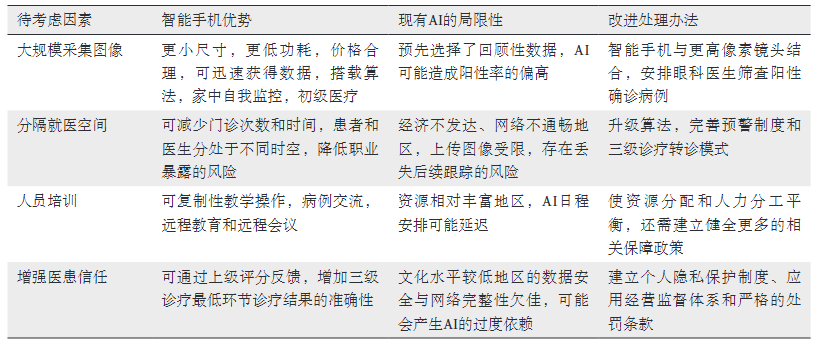
大量研究[10-13]表明:DL可通过眼底彩照高灵敏度地检测DR,但其中大多数研究都是使用回顾性收集的数据。2018年,Abràmoff等[14]招募了900名未经DR初筛的受试者,验证了自主AI系统的诊断性能具有高特异性和高灵敏度。基于此,同年4月,IDx-DR,第一台使用AI检测轻度以上的DR和DM黄斑水肿的医疗设备被美国食品和药物管理局(Food and Drug Administration,FDA)允许上市销售[14-15]。然而,由于疾病患病率和图像质量的变化,当疾病发生率较低时,阳性预测值也将较低,整体性能可能会降低。
iGlaucoma是世界上第一个基于智能手机,能够通过Humphrey VFs的模式偏差概率图(pattern deviation probability plot,PDP)地图检测青光眼的应用程序,在大规模临床部署中都具有巨大价值。2020年9月中山眼科中心发表了一项关于iGlaucoma评估基于VF的多模式DL算法的研究[25]。基于智能手机的增强深度学习系统(deep learning system,DLS),该研究开发了青光眼检测工具iGlaucoma,并评估了中国7个三级青光眼中心超过160万数据点,在2个阶段的青光眼VF检测中,检测出其中的青光眼病例,实现从实验室到临床应用的转换。这种仅根据VFs来判断的性能水平超过6名普通眼科医生,诊断青光眼的速度快5倍。未来还可将虚拟现实(virtual reality,VR)和DL技术结合起来,将Humphrey Field Analyzer移植到VR护目镜中,创造一种智能的VF测试和诊断设备。这表明将DLS并入VF,作为初级眼保健界未来的青光眼诊断工具之一,让机器帮助做出青光眼诊断成为可能[25]。
中国人工智能医学联盟(the Chinese Medical Alliance for Artificial Intelligence,CMAAI)应用Django框架建立了用于白内障诊断的Web平台,远程实时监控患者疾病状况。选择年龄范围和诊断模块后[特别是用于后囊膜浑浊(posterior capsular opacification,PCO)诊断的逆光照明图片],用户可以从文件中选择图像来上传新病例,网站上则提供捕获模式、白内障诊断、严重性评估和转诊建议等。每周医生会根据一般分类标准来评估所有病例,并及时与患者沟通,防止误诊。根据最新的诊断准则来更新逻辑语义,平台的诊断和治疗决策可满足最新的诊断标准,以便随时更新。他们还建立了一种新颖的三级医疗转诊模式,包括家中的自我监控、初级医疗和专业医院服务。与传统方式相比,该平台的眼科医生与人口的服务比例增加了10.2倍[42]。接下来还需要进一步社区筛查的临床试验,如果收效明显,那么未来该智能手机远程诊疗白内障疾病平台将大有可为。
本科教学质量工程项目[教务(2021)93号]。This work was supported by Undergraduate Teaching Quality Engineering Project, China [(2021) No. 93].
本科教学质量工程项目 [ 教务 (2021)93 号 ]。This work was supported by the Undergraduate Teaching Quality Engineering Project, China [(2021) No. 93].
References
Statista. Anzahl der Smartphone-Nutzer weltweit von 2016 bis 2019 und Prognose bis 2023[EB/OL]. 2021. [2021-01-14]. https://de.statista.com/statistik/daten/studie/309656/umfrage/prognose-zur-anzahl-der-smartphone-nutzer-weltweit/.
Whitehead L, Seaton P. The Effectiveness of self-management mobile phone and tablet apps in long-term condition management: A systematic review[J]. J Med Internet Res, 2016, 18(5): e97.
Yang M, Lo ACY, Lam WC. Smart phone apps every ophthalmologist should know about[J]. Int J Ophthalmol, 2020, 13(8): 1329-1333.
Cheung N, Mitchell P, Wong TY. Diabetic retinopathy[J]. Lancet, 2010, 376(9735): 124-136.
Lee R, Wong TY, Sabanayagam C. Epidemiology of diabetic retinopathy, diabetic macular edema and related vision loss[J]. Eye Vis (Lond), 2015, 2: 17.
Rodrigues GB, Abe RY, Zangalli C, et al. Neovascular glaucoma: A review[J]. Int J Retina Vitreous, 2016, 2: 26.
Tan CH, Kyaw BM, Smith H, et al. Use of Smartphones to detect diabetic retinopathy: Scoping review and meta-analysis of diagnostic test accuracy studies[J]. J Med Internet Res, 2020, 22(5): e16658.
Rajalakshmi R, Subashini R, Anjana RM, et al. Automated diabetic retinopathy detection in smartphone-based fundus photography using artificial intelligence[J]. Eye (Lond), 2018, 32(6): 1138-1144.
Natarajan S, Jain A, Krishnan R, et al. Diagnostic accuracy of community-based diabetic retinopathy screening with an offline artificial intelligence system on a smartphone[J]. JAMA Ophthalmol, 2019, 137(10): 1182-1188.
Klonoff DC, Schwartz DM. An economic analysis of interventions for diabetes[J]. Diabetes Care, 2000, 23(3): 390-404.
Kanagasingam Y, Xiao D, Vignarajan J, et al. Evaluation of artificial intelligence-based grading of diabetic retinopathy in primary care[J]. JAMA Netw Open, 2018, 1(5): e182665.
Karakaya M, Hacisoftaoglu RE. Comparison of smartphone-based retinal imaging systems for diabetic retinopathy detection using deep learning[J]. BMC Bioinformatics, 2020, 21(Suppl 4): 259.
Abràmoff MD, Lavin PT, Birch M, et al. Pivotal trial of an autonomous AI-based diagnostic system for detection of diabetic retinopathy in primary care offices[J]. NPJ Digit Med, 2018, 1: 39.
US Food and Drug Administration. FDA permits marketing of artificial intelligence-based device to detect certain diabetes-related eye problems[EB/OL]. April 12, 2018 (Washington, DC, 2018). https://www.fda.gov/news-events/press-announcements/fda-permits-marketing-artificial-intelligence-based-device-detect-certain-diabetes-related-eye.
Osborne NN, Wood JP, Chidlow G, et al. Ganglion cell death in glaucoma: what do we really know?[J]. Br J Ophthalmol, 1999, 83(8): 980-986.
Quigley HA. Neuronal death in glaucoma[J]. Prog Retin Eye Res, 1999, 18(1): 39-57.
Nicoar? S. The mechanisms of neuronal death in glaucoma[J]. Oftalmologia, 2000, 51(2): 4-6.
Tham YC, Li X, Wong TY, et al. Global prevalence of glaucoma and projections of glaucoma burden through 2040: A systematic review and meta-analysis[J]. Ophthalmology, 2014, 121(11): 2081-2090.
Jonas JB, Aung T, Bourne RR, et al. Glaucoma[J]. Lancet, 2017, 390(10108): 2183-2193.
Mohammadpour M, Heidari Z, Mirghorbani M, et al. Smartphones, tele-ophthalmology, and VISION 2020[J]. Int J Ophthalmol, 2017, 10(12): 1909-1918.
Araci IE, Su B, Quake SR, et al. An implantable microfluidic device for self-monitoring of intraocular pressure[J]. Nat Med, 2014, 20(9): 1074-1078.
Russo A, Morescalchi F, Costagliola C, et al. A novel device to exploit the smartphone camera for fundus photography[J]. J Ophthalmol, 2015, 2015: 823139.
Li F, Song D, Chen H, et al. Development and clinical deployment of a smartphone-based visual field deep learning system for glaucoma detection[J]. NPJ Digit Med, 2020, 3: 123.
Ran AR, Tham CC, Chan PP, et al. Deep learning in glaucoma with optical coherence tomography: A review[J]. Eye (Lond), 2021, 35(1): 188-201.
Cataract in China: Research and development direction and problems encountered[J]. Chinese Journal of Ophthalmology, 2015, 51(4): 241-244.
Eppig T, Scholz K, L?ffler A, et al. Effect of decentration and tilt on the image quality of aspheric intraocular lens designs in a model eye[J]. J Cataract Refract Surg, 2009, 35(6): 1091-1100.
Baumeister M, Bühren J, Kohnen T. Tilt and decentration of spherical and aspheric intraocular lenses: Effect on higher-order aberrations[J]. J Cataract Refract Surg, 2009, 35(6): 1006-1012.
Oshika T, Sugita G, Miyata K, et al. Influence of tilt and decentration of scleral-sutured intraocular lens on ocular higher-order wavefront aberration[J]. Br J Ophthalmol, 2007, 91(2): 185-188.
Ashena Z, Maqsood S, Ahmed SN, et al. Effect of intraocular lens tilt and decentration on visual acuity, dysphotopsia and wavefront aberrations[J]. Vision (Basel), 2020, 4(3): 41.
Xin C, Bian GB, Zhang H, et al. Optical coherence tomography-based deep learning algorithm for quantification of the location of the intraocular lens[J]. Ann Transl Med, 2020, 8(14): 872.
Wu X, Long E, Lin H, et al. Prevalence and epidemiological characteristics of congenital cataract: A systematic review and meta-analysis[J]. Sci Rep, 2016, 6: 28564.
Lin D, Chen J, Lin Z, et al. A practical model for the identification of congenital cataracts using machine learning[J]. EBioMedicine, 2020, 51: 102621.
Lambert SR, Purohit A, Superak HM, et al. Long-term risk of glaucoma after congenital cataract surgery[J]. Am J Ophthalmol, 2013, 156(2): 355-361.e2.
Plager DA, Lynn MJ, Buckley EG, et al. Complications, adverse events, and additional intraocular surgery 1 year after cataract surgery in the Infant Aphakia Treatment Study[J]. Ophthalmology, 2011, 118(12): 2330-2334.
Zhang L, Wu X, Lin D, et al. Visual outcome and related factors in bilateral total congenital cataract patients: A prospective cohort study[J]. Sci Rep, 2016, 6: 31307.
Long E, Chen J, Wu X, et al. Artificial intelligence manages congenital cataract with individualized prediction and telehealth computing[J]. NPJ Digit Med, 2020, 3: 112.
Wu X, Huang Y, Liu Z, et al. Universal artificial intelligence platform for collaborative management of cataracts[J]. Br J Ophthalmol, 2019, 103(11): 1553-1560.
Shahid K, Kolomeyer AM, Nayak NV, et al. Ocular telehealth screenings in an urban community[J]. Telemed J E Health, 2012, 18(2): 95-100.
Li JO, Liu H, Ting DSJ, et al. Digital technology, tele-medicine and artificial intelligence in ophthalmology: A global perspective[J]. Prog Retin Eye Res, 2021, 82: 100900.
Kiage D, Kherani IN, Gichuhi S, et al. The Muranga teleophthalmology study: Comparison of virtual (Teleglaucoma) with in-person clinical assessment to diagnose glaucoma[J]. Middle East Afr J Ophthalmol, 2013, 20(2): 150-157.
Rachapelle S, Legood R, Alavi Y, et al. The cost-utility of telemedicine to screen for diabetic retinopathy in India[J]. Ophthalmology, 2013, 120(3): 566-573.
Madanagopalan VG, Raman R. Commentary: Artificial intelligence and smartphone fundus photography—Are we at the cusp of revolutionary changes in retinal disease detection?[J]. Indian J Ophthalmol, 2020, 68(2): 396-397.
Fischer F, Kleen S. Possibilities, problems, and perspectives of data collection by mobile apps in longitudinal epidemiological studies: Scoping review[J]. J Med Internet Res, 2021, 23(1): e17691.