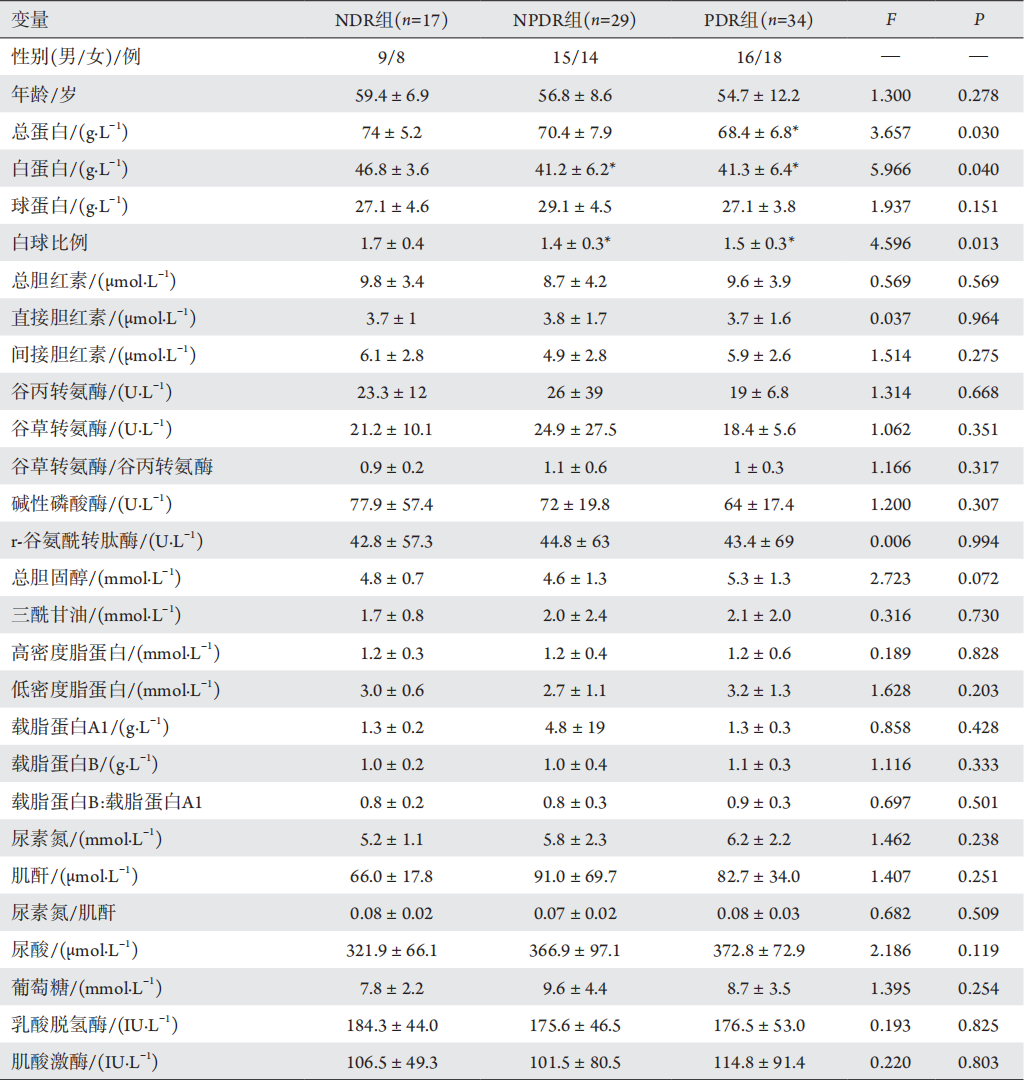
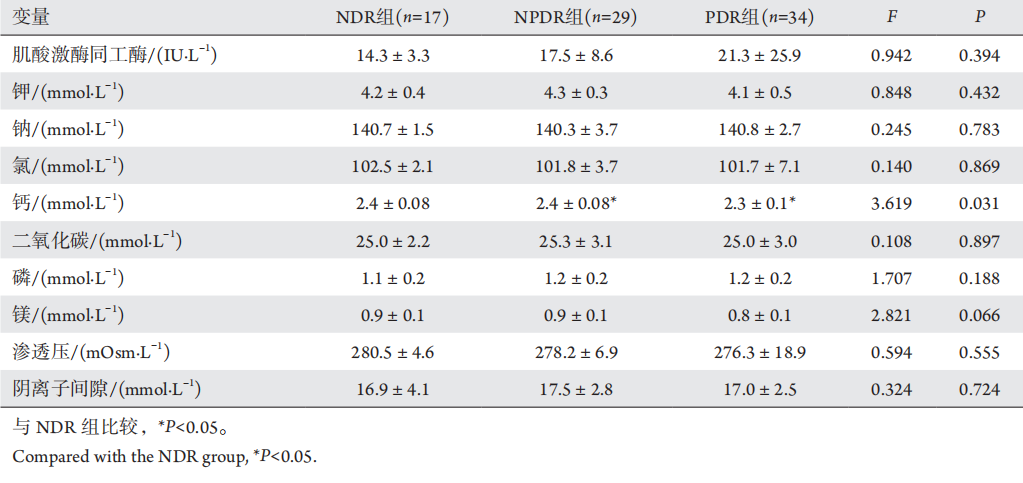
Objective: To analyze the serum biochemical indexes of different degrees of type 2 diabetic retinopathy, and the correlation between biochemical indexes and the degree of diabetic retinopathy (DR). Methods: Patients with type 2 diabetes admitted to the Fujian Medical University 2nd Affiliate Hospital from May 2018 to October 2020 were retrospectively collected. The patients were divided into 3 groups according to fundus conditions: non-diabetic retinopathy (NDR) group (n=17), diabetes with non-proliferative diabetic retinopathy (NPDR) group (n=29),diabetes with proliferative diabetic retinopathy (PDR) group (n=34). SPSS 24.0 was used to compare the levels of a complete set of serum biochemical indexes in the three groups. Pearson correlation analysis and multiple linear regression analysis were used for the correlation between the different indexes and DR. Results: There was no statistically significant difference in age between the three groups. The differences in total protein, albumin, white sphere ratio, and calcium concentration of the three groups were statistically significant (P<0.05). The comparison between the groups showed that the total protein, albumin, white sphere ratio, and calcium concentration in the NPDR and PDR groups were lower than those in the NDR group. The difference was statistically significant (P<0.05). Pearson correlation analysis showed that total protein (r=?0.290), albumin (r=?0.304), and
calcium concentration (r=?0.252) were negatively correlated with DR (all P<0.05). Multiple linear regression indicated total protein, albumin and blood calcium concentration were the protective factors of DR (P<0.05).Conclusion: This study found that serum levels of total protein, albumin, and blood calcium levels are negatively correlated with DR. Maintaining a relatively high level of these indexes within the physiological range may provide new ideas for the prevention and treatment of diabetic retinopathy.
Song SJ, Wong TY. Current concepts in diabetic retinopathy[ J].
Diabetes Metab J, 2014, 38(6): 416-425.
Zhu Y, Cai X, Liu Y, et al. Serum albumin, but not bilirubin, is
associated with diabetic chronic vascular complications in a Chinese
Type 2 diabetic population[ J]. Sci Rep, 2019, 9(1): 12086.
Iwasaki T, Togashi Y, Terauchi Y. Significant association of serum
albumin with severity of retinopathy and neuropathy, in addition to that
of nephropathy, in Japanese type 2 diabetic patients[ J]. Endocr J, 2008,
55(2): 311-316.
Ferrucci L, Fabbri E. Inflammageing: chronic inflammation in ageing,
cardiovascular disease, and frailty[ J]. Nat Rev Cardiol, 2018, 15(9):
505-522.
Kern TS. Contributions of inflammatory processes to the development
of the early stages of diabetic retinopathy[ J]. Exp Diabetes Res, 2007,
2007: 95103.
Jha JC, Ho F, Dan C, et al. A causal link between oxidative stress and
inflammation in cardiovascular and renal complications of diabetes[ J].
Clin Sci (Lond), 2018, 132(16): 1811-1836.
Yaribeygi H, Atkin SL, Sahebkar A. A review of the molecular
mechanisms of hyperglycemia‐induced free radical generation leading
to oxidative stress[ J]. J Cell Physiol, 2019, 234(2): 1300-1312.
王珊珊, 陈莉明, 常宝成, 等. 2型糖尿病患者血清钙与糖代谢的
相关关系[ J]. 中华内分泌代谢杂志, 2014, 30(1): 26-30.
WANG SS, CHEN LiM, CHANG BC, et al. The
correlation between serum calcium and glucose metabolism in patients
with type 2 diabetes[ J]. Chinese Journal of Endocrinology and
Metabolism, 2014, 30(1): 26-30.