HIGHLIGHTS
· This review summarizes the application of omics approaches in the study of pediatric cataract over the past decade
· This paper employs a comprehensive review methodology to integrate the knowledge of multiple omics in the field of pediatric cataract, discussing the advantages, challenges, and future prospects of omics concerning this disease.
· The review depicts a future landscape of multi-omics in pediatric cataract:
1) Mechanism Research: Systematically surveying the molecular expression profiles of pediatric cataract at “gene-mRNA-protein-metabolite” levels to understand its etiological mechanisms.
2) Therapeutic Improvements: Exploration of potential biomarkers and key pathways to improve personalized diagnosis and treatment.
INTRODUCTION
Pediatric cataract, characterized by lens opacity present at birth or developing during childhood, is a major cause of visual impairment and blindness in children globally,[1] affecting 1 to 15 per 10,000 newborns.[2] This condition severely impacts the quality of visual information during the critical period of children's visual system development. If left uncorrected, it can lead to irreversible visual impairment or even permanent blindness, imposing a substantial economic burden on families and societies. Congenital cataract, the most prevalent form of pediatric cataract, incurs annual global costs 3.1 to 5.2 billion dollars.[3] Surgical removal of the form deprivation is the recommended treatment to facilitate visual rehabilitation. However, the surgical management of pediatric cataract is considerably more challenging than that of adult-onset cataract, with risks of postoperative complications including glaucoma, posterior capsule opacification, and retinal detachment.[4] Consequently, researchers are committed to investigating regulatory mechanisms and key pathway targets underlying the pathogenesis of pediatric cataract , which may pave the way for exploring non-surgical therapies to prevent or reverse lens opacification, thereby improving the prevention, treatment and visual prognosis in children. The pathogenesis of pediatric cataract is diverse. While clear causes such as trauma, complications, drug-induced effects, and metabolic disorders are identified in some cases, the pathogenesis remains unclear in over 50% of instances.[5] Furthermore, given the high degree of heterogeneity in pediatric cataract, comprehensive and in-depth investigations at the molecular level are essential to accurately elucidate the pathogenesis, enhancing the prospects for accurate diagnosis, precise treatment, and prognosis assessment.
Advances in high-throughput sequencing technology and bioinformatics methods have introduced omics as a novel tool to facilitate our understanding of the complex pathogenesis and specific biomolecular processes underlying pediatric cataract. Omics refers to a set of disciplines that aim to measure and characterize biomolecules in a system using high-throughput approaches. Genomics focuses on identifying genetic variants implicated in disease, providing valuable insights into the discovery of pathogenic variations or mutations.[6] Transcriptomics serves as a powerful tool for the qualitative and quantitatively detection of the genome-wide RNA expression patterns, offering crucial information on gene expression, structure and regulation.[6] High-throughput proteomics enables the acquisition of information on peptide abundance, post-translational modifications, and protein-protein interactions across thousands of proteins, reflecting global protein expression.[7] As the omics field most intimately linked to the phenotype, metabolomics can quantify various small molecules, such as amino acids, fatty acids, carbohydrates and other products of cellular metabolism, providing metabolic profiles and identifying potential biomarkers and pathological metabolic pathways.[7] Based on the genetic central dogma, multi-omics approaches, including genomics, transcriptomics, proteomics, and metabolomics, offer a systematic and comprehensive understanding of disease states and biological processes at biomolecular levels of "DNA-mRNA-proteome-metabolite". Omics technology has been widely applied in ophthalmology to enhance our understanding of eye diseases at the biomolecular level, aiding in diagnosis and the identification of new therapeutic targets.
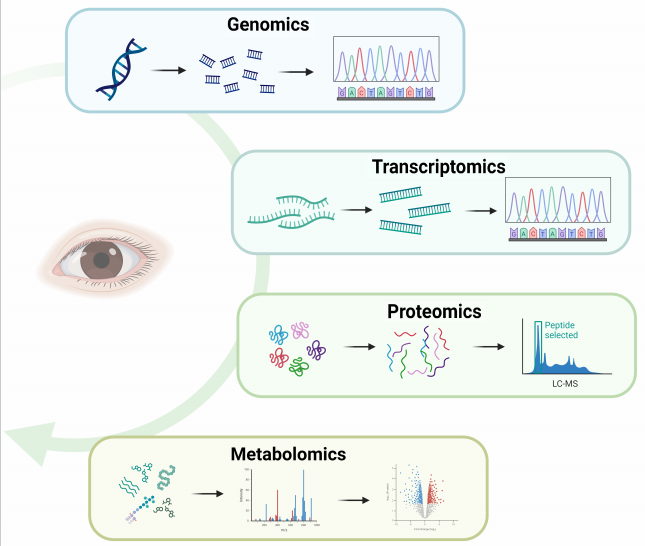
This study aims to provide a comprehensively review of the application of omics in the study of pediatric cataract over the past decade, encompassing genomics, transcriptomics, proteomics, and metabolomics (Figure 1), it will discuss the advantages and value of these applications in both clinical and laboratory setting, and outline the current challenges as well as future development directions of omics in the field of pediatric cataract.
Figure1 Omics approaches for the study of pediatric cataract
GENOMICS OF PEDIATRIC CATARACT
Overview of Genomics
Genomics identifies genetic variants and key genes based on DNA. Genomics can comprehensively analyze the organism’s genetic information by studying the structure and function of DNA sequences, including all coding and non-coding regions of a genome, as well as regions between genes.[8] The main genomics technologies include microarrays, whole exome sequencing(WES), whole genome sequencing (WGS), etc.[9] Microarrays can be used to identify loci of preset disease variants.[9] WES primarily sequences the coding regions of a genome, making it relatively efficient and cost-effective, while WGS obtains all genes of an individual, including both coding and non-coding regions, providing a more comprehensive but more expensive approach.[9] Genomics compares the sequenced genomes to reference genomes to identify genetic variants, such as DNA insertions or deletions, single nucleotide variants, copy number variants, and structural variants. Further annotation of their functionality can reveal possible causative gene mutations and provide references for disease diagnosis and genotype-phenotype associations.[10,11]
Applications of Genomics in Pediatric Cataract
Genetic factors contribute to 8 to 29% of pediatric cataract cases.[13] Pediatric cataract demonstrates significant genetic and phenotypic heterogeneity, and genotype-phenotype associations remain limited, posing challenges for clinical detection and diagnosis. With the advancement of high-throughput sequencing technology, genetic testing is increasingly utilized for clinical diagnosis, guiding clinical decision-making, predicting prognosis, providing reproductive guidance, and combining with phenotypic data to enhance diagnostic capabilities and explore new therapeutic options.
Utilizing genomics technology, a substantial number of causative genes have been implicated in pediatric cataract. Over 50 genes related to pediatric cataract have been identified, including crystallin genes (CRYAA, CRYAB, CRYBB1, CRYBB2, CRYBB3, CRYBA1, CRYBA3, CRYBA2, CRYBA4, CRYGC, CRYGD, CRYGS),[12-18] membrane protein genes (GJA3, GJA8, MIP, LIM2),[19,20] cytoskeletal protein genes (VIM, BFSP1, BFSP2),[21] transcription factor genes (PAX6, MAF, PITX3),[22-24] signal molecule genes (EPHA2),[25] syndrome-related genes (NHS, C10orf71, OCRL, SMARCA1, HMX1, RGS6, STX3, GALK1),[26-33] and other genes (PIKFYVE, PGRMC1).[34,35]
Next-generation genome sequencing methods can achieve diagnostic rates ranging from 37.5% to 77% in pediatric cataract cohorts, aiding in the expansion of the gene mutation spectrum associated with pediatric cataract. In 2017, Javadiyan et al.[36] utilized high-throughput gene sequencing technology to sequence 51 previously reported pediatric cataract genes in 33 Australian pediatric cataract children with a family history. Their study identified potential disease-causing variants in 42% of patients and uncovered 11 potentially novel mutations. In the same year, Patel et al.[37] applied multiple-gene panel sequencing and exome sequencing to 166 pediatric cataract patients from 74 families in Saudi Arabia, targeting 322 previously reported genes mutation linked to inherited eye diseases. The detected mutation rate among these patients was 58%, and 15 novel gene mutations were identified. In 2021, Ma et al. [38] applied genome sequencing techniques, including WES and WGS, to 52 Australian children with congenital cataracts, achieving an overall diagnosis rate of 77%. Recently, in 2023, Rossen et al.[39] assessed diagnostic rates of different genetic testing approaches in a 20-year US cohort of congenital cataracts, with WES demonstrating the highest diagnostic rate at 46.2%.
Diagnostic efficacy varies among different genetic testing approaches, with the WGS exhibiting the highest diagnostic rate, followed by WES. In contrast, panel-based sequencing and microarrays targeting preset cataract-related genes demonstrate lower diagnostic rates. Previously, a cohort study of congenital cataract evaluated the diagnostic efficacy of various genetic testing methods, and found the WES group had the highest diagnostic rate (46.2%), followed by the group undergoing targeted sequencing of congenital cataract-associated genes (37.5%), with the lowest rate observed in the microarrays group (11%).[39] Another cohort study involving 52 congenital cataract patients revealed that the genome sequencing could improve diagnostic yield by an additional 10% (up to 77%), although exome sequencing detected variants in 67% of cases.[38] Panel-based or targeted sequencing of cataract-associated genes is limited by the originally designed gene set, which may explain the correspondingly low overall diagnostic rate. WES analysis encompasses all regions of the exome and covers more than 20,000 genes, enabling comprehensive screening to identify potential disease-causing mutation in over 85% of human genetic diseases. Furthermore, WGS has a broader scope of detection, including coding and non-coding regions, and can detect small copy number variants, DNA indels in repetitive regions, or single nucleotide variants in GC-enriched regions that are not detectable by microarrays, panel-based assays, or WES.[38]
TRANSCRIPTMICS OF PEDIATRIC CATARACT
Overview of Transcriptomics
Transcriptomics identifies the expressions of key genes in organisms based on RNA. It detects the presence of transcripts, novel splice sites, RNA editing sites, and the expression levels of individual transcripts through quantitative and qualitative examination of RNA within genomes of a biological sample.[38] Although only about 3% of genomes encode proteins, up to 80% of genomes is transcribed.[40] In addition to the protein-coding transcriptome, thousands of long-stranded non-coding RNAs transcribed in cells play crucial roles in physiological processes, and dysregulation of short non-coding RNAs and circular RNAs is potentially relevant to various diseases.[6]
Current transcriptome technologies encompass microarrays, bulk RNA sequencing, single-cell/single-nucleus RNA sequencing, and spatial transcriptomics, etc.[41] Microarrays quantify the expression levels of a predetermined set of transcript sequences, whereas high-throughput bulk RNA sequencing can capture the sequences of all transcript. Single-cell/single-nucleus RNA sequencing represents transcriptomics at the single-cell level, utilizing high-throughput techniques to sequence all RNAs from a single cell/nucleus. Spatial transcriptomics techniques enable the measurements of cellular-level expression activity within a morphological context. Applications of transcriptomics facilitate the comparison of gene expression differences between pathological and normal biological samples, identifying significantly differentially expressed transcripts that can be enriched in key functional pathways. This contributes to a deeper understanding of the disease pathogenesis and reveals important biomarkers and potential pathways.[10]
3.2 Application of Transcriptomics in Pediatric Cataract
Studies investigated the transcriptome of pediatric cataract patients are limited. Lin et al.[42] performed mRNA sequencing of the lenses from six patients with posterior subcapsular congenital cataracts and eight normal children (lenses obtained from an eye bank). The study revealed that, compared with controls, down-regulated genes in the lens epithelium of posterior subcapsular congenital cataracts were significantly enriched in processes related to the structural constituent, lens development, and lens fibroblast differentiation. In the lens cortex and nucleus, down-regulated genes were enriched in wound healing and acid metabolic processes. Furthermore, priority candidate genes associated with posterior subcapsular congenital cataracts were screened using databases, including GRIFIN, HTRA1, and DAPL1. [42]
Several studies have utilized transcriptomics to exploring the transcriptional regulatory networks and molecular mechanisms underlying congenital cataract-associated genes, as well as to elucidate the specific roles of downstream molecular changes and functional effects following mutations in specific genes in the pathogenesis and progression of congenital cataract. To investigate the regulation of lens mRNAs by the congenital cataract-linked tudor domain-containing protein gene TDRD7, Anand et al.[43] conducted a transcriptome analysis of Tdrd7-targeted knockout mice at postnatal days 4 and 20. They identified 18 preferentially reduced target mRNAs compared to lenses from normal mice. Gene ontology enrichment analysis and miRNA-RNA networks revealed several new mRNA targets and associated pathways related to lens biology.[43] Additionally, Tu et al.[44] performed a transcriptome analysis from Tdrd7-targeted knockout mice and found that the mRNA expression of Tbc1d20, a key regulator of autophagosomes maturation, was significantly down-regulated. Further molecular experiments revealed that TDRD7-mediated autophagosome maturation plays a role in lens development. Using transcriptomics, Zhang et al.[45] discovered that differentially expressed genes in lenses of HSF4 mutant mice, which developed congenital cataract, included a group of autophagy-related genes. Subsequent molecular experiments led to the identification of the core autophagy molecule ATG9a, suggesting that autophagy activation may be a potential therapeutic strategy for HSF4-associated congenital cataracts. To investigate the pathogenesis of congenital cataract caused by βB2-crystallin mutations, Xiao et al.[46] analyzed the transcriptome of lenses from βB2-crystallin mutant mice and found that significantly up-regulated genes were enriched in endoplasmic reticulum stress, lysosomal pathways, apoptosis, cell migration and fibrosis, which may contribute to the development of congenital cataract. To explore the role of miR-184 mutations in hereditary eye diseases, including congenital cataract, Luo et al.[47] performed transcriptome sequencing in human lens epithelial cells transfected with mutant miR-184. They found that several genes and circular RNAs were differentially regulated by mutant miR-184, providing insights into the pathogenic role of mutant miR-184 in hereditary eye diseases.
PROTEOMICS OF PEDIATRIC CATARACT
Overview of Proteomics
Proteomics examines alterations in protein expression and post-translational modifications under both physiological and pathological conditions. By comparing the diversity and abundance of proteins (encompassing isoforms and post-translational modifications) in healthy individuals or those undergoing natural aging with those in diseased states or under treatments [48,49] ,proteomics can offer novel insights into the pathogenesis of eye disease The application of proteomics can facilitate the identification of disease-associated biomarkers, which can help identify individuals at risk of developing diseases, unravel disease-specific regulatory networks and signaling pathways, and monitor individual responses to therapeutic interventions.[50]
The main techniques in proteomics encompass non-targeted and targeted analyses. Non-targeted proteomics involves the qualitative analysis and relative quantification of all proteins present in one or more samples. Targeted proteomics, on the other hand, focuses on the identification and absolute quantification of specific proteins or peptides within a complex protein mixture. Following mass spectrometry of protein peptides in biological samples and subsequent protein identification and quantification, proteomics can further analyze the data from multiple perspectives through bioinformatics analyses, such as identifying differentially expressed proteins, conducting pathway enrichments, and constructing protein-protein interaction networks.
Proteomics in Pediatric Cataract
Studies on proteomics of pediatric cataract patients remain relatively scarce. In 2017, Wu et al.[51] quantified proteomic data from human lens in congenital cataract, secondary cataract, and age-related cataracts, revealing that congenital cataracts are associated with gene expression and the vascular endothelial growth factor signaling pathway. Their study confirmed the involvement of genetic predisposition and developmental disorders in congenital cataract, thereby enhancing our molecular understanding of this disease.[51] To gain insights into protein composition of posterior capsular plaque (PCP) in congenital unilateral cataract with anterior vitreolenticular interface dysgenesis, Looveren et al.[52] collected PCP during surgery, performed proteomic analysis, and found that the protein composition of the PCP was similar to that known to be present in lens epithelial cells and fibres. In 2023, Theophanous et al.[50] conducted the first proteomics analysis of aqueous humor in pediatric cataract patients and discovered that, compared to adult controls, crystallin proteins were significantly up-regulated in patients with congenital cataract or traumatic cataract. They also revealed that inflammatory and oxidative stress pathways were up-regulated in pediatric cataract, potentially contributing to its formation. Despite the age difference and relatively small sample size, this study provides new insights into the pathological mechanisms of pediatric cataract.
Proteomics has proven to be a powerful tool for elucidating underlying mechanisms of congenital cataract in various animal models. In a proteomics analysis of lenses from congenital cataract-associated Ubiquitin-mutant (K6w-Ub) mice, Shang et al.[53] observed down-regulation of γ-crystallin , which is maintaining the optical properties of lens. Using mass spectrometry-based tandem mass tagging, Bejarano et al.[54] conducted a quantitative proteomics study employing K6w-Ub model of congenital cataract and indicated that an unbalanced redox state, resulting from an imbalance of taurine and glutathione, may be a major determinant of lens opacity that occurs early in life. Their finding confirm that amino acid metabolism-regulating proteins are potential therapeutic targets for congenital cataract. As the application of proteomics in animal models of congenital or early-onset cataract-related phenotypes remains relatively rare, it is anticipated that proteomics will be more widely utilized in the future to explore pediatric cataract biomarkers and potential pathways involved in pediatric cataract.
METABOLOMICS OF PEDIATRIC CATARACT
Overview of Metabolomics
Metabolomics is gaining increasing popularity as a means of investigating disease mechanisms. It is a discipline that involves the separation, qualitatively and quantitatively analysis of all small molecule metabolites in organisms, tissues or cells, with the aim of identifying metabolite changes or differences that are related to physiological and phenotypic changes, thereby addressing biological questions. Metabolites are highly diverse and include compounds such as sugars, amino acids, lipids, and nucleotides.[55] A key objective of metabolomics is to discover potential biomarkers and facilitate their translation into clinical practice, enabling personalized diagnostics and a deeper understanding of disease pathogenesis.
Mass spectrometry-based metabolomics analysis can be categorized into two types: untargeted and targeted metabolomics.[56] Untargeted metabolomics detects all metabolites in biological samples without bias, screens for differential metabolites between control and experimental groups, and further explains biological roles played by these differential metabolites in metabolic pathways. This approach offers the advantages of unbiasedness, broad metabolite coverage, high throughput, and high resolution. However, it also has limitations, including poor reproducibility and complex data processing.[57] In contrast, targeted metabolomics utilizes metabolite standards as references to specifically detect and analyze particular metabolites. The advantages of targeted metabolomics include high sensitivity, qualitative and quantitative accuracy. Its limitations lie in the reliance on standards and limited metabolite coverage (low throughput).[58] Compared to genomics and proteomics, metabolomics is a relatively simpler technology, as metabolites can be easily detected, validated, and analyzed. The metabolic level is closer to the phenotypic level of organisms, and thereby changes in metabolite levels can reveal physiological and pathological states of the organism in real time, establishing a direct correlation with phenotype changes.[59]
Metabolomics in Pediatric Cataract
There are limited metabolomics studies on pediatric cataract. In 2024, Chen et al.[60] compared the metabolomic profiles of aqueous humor between pediatric cataract and age-related cataract patients using untargeted metabolomics analysis. They found that differential metabolites were mainly enriched in histidine metabolism and tryptophan metabolism pathways, and identified 11 metabolites that could serve as potential biomarkers for pediatric cataract patients. Despite the age differences between groups, this study offers new insights into potential metabolic mechanisms underlying the pathogenesis of pediatric cataract .
SUMMARY AND FUTURE PROSPECTS
In this review, we summarize the current applications of omics approaches, including genomics, transcriptomics, proteomics, and metabolomics, in the study of pediatric cataracts (Table 1). Although the application of omics in pediatric cataract research is still in its infancy, it has increasingly become an important tool for researchers to explore the pathogenesis of pediatric cataracts over the past decade. Multi-omics data can provide a systematic overview of molecular expression profiles in pediatric cataract at “gene-mRNA-protein-metabolite” levels, enabling a more comprehensive and in-depth understanding of etiological mechanisms. Additionally, this approach allows for the exploration of potential biomarkers and key pathways, which may offer great opportunities for personalized and precise diagnosis, treatment, and prognosis improvements for pediatric cataract patients in the future.
Despite the significant advances in high-throughput sequencing and mass spectrometry chromatography, challenges exit in the effective integration of omics applications into clinical research. Firstly, since pediatric cataract is a relatively rare disease, it may be challenging to conduct large-scale studies of different subtypes or to collect sufficient biological samples. Secondly, it is difficult to find age-matched pediatric controls with other pathology to make the identification of pediatric cataract-specific proteins and metabolites more rigorous. Furthermore, the collation of large-scale, complex omics data collation requires advanced bioinformatics technology combined with a solid foundation of clinical, genetic, and biological knowledge to identify key molecules and pathways from a vast amount of information. Additionally, most current omics studies of pediatric cataract are based on a single omics approach, and each study is relatively fragmented and independent. Due to high heterogeneity of pediatric cataract, it is difficult to integrate and complement for multi-omics studies from different sample sources.
In addition, the limitations of different omics approaches should be considered when applied individually to explore the mechanisms underlying pediatric cataracts. The development of pediatric cataract is influenced by multiple factors, including genetics and environment, whereas a single omics can only provide information from a single perspective. As genomics focuses on gene mutation sites, it is challenging to elucidate downstream molecular expressions and the regulation of biological processes such as metabolism, leading to limitations in exploring gene-environment interactions and explaining the mechanisms behind different pediatric cataract phenotypes resulting from the same gene mutation. Although transcriptomics can reveal changes in gene expression, it cannot directly unveil structural variants, mutations, or copy number changes in genes, which may play a crucial role in the pathogenesis of pediatric cataract. Proteomics and metabolomics are susceptible to environmental influences, such as interference from drugs and food. Relying only on proteomics or metabolomics, it is difficult to discern which protein/metabolite changes are truly disease-related or indirectly caused by other factors, making it hard to rigorously screen for potential disease-related markers. Moreover, protein expression and metabolism are downstream of biological processes and may only reflect common pathogenic processes, it is difficult to delineate the differences in the pathogenesis of various pediatric cataract subtypes. In short, each single omics approach can only provide information at single molecule level, which limits our comprehensive understanding of the complex mechanisms of pediatric cataracts and the screening for intervention targets.
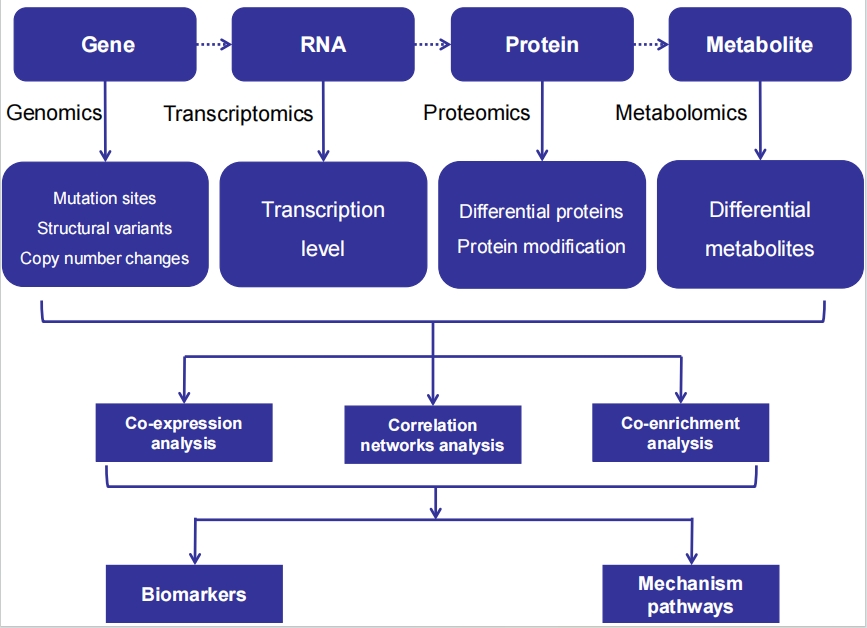
Multi-omic integration is anticipated to offer a comprehensive insight into pediatric cataracts, as it offers a glimpse into the intricate web of molecular interactions and systems biology regulations (Figure 2). By adhering to the central tenet, multi-omic approaches can unveil genotyping traits, RNA transcription, differences in protein expression, and systemic metabolic shifts in pediatric cataract patients. Through the integration of multidimensional omics data, encompassing genetic variants and expression disparities in RNA, proteins, and metabolite during disease states, along with the conduct of correlation networks analyses, we can identify reliable pathogenesis-related pathways and disease-related biomarkers, including specific proteins and metabolites. This holistic approach, characterized by mutual validation and complementation between the upstream and downstream molecular levels, facilitates the identification of the key pathways in pathogenesis-related disorder and enhances our understanding of the biological regulatory network underlying the disease. This, in turn, paves the way for the development of novel therapeutic targets and more efficacious therapeutic strategies. Furthermore, multi-omics data can be further analyzed in conjunction with the phenotypes manifestations of pediatric cataracts to identify the specific molecular pathogenic mechanisms of particular subtypes, potentially aiding in the formulation of individualized clinical diagnosis and treatment strategies.
Figure2 Combined analyses of multi-omics data to explore the molecular pathogenesis
In the future, it is recommended to conduct multi-omics analysis on various biological materials, including peripheral blood, aqueous humor, and lens epithelium, obtained from pediatric cataract patients, particularly from the same cohort of patients. The combined analysis of genomics, proteomics, and metabolomics data from the same patient may have additional clinical value, enabling us to integrate multiple biological processes, systematically and reliably investigate the molecular mechanisms underlying pediatric cataract, and rigorously identify candidate biomarkers and key pathways. Furthermore, multi-omics can establish molecular profiles at different stages of the disease, which, when combine with clinical phenotype data, can achieve the link of between "genotype-protein-metabolite-phenotype". This integration can provide researchers with new perspectives for developing new diagnostic and targeted therapeutic strategies for pediatric cataract.
Table 1 Main technologies and biological samples of omics approaches that have been used in studies of pediatric cataracts
|
Omics layer
|
Biological samples
|
Main technologies
|
|
Genomics
|
Peripheral blood
|
Whole genome sequencing
|
|
|
|
Whole exome sequencing
|
|
|
|
Panel-based sequencing
|
|
|
|
Microarray analysis
|
|
|
|
|
|
Transcriptomics
|
Peripheral blood
|
Whole RNA sequencing
|
|
|
Lens or lens contents
|
mRNA sequencing
|
|
|
Human lens epithelial cells
|
Microarray analysis
|
|
|
|
|
|
Proteomics
|
Aqueous humor
|
Non-targeted proteomics
|
|
|
Lens or lens contents
|
Targeted proteomics
|
|
|
|
|
|
Metabolomics
|
Aqueous humor
|
Non-targeted metabolomics
|
Correction notice
None
Acknowledgements
None
Author Contributions
(I) Conception and design: Zhenzhen Liu
(II) Administrative support: Zhenzhen Liu
(III) Provision of study materials or patients: Not applicable
(IV) Collection and assembly of data: Yinglin Yu, Shuo Gao
(V) Data analysis and interpretation: Yinglin Yu, Shuo Gao
(VI) Manuscript writing: All authors
(VII) Final approval of manuscript: All authors
Conflict of Interests
The authors disclose that the corresponding author, Zhenzhen Liu, serves as Executive Editor-in-Chief of Eye Science. To avoid any potential conflict of interest, the editorial handling of this manuscript was assigned to an independent editor, and the authors were not involved in the peer-review or decision-making process. All editorial procedures were conducted in accordance with COPE guidelines and the journal's standard policies.
The authors declare no other competing financial or non-financial interests relevant to this work.
Patient consent for publication
None
Ethics approval and consent to participate
None
Data availability statement
None
Open access
This is an Open Access article distributed in accordance with the Creative Commons AttributionNonCommercial-NoDerivs 4.0 International License (CC BY-NC-ND 4.0), which permits the non-commercial replication and distribution of the article with the strict proviso that no changes or edits are made and the original work is properly cited (including links to both the formal publication through the relevant DOI and the license).