





Introduction
Pediatric cataract is a broad term that refers to any form of cataract developing between birth and 14 years of age. Congenital cataract is the most common subtype, with a prevalence in developing countries of 5-15 per 10,000 children1,2. Pediatric cataracts are the leading cause of blindness in children worldwide3; for example, a survey conducted in Cambodia showed that visual impairment and blindness is traceable to the lens in 27.4% of children4.
To date, surgery is still the sole means of treating pediatric cataracts5-8. Advanced surgical techniques and timely intervention allow early extraction of cataracts, assuring proper optical correction and treatment/prevention of otherwise irreversible deprivation amblyopia9. The epidemiology of previous hospital-based sampling may be representative of a broader population.
Though our efforts, the etiologies and characteristics of pediatric cataracts were reviewed in a large, diverse cohort of sufferers hospitalized in Shengjing Hospital over the past decade. The details provided are intended to provide insight into children's eye health in China.
The most frequently associated ocular anomaly was nystagmus (Table 1), which was found in 249 patients (84.1%) with congenital cataracts. Strabismus was present in 212 patients (71.6%). Other documented ocular abnormalities were as follows: 1) pseudo microphthalmus (76/296, 25.7%); 2) persistent hyperplastic primary vitreous (PHPV; 6/296, 2.0%) 3) persistent pupillary membrane (PPM; 4/296, 1.4%); 4) congenital glaucoma (2/296, 0.7%); 5) structural abnormalities (2/296, 0.7%); and 6) Morning glory syndrome (1/296, 0.3%).
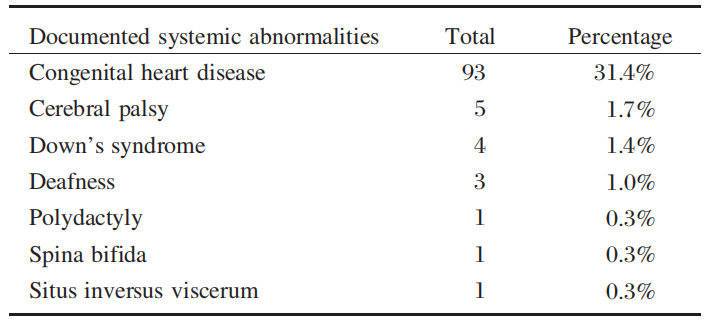
 Congenital heart disease (septal defects, patent ductus arteriosus, valvular stenosis, etc.) accompanied 31.4% (93/296) of congenital cataracts. Other systemic abnormalities documented with congenital cataracts included cerebral palsy (n=5), Down's syndrome (n=4), deafness(n=3), polydactyly(n=1), spinabifida(n=1), and situsinversus viscerum(n= 1) (Table 2).
We discovered that only 16.22% congenital cataracts in our patient population were familial in nature, which was considerably lower than the range (1:4-1:3 ratio) cited by Yi et al11. Although Perucho-Martínez et al12. of Madrid also reported a 17% rate of inheritable congenital cataracts, this figure was considered low, given that primary mutations could present as isolated occurrences. Another study by Lim et al13. of Toronto indicated a lower rate (11.7%), while maintaining that some idiopathic cataracts likely were inheritable but could only be recognized over time or through improved access to molecular genetic testing. We concur with the latter interpretation,acknowledging that our inability to detect such primary mutations may have skewed our rate o inheritable cataracts to a lower value.
In patients with congenital cataracts, an interesting phenomenon emerged in the form of a definitive link with congenital heart disease (31.4%; Table 2). It is thus fair to speculate that the lens of the eye may share structural proteins with the cardiac framework and heart valves. Certainly, this assumption is tentative and in need of validation. Other systemic abnormalities observed in this context were deafness, cerebral palsy, Down's syndrome, polydactyly, spina bifida, and situs inversus viscerum, all at low incidences (0.3-1.7%, Table 2).
We also identified nystagmus (84.1%) and strabismus (71.6%; Table 1) as the top two ocular complications of congenital cataracts. Following cataract extraction, nystagmus may be relieved to some extent through prompt optical correction and treatment of amblyopia, but in the majority our patients, nystagmus persisted to some extent. In addition, 76 eyes (25.7%) with congenital cataracts were smaller than normal. Average corneal diameter varied from 6-9 mm, and axial length varied from 16-20 mm, suggesting pseudo-microphthalmus. In this regard, second-round intraocular lens implantation may be impacted.
Screening for lens opacity is routinely practiced in developed countries, enabling ophthalmologists to identify and treat cataracts without delay. Half of the children in a UK study were diagnosed by the age of 10 weeks, and only 30% were diagnosed after the first year of life14. On the other hand, only one in five children in our cohort was diagnosed by the age of 3 months, and 43.9% were diagnosed after the first year of life. According to You et al9., the mean delay in diagnosis of congenital cataracts for Shandong province of China was 35.7 months;and no cataract surgeries were done within the first 3 months of life. These findings underscore a significant lag in ophthalmic evaluation of infants in China that deserves attention.
Traumatic cataracts (85.92%), all of which were unilateral, constituted the most common subtype of acquired cataracts in our analysis. Eye injuries are the chief cause of non-congenital unilateral blindness in children15, with males typically affected more often than females16. Our male to female ratio of 5:2 was weighted accordingly but was lower than the 4:1 ratio reported by Johar et al. for Western India. Traumatic cataracts also tend to occur in older children17 (mean age,78.5 months). Because these cataracts are largely preventable, children and parents should be forewarned that blunt or perforating trauma, ocular foreign bodies, chemical burns, and radiant energy may encourage the development of cataracts18.
The few cataracts we encountered due to steroid use (n=3) and metabolic disorders (n=2) were bilateral and involved males, in a manner seen with nephrotic syndrome¹⁹. This is perhaps more of an issue in the Kingdom of Saudi Arabia, where 4.6% of pediatric cataracts are attributable to long-term systemic steroid use20. Nevertheless, it is especially important that children subjected to this type of treatment undergo regular ophthalmic evaluations.
Materials and methods
Review materials
Complete medical records of 367 children hospitalized at Shengjing Hospital of China Medical University between August, 2003 and July, 2013 for pediatric cataracts were reviewed retrospectively. All patients were under 14 years of age and presented with various subtypes of cataract as the sole criterion for inclusion.Patient stratification
Subjects were grouped according to etiology as follows: 1) Congenital cataracts: both idiopathic and genetic in nature, or associated with other systemic and ocular abnormalities, and 2) Acquired cataracts: induced by trauma, stemming from complications, and due to steroidal or metabolic influence.Statistical analysis
A descriptive statistical analysis was performed using Microsoft Excel. All original medical records were collected (hard copy from August, 2003 to December, 2008; digital format from January, 2009 to July, 2013) to create a database, including age at clinical presentation, gender, home address, cataract laterality and morphology, family history, primary and secondary diagnosis, and any other coexisting ocular or systemic abnormalities. Visual acuity was not addressed in this analysis, considering a majority of the children were too young for testing. All data were categorized, computed, checked, and then analyzed.Results
Overall, 17,272 admissions were recorded by the Eye Department of Shengjing Hospital between August, 2003 and July, 2013, including 4162 children (24.1%). The 367 patients hospitalized (598 exposures) for pediatric cataracts (males: 232, 63.2%; females: 135, 36.8%; bilateral cataracts: 200, 54.5%) represented 14.4% of all pediatric admissions. Only 16 patients (4.4%) were from regions of China other than the Northeast.Age
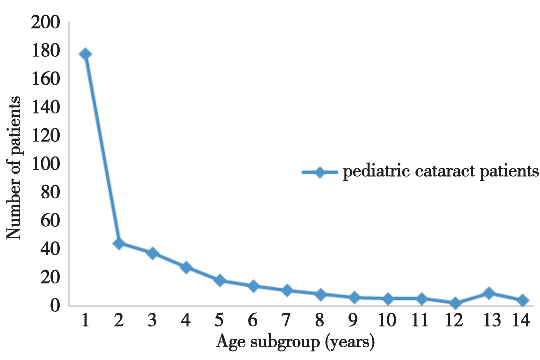
Cataract prevalence declined sharply as a function of age (Figure 1), with 258 patients (70.3%)<3 years old. Cataract subtypes also varied by age. The vast majority (93.8%) of cataracts seen in children<1 year old were congenital. Mean age of traumatic cataracts was 78.5 months.Figure 1 Distribution of pediatric cataracts by age
Gender
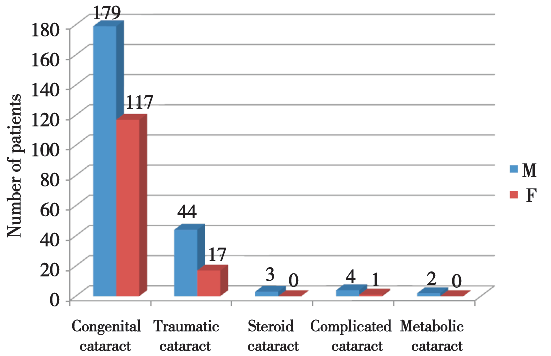
Males in all age groups and in all subtypes of cataract were more commonly affected (male to female ratios by subtype: congenital, 3: 2; acquired, 3:1) (Figure 2). All cataracts due to steroids (n=3) and metabolic disorders (n=2) developed in males.Figure 2 Distribution of pediatric cataracts by subtype and gender
Cataract laterality
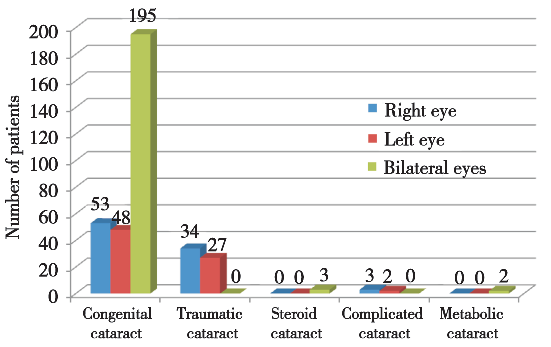
Most congenital cataracts were bilateral (65.9%), rather than unilateral (34.1%; right, 17.9%; left, 16.2%); whereas all acquired cataracts related to trauma were unilateral (right, 55.7%; left, 44.3%), and all cataracts due to steroids and metabolic disorders were bilateral (Figure 3).Figure 3 Distribution of pediatric cataracts by subtype and laterality
Congenital cataracts
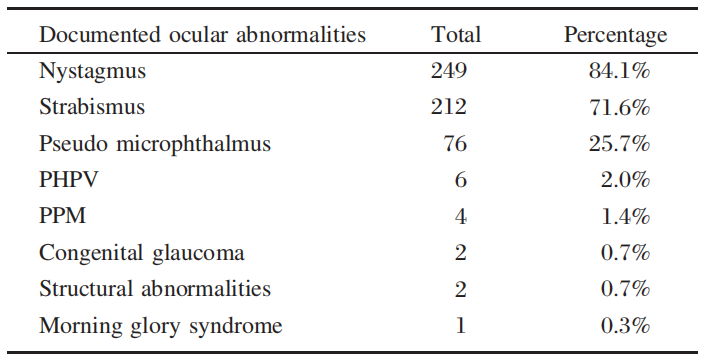
Congenital cataracts (296/367, 80.7%) were the most common overall and were generally seen in Males (179/296, 60.5%) rather than females (117/296, 39.5%). Forty-eight (16.2%) congenital cataracts were genetic anomalies with autosomal dominance, 10 (3.4%) were associated with older parents, 5 (1.7%) occurred in twins, 1 (0.3%) involved a set of triplets, 11 (3.7%) were due to intrauterine infections (rubella), and 8 (2.7%) developed in premature infants.The most frequently associated ocular anomaly was nystagmus (Table 1), which was found in 249 patients (84.1%) with congenital cataracts. Strabismus was present in 212 patients (71.6%). Other documented ocular abnormalities were as follows: 1) pseudo microphthalmus (76/296, 25.7%); 2) persistent hyperplastic primary vitreous (PHPV; 6/296, 2.0%) 3) persistent pupillary membrane (PPM; 4/296, 1.4%); 4) congenital glaucoma (2/296, 0.7%); 5) structural abnormalities (2/296, 0.7%); and 6) Morning glory syndrome (1/296, 0.3%).
Table 1 Other ocular abnormalities associated with congenital cataracts
Table 2 Systemic abnormalities associated with congenital cataracts
Acquired cataracts
Traumatic cataracts constituted 85.9% of all acquired cataracts. Five patients developed cataracts as complications secondary to anti-glaucoma surgery (n=2), iritis (n=2), and vitreous hemorrhage (from retinal detachment in aplastic anemia; n=1). Three patients also suffered cataracts from long-term steroid exposure for kidney conditions (n=2) and during high-dose treatment of Crohn's disease (n=1). In two patients, cataracts resulted from metabolic disorders (galactosemia and Wilson's disease).Discussion
In this investigation,congenital cataracts (296/367, 80.7%) clearly predominated, most of which were bilateral (65.9%) and found in males (M/F ratio, 3:2). Similar results were reported by Haargaard et al. in Denmark10, where 1027 children were afflicted with largely bilateral (64%) and male-predominant (males, 529; females, 498) congenital/infantile cataracts.We discovered that only 16.22% congenital cataracts in our patient population were familial in nature, which was considerably lower than the range (1:4-1:3 ratio) cited by Yi et al11. Although Perucho-Martínez et al12. of Madrid also reported a 17% rate of inheritable congenital cataracts, this figure was considered low, given that primary mutations could present as isolated occurrences. Another study by Lim et al13. of Toronto indicated a lower rate (11.7%), while maintaining that some idiopathic cataracts likely were inheritable but could only be recognized over time or through improved access to molecular genetic testing. We concur with the latter interpretation,acknowledging that our inability to detect such primary mutations may have skewed our rate o inheritable cataracts to a lower value.
In patients with congenital cataracts, an interesting phenomenon emerged in the form of a definitive link with congenital heart disease (31.4%; Table 2). It is thus fair to speculate that the lens of the eye may share structural proteins with the cardiac framework and heart valves. Certainly, this assumption is tentative and in need of validation. Other systemic abnormalities observed in this context were deafness, cerebral palsy, Down's syndrome, polydactyly, spina bifida, and situs inversus viscerum, all at low incidences (0.3-1.7%, Table 2).
We also identified nystagmus (84.1%) and strabismus (71.6%; Table 1) as the top two ocular complications of congenital cataracts. Following cataract extraction, nystagmus may be relieved to some extent through prompt optical correction and treatment of amblyopia, but in the majority our patients, nystagmus persisted to some extent. In addition, 76 eyes (25.7%) with congenital cataracts were smaller than normal. Average corneal diameter varied from 6-9 mm, and axial length varied from 16-20 mm, suggesting pseudo-microphthalmus. In this regard, second-round intraocular lens implantation may be impacted.
Screening for lens opacity is routinely practiced in developed countries, enabling ophthalmologists to identify and treat cataracts without delay. Half of the children in a UK study were diagnosed by the age of 10 weeks, and only 30% were diagnosed after the first year of life14. On the other hand, only one in five children in our cohort was diagnosed by the age of 3 months, and 43.9% were diagnosed after the first year of life. According to You et al9., the mean delay in diagnosis of congenital cataracts for Shandong province of China was 35.7 months;and no cataract surgeries were done within the first 3 months of life. These findings underscore a significant lag in ophthalmic evaluation of infants in China that deserves attention.
Traumatic cataracts (85.92%), all of which were unilateral, constituted the most common subtype of acquired cataracts in our analysis. Eye injuries are the chief cause of non-congenital unilateral blindness in children15, with males typically affected more often than females16. Our male to female ratio of 5:2 was weighted accordingly but was lower than the 4:1 ratio reported by Johar et al. for Western India. Traumatic cataracts also tend to occur in older children17 (mean age,78.5 months). Because these cataracts are largely preventable, children and parents should be forewarned that blunt or perforating trauma, ocular foreign bodies, chemical burns, and radiant energy may encourage the development of cataracts18.
The few cataracts we encountered due to steroid use (n=3) and metabolic disorders (n=2) were bilateral and involved males, in a manner seen with nephrotic syndrome¹⁹. This is perhaps more of an issue in the Kingdom of Saudi Arabia, where 4.6% of pediatric cataracts are attributable to long-term systemic steroid use20. Nevertheless, it is especially important that children subjected to this type of treatment undergo regular ophthalmic evaluations.