Intravitreal injection of anti-VEGF agents in wet age-related macular degeneration: a 5-year retrospective study
Views:
17445
DOI:
10.3978/j.issn.1000-4432.2022.06.07
Publication Date:
2022/12/14
Author(s):
XU Jingjing1, WANG Jianing2, LU Yingyi3, DAI Hong3
XU Jingjing1, WANG Jianing2, LU Yingyi3, DAI Hong3
Institution/Unit:
Tsinghua Medicine, Tsinghua University
Peking University Fifth School of Clinical Medicine, Department of Ophthalmology, Beijing Hospital, National Center of Gerontology, Institute of Geriatric Medicine, Chinese Academy of Medical Sciences
Department of Ophthalmology, Beijing Hospital, National Center of Gerontology, Institute of Geriatric Medicine, Chinese Academy of Medical Sciences
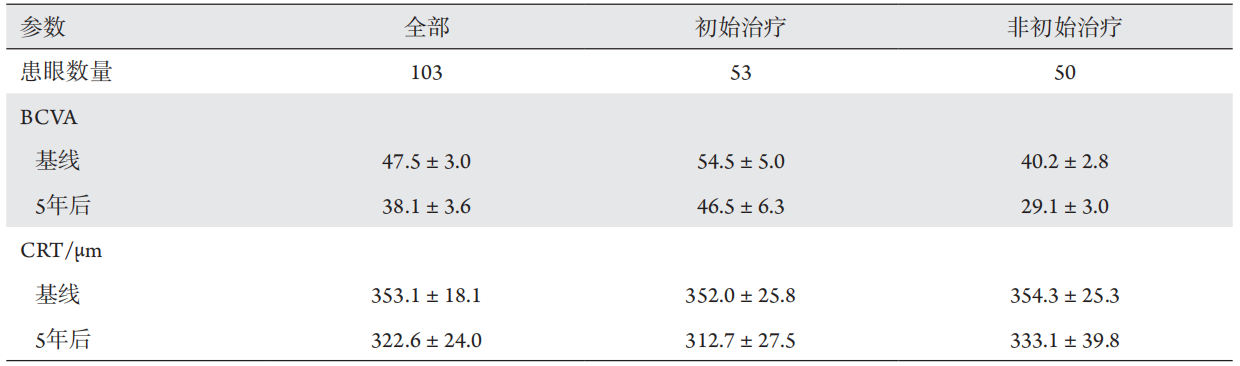
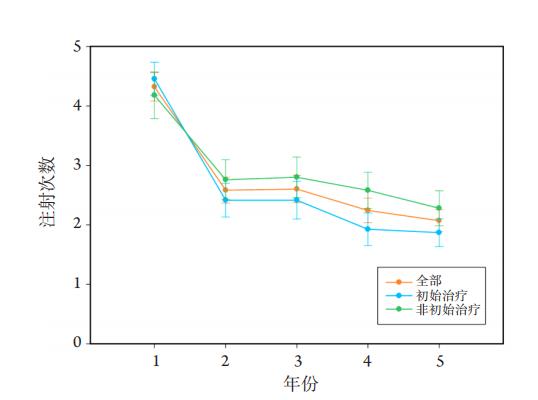
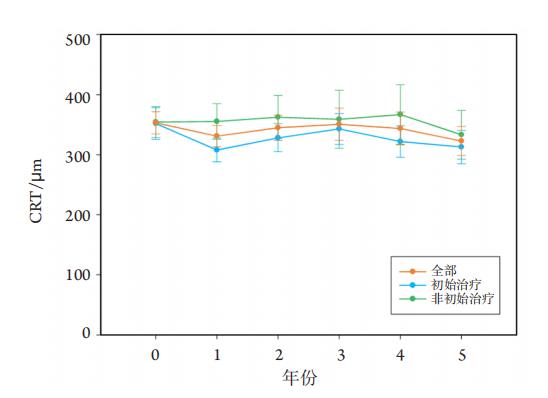
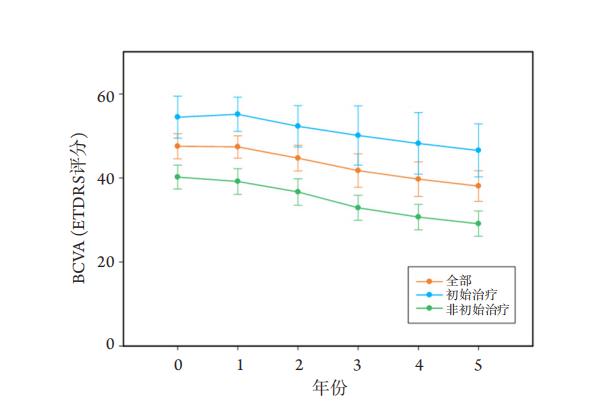
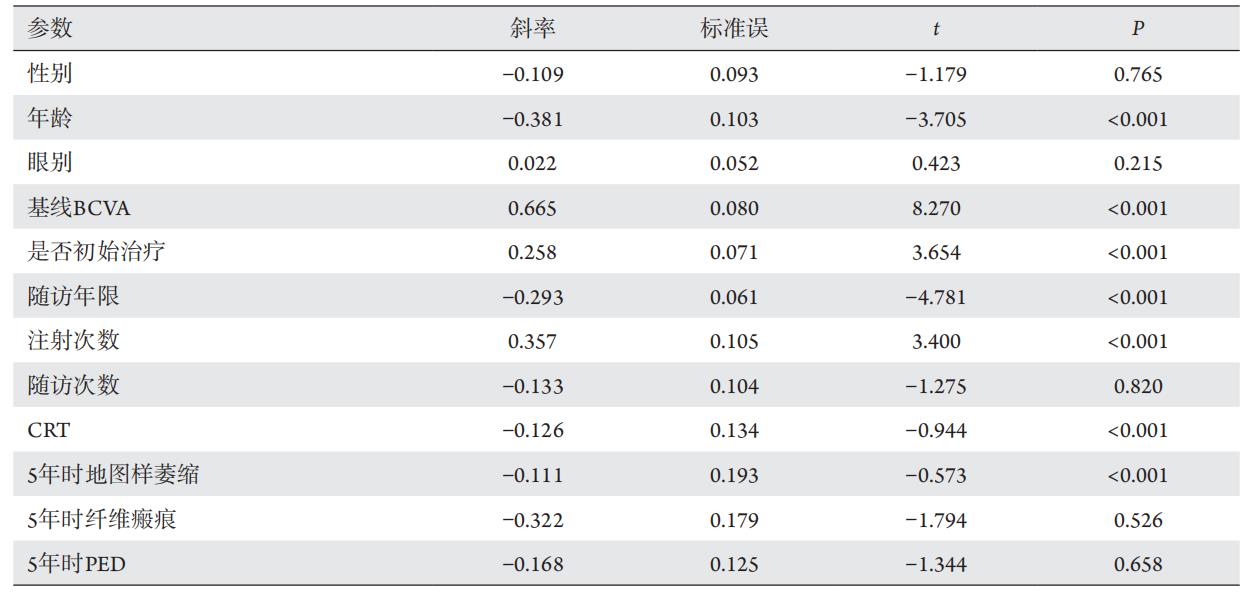
Objective:To investigate the efficacy of anti-VEGF injection in the treatment of wet age-related macular degeneration (wAMD) for 5 years. Methods: A total of 84 patients (103 eyes) wAMD diagnosed in Department of Ophthalmology in Beijing Hospital from 2011 to 2021 were analyzed retrospectively. 3 + PRN regimen was applied for anti-VEGF treatment. The changes of best corrected visual acuity (BCVA), the number of intravitreal injections and the number of follow-up visits, and the anatomical changes of the lesions in the past 5 years were collected. Results: The average BCVA after 5 years was 38.1 letters, indicating a decrease of 9.4 letters comparing to baseline, which was statistically significant (P<0.001). 23.3% of the eyes could maintain the baseline BCVA after 5 years. The average injection times within 5 years was 13.8, and the injection was concentrated in the first year, with an average of 4.3. The average number of follow-up visits within 5 years was 24.3, and only 34.0% of the affected eyes could keep the follow-up interval ≤3 months. After 5 years, 68.0% of the eyes developed fibrous scar, 27.2% developed geographic atrophy, and 69.0% (71/103) had consistent pigment epithelial detachment. Factors significantly affect BCVA include: age, baseline BCVA, initial treatment, follow-up time, injection times, central retinal thickness, geographic atrophy and so on. Conclusion: Most patients can maintain vision within the first year after anti-VEGF treatment, but the efficacy is poor for more than 5 years. Early diagnosis and treatment, and increased injection frequency may be the research direction for improving prognosis in the future.
Kertes PJ, Galic IJ, Greve M, et al. Efficacy of a treat-and-extend
regimen with ranibizumab in patients with neovascular age-related
macular disease: a randomized clinical trial[ J]. JAMA Ophthalmol,
2020, 138(3): 244-250.
Garretón R, González R. Treat and extend compared to pro re nata
regimen in neovascular age-related macular degeneration[ J]. Medwave,
2020, 20(8): e8024.
Maruko I, Ogasawara M, Yamamoto A, et al. Two-year outcomes
of treat-and-extend intravitreal aflibercept for exudative age-related
macular degeneration: a prospective study[ J]. Ophthalmol Retina,
2020, 4(8): 767-776.
Chaikitmongkol V, Nanegr ungsunk O, Patikulsila D, et al.
Repeatability and agreement of visual acuity using the ETDRS
Number Chart, Landolt C Chart, or ETDRS Alphabet Chart in eyes
with or without sight-threatening diseases[ J]. JAMA Ophthalmol,
2018, 136(3): 286-290.
Jolly JK, Juenemann K, Boagey H, et al. Validation of electronic visual
acuity (EVA) measurement against standardised ETDRS charts in
patients with visual field loss from inherited retinal degenerations[ J].
Br J Ophthalmol, 2020, 104(7): 924-931.
中华医学会眼科学分会眼底病学组中国老年性黄斑变性临床
指南与临床路径制订委员会. 中国老年性黄斑变性临床诊断治
疗路径[ J]. 中华眼底病杂志, 2013, 29(4): 343-355.
The Clinical Guideline and Clinical Pathway Development Commitee
of Age-Related Macular Degeneration, Ocular Fundus Diseases Society,
Chinese Ophthalmological Society, Chinese Medical Association.
Clinical pathway of age-related macular degeneration in China[ J].
Chinese Journal of Ocular Fundus Diseases, 2013, 29(4): 343-355.
Lu Y, Huang J, Zhao J, et al. Effects of intravitreal ranibizumab injection
on chinese patients with wet age-related macular degeneration: 5-year
follow-up results[ J]. J Ophthalmol, 2016, 2016: 6538192.
Stattin M, Forster J, Graf A, et al. Five-year outcomes of a personalized
pro re nata treatment regimen with anti-vascular endothelial growth
factor for neovascular age-related macular degeneration[ J]. Acta
Ophthalmol, 2019, 97(1): e131-e133.
Kung FF, Starr MR, Bui YT, et al. Long-term follow-up of patients with
exudative age-related macular degeneration treated with intravitreal
anti-vascular endothelial growth factor injections[ J]. Ophthalmol
Retina, 2020, 4(11): 1047-1053.
Starr MR, Kung FF, Mejia CA, et al. Ten-year follow-up of patients with
exudative age-related macular degeneration treated with intravitreal
anti-vascular endothelial growth factor injections[ J]. Retina, 2020,
40(9): 1665-1672.
Haddad WM, Minous FL, Legeai J, et al. Long-term outcomes and
incidence of recurrence of neovascularization in treated exudative age-
related macular degeneration[ J]. Retina, 2017, 37(5): 951-961.
Berg K, Roald AB, Navaratnam J, et al. An 8-year follow-up of anti-
vascular endothelial growth factor treatment with a treat-and-extend
modality for neovascular age-related macular degeneration[ J]. Acta
Ophthalmol, 2017, 95(8): 796-802.
Jaffe GJ, Ying GS, Toth CA, et al. Macular morphology and visual acuity
in year five of the comparison of age-related macular degeneration
treatments trials[ J]. Ophthalmology, 2019, 126(2): 252-260.
Comparison of Age-related Macular Degeneration Treatments Trials
(CATT) Research Group; Maguire MG, Martin DF, et al. Five-year
outcomes with anti-vascular endothelial growth factor treatment of
neovascular age-related macular degeneration: the comparison of age-
related macular degeneration treatments trials[ J]. Ophthalmology,
2016, 123(8): 1751-1761.
Keenan TDL, Cukras CA, Chew EY. Age-related macular degeneration:
epidemiology and clinical aspects[ J]. Adv Exp Med Biol, 2021, 1256:
1-31.
Tan W, Zou J, Yoshida S, et al. The role of inflammation in age-related
macular degeneration[ J]. Int J Biol Sci, 2020, 16(15): 2989-3001.
Deng Y, Qiao L, Du M, et al. Age-related macular degeneration:
Epidemiology, genetics, pathophysiology, diagnosis, and targeted
therapy[ J]. Genes Dis, 2022, 9(1): 62-79.
Armento A, Ueffing M, Clark SJ. The complement system in age-related
macular degeneration[ J]. Cell Mol Life Sci, 2021, 78(10): 4487-4505.
K aarniranta K , Uusitalo H, Blasiak J, et al. Mechanisms of
mitochondrial dysfunction and their impact on age-related macular
degeneration[ J]. Prog Retin Eye Res, 2020, 79: 100858.
Li JQ, Welchowski T, Schmid M, et al. Prevalence and incidence of age-
related macular degeneration in Europe: a systematic review and meta-
analysis[ J]. Br J Ophthalmol, 2020, 104(8): 1077-1084.