





Introduction
Refractive error is a common eye disease. According to a World Health organization report, as of 2002, over 160 million patients have suffered from visual impairment induced by refractive error and alternative ocular diseases. Myopia accounts for more than 75% of refractive error cases. Pathological changes, such as macular degeneration, proliferative choroidal retinopathy, and optic neuropathy, may lead to blindness, which imposes heavy mental and economic burdens, and becomes a severe public health problem1-9.
Recent studies demonstrated that refractive error is a disease collectively caused by the interaction between hereditary and environmental factors, where the hereditary factors play a leading role10. Refractive error is occasionally accompanied by cataract and other eye abnormalities that affect the results of a refraction test. In addition, the heritability of spherical equivalent significantly varies among different studies. Ocular biometrics related to refractive error mainly include corneal and lens refraction, anterior chamber depth (ACD), vitreous chamber depth and axial length (AL), etc. Thus, use of spherical equivalent may possibly prohibit the accurate summarization of the genetic mechanism underlying myopia11. Previous research suggested that AL represented a combination of anterior chamber depth, lens thickness, and vitreous chamber depth. The heritability remained relatively stable among different investigations and was subject to slight influence from environmental factors, which could act as an endophenotype of myopia in genetics-related studies12-14.
Twin study is a vital method of identifying the genetic basis of complex diseases or traits. As a "perfect natural experiment ," twin study has been widely applied in the heritability measurement of phenotype. The Guangzhou Twin Eye study is a population-based eye investigation in twin children15.
Materials and methods
Sample collection
Study subjects were selected from Guangzhou Twin Eye study15. This human research adhered to the principles of the Helsinki Declaration. All test procedures were approved by the ethics committee of zhongshan ophthalmic center, sun yat-sen university. The average age was (10.68±0.11) years for boys and (10.91±0.11) years for girls. Twins or one of the twins who had the following situations were excluded from this study:
1. Congenital or acquired diseases affecting physical development.
2. Refractive media opacity.
3. Strabismus or amblyopia.
4. Ocular pathological changes, such as retinopathy of prematurity and congenital cataract, etc.
5. Recent use of corneal contact lenses for visual acuity correction.
Clinical examination
An IOL Master (Carl Zeiss Meditec, Oberkochen, Germany) was utilized to measure AL. The examination was carried out in a dark room with the glasses taken off. The children's refractive test was conducted after mydriasis, performed using cyclopentolate 1% (Alcon pharma) as a cycloplegic agent every 5 min. The cycloplegic effect was evaluated 20 min later based on pupil reflection. Cycloplegia is defined as the absence of a pupillary reflex. Full dilation of the pupil is defined as a diameter of the pupil exceeding 6 mm. If a cycloplegic effect was not achieved, a third drop of cyclopentolate was administered and the effect of cycloplegia was observed 15 min later. The pupillary reflex and pupil size were recorded. A refraction examination was performed when the pupillary reflex was absent. An optometry examination was conducted by trained nurses using a Topcon autorefractor (Autorefractometer KR-8800, Topcon corp, Tokyo, Japan).
Definition and statistical methods of refractive error
Myopia is defined as a spherical equivalent of either or both eyes≤-0.50D. Hyperopia is defined as a spherical equivalent of either or both eyes≥+2.00D. Astigmatism is defined as the degree of astigmatism≥0.75D. spherical equivalent=spherical degree+cylinder degree/2. Eyes not in accord with the definition of myopia, hyperopia, and astigmatism were regarded as emmetropic. Eyes with naked visual acuity≤20/40 were diagnosed as affected. The patients with unilateral best corrected visual acuity≥20/32 were diagnosed with refractive error.
Amblyopia was defined as no organic changes, corrected visual acuity below the required standard, and meeting at least one of the following criteria: 1) The subjects had esotropia, exotropia, or vertical strabismus when viewing a distant object or presented with esotropia or vertical strabismus when viewing a near object; 2) Anisometropia : the difference between bilateral spherical equivalent≥2D; 3) Bilateral hyperopia>+6D. The other subjects with poor visual correction were diagnosed with unknown causes.
Stata software was utilized for statistical analysis (stata statistical software, Release 11.0, stata corp. , College station, TX). Multiple linear regression analysis was adopted to analyze the influence of ocular biometrics on refraction, adjusted by age and gender. Age was defined as the period between the date of the examination and the date of birth. The refraction in Guangzhou twin children was non-nor-mally distributed , so the spherical equivalent was transformed into an approximately normal distribu- tion before linear regression analysis using the following formula (where abs denotes an absolute value function):
Ref-trans=(spherical equivalent-0.89)×abs(spherical equivalent-0.89)-0.5
After normal distribution transformation, skewness=0.35 and Kurtosis=2.50 for approximation normal distribution. The measurement of ocular biometrics between the two eyes was highly correlated (the correlation coefficient was 0.91 for the first measurement of spherical equivalent, 0.95 for AL, 0.92 for ACD, and 0.96 for corneal radius of curvature). The outcomes of the right eyes were selected during analysis of the influencing factors of refraction. The data from the older of the twins were chosen for analysis since the measured values between twins were not independent.
Results
General data
A total of 1217 twins participated in the examination. Those with corneal opacity, fundus pathological changes, amblyopia, and congenital cataract were excluded from this study. Finally, 1195 twins aged 7-15 years completed the first examination. Among 1195 children, 1123 eyes (94%) had a pupil diam eter>6 mm and no light reflex, 63 (5.21%) had no light reflex while the pupil diameter was not long enough, and 3 (0.25%) had pupil dilation and light reflex. The corresponding data for the left eyes were 1116 (93.4% ), 70 (5.85%), and 6 (0.5%). Six right and three left eyes failed to undergo mydriasis.
Relationship between refractive error and ocular biometrics
The distribution of spherical equivalent, AL, ACD, and radius of curvature among different groups during the first examination is illustrated in Figures 1-4. Spherical equivalent was gradually decreased with age, with a trend towards myopia development. AL and ACD increased with age whereas corneal radius of curvature remained stable.
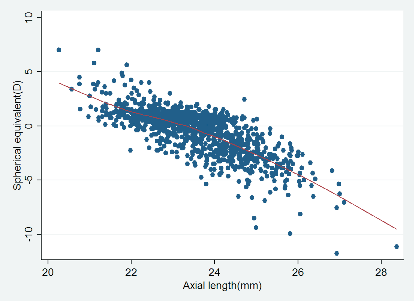
Spherical equivalent after transformation was used as a dependent variable, and AL, ACD, and corneal curvature as predictable variables. Multiple linear regression analysis was adopted to analyze the influence of ocular biometrics on refraction, adjusted by age and gender. A Lowess curve for spherical equivalent and AL is shown in Figure 5. Slight changes were observed at a 23 mm eye axis in the fitting curve. Consequently, the results were analyzed according to eye axis ≤23 mm and>23 mm, as illustrated in the table.
In children with AL≤23 mm, 62% of spherical equivalent changes were caused by predictable variables (R2=0.62, P<0.001), suggesting that AL (β=-1.42, P<0.001), ACD (β=0.96, P<0.001), and corneal radius of curvature (β=2.94, P<0.001) were the primary factor affecting children's refraction. Girls had lower spherical equivalents than boys and had a tendency toward myopia (β=-0.28, P<0.001). Age had no effect on the changes in refraction (β=-0.01, P=0.46).
For those with AL>23 mm, 75% of the spherical equivalent changes were caused bypredictable variables (R2=0.75, P<0.001). Primary influential factors of children's refraction included AL (β=-0.84, P<0.001) , ACD (β=0.26, P<0.001), and corneal radius of curvature (β=1.96, P<0.001). Girls had a lower spherical equivalent than boys and had a tendency toward myopia (β=-0.26, P<0.001). Age had no effect on the changes in refraction (β=-0.01, P=0.017).
Among all enrolled children, 77% of their spherical equivalent changes were caused by predictable variables (R2=0.77, P<0.001). Primary influential factors of children’s refraction included AL (β=-0.97, P<0.001), ACD (β=0.33, P<0.001), and corneal curvature radius (β=2.10, P<0.001). Girls had a lower spherical equivalent than boys and had a tendency toward myopia (β=-0.26, P<0.001). Age had no effect on the changes in refraction(β=-0.01, P=0.25).
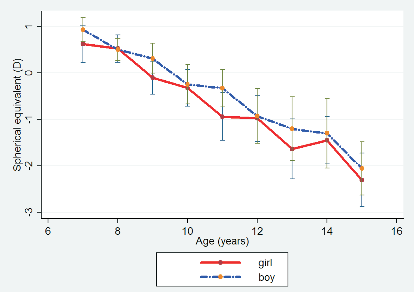
Figure 1 Changes in refraction with aging
Figure 2 Changes in axial length with aging
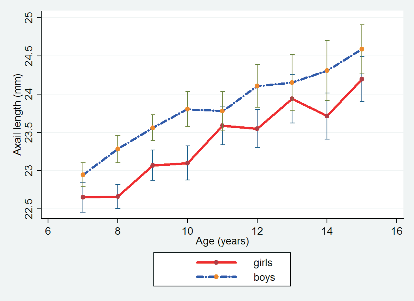
Figure 3 Changes in ACD with aging
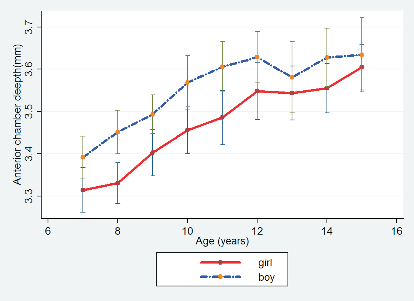
Figure 4 Changes in corneal curvature radius with aging
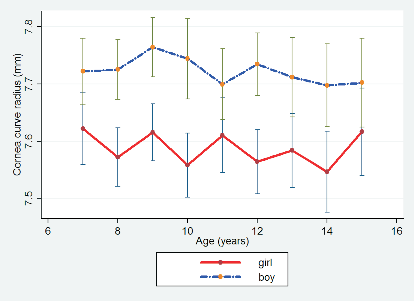
Figure 5 Lowess curve for spherical equivalent and axial length
Discussion
Refractive error is a common eye disease. Blindness in approximately 5 million patients is estimated to be caused by refractive error, with myopia accounting for more than 75% of refractive error16. Uncorrected refractive error, cataract, macular degeneration, infectious eye diseases, and vitamin A deficiency are categorized as the major causes of visual impairment and blindness according to the world Health organization17. In this study, multiple regression analysis revealed that the refraction of children aged 7-15 years was correlated with the changes in AL, ACD, and corneal radius of curvature. AL was the primary influencing factor of refraction.
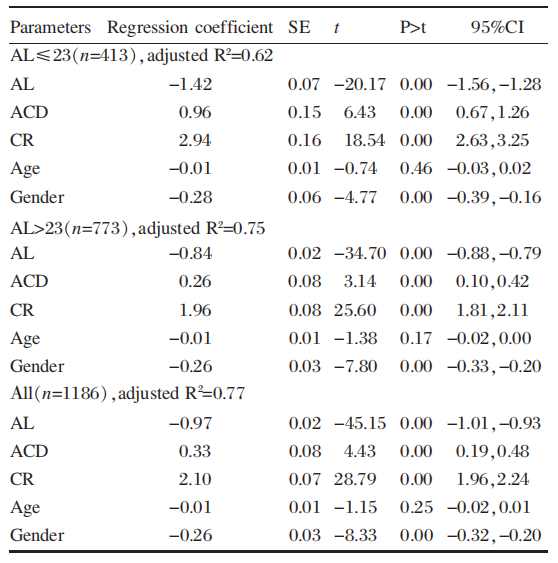
Table 1 Multiple linear regression annalysis of factors influencing refractive eror
Refraction-related ocular biometrics mainly in clude corneal and lens diopter, ACD, vitreous chamber depth, and AL, etc. Sorsby et al. demonstrated that the status of emmetropic eyes was maintained based on the balance between AL and corneal curvature; that is, a longer AL was consistently accompanied by a longer corneal radius of curvature, or vice versa. Refractive error may arise if this balance is disrupted18 ,19. Many studies have indicated that refraction in both children and adults is mainly determined by the changes in AL, which is negatively correlated with refraction. The changes in AL are mainly associated with the alterations in vitreous chamber depth rather than with ACD20-22. Although changes in corneal curvature radius may alter refraction, the corneal radius of curvature does not significantly change among children of different ages. Consequently, it is not the primary cause of changes in refraction23. The present research demonstrated that the refraction of twin children aged 7-15 years was correlated with AL, ACD, and corneal radius of curvature. Spherical equivalent decreased with age, AL increased, and corneal radius of curvature remained stable. Thus, the refraction in Chinese children appears to be mainly determined by AL, which is consistent with previous findings.
In addition, gender is a risk factor for the progression of refraction into myopia. Female subjects have a higher tendency toward myopia compared with males. previous research in India, shunyi, Guangzhou, and Hong Kong in china and Nepal all demonstrated that the female gender is a risk factor for myopia in school-age children, whereas studies in Chile and south Africa revealed that female gender is a risk factor for hyperopia rather than myopia5,7. This discrepancy probably reflects the selection of the study population. In addition, gender exerts different influences upon refraction in children of various races.
Conclusion
The refraction of twin children aged 7-15 years in Guangzhou is correlated with AL, ACD, and corneal radius of curvature. AL is the leading determining factor of refraction.