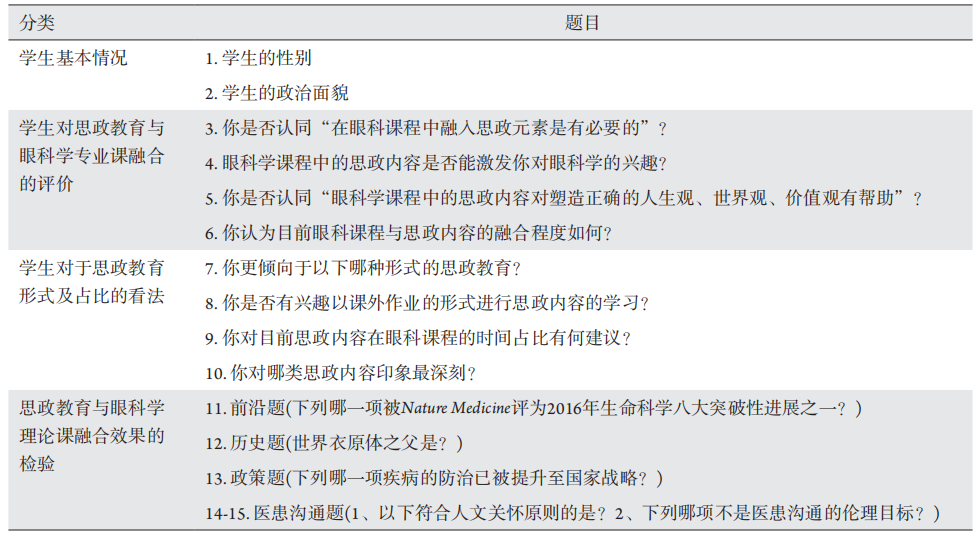
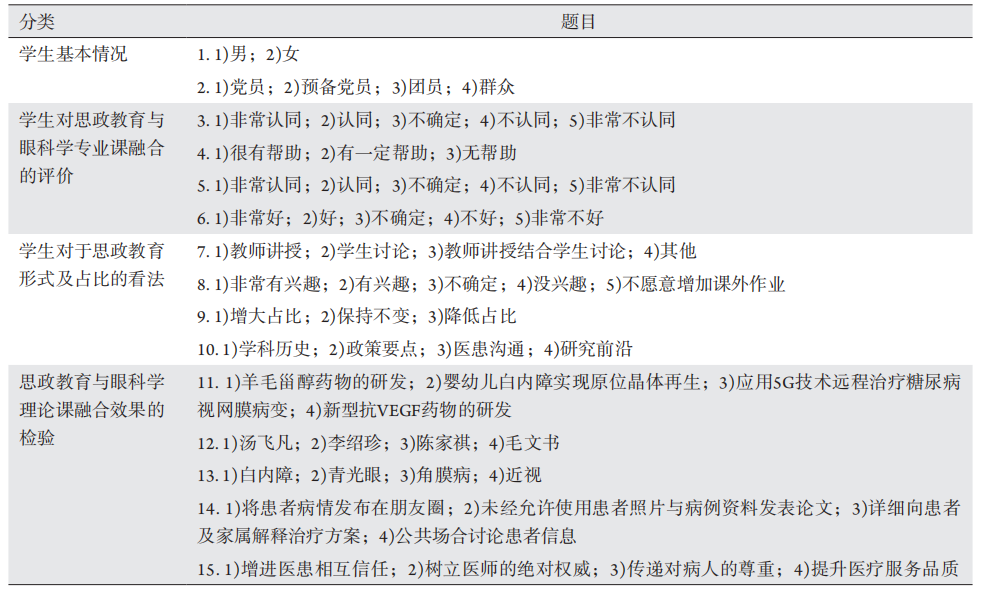
(A) The acceptance of the ideological and political elements in students; (B) Students’ perceptions of the integration of ideological and political elements in the current curriculum; (C) Students’ perceptions that whether the ideological and political elements are beneficial for stimulating their interest in ophthalmology.
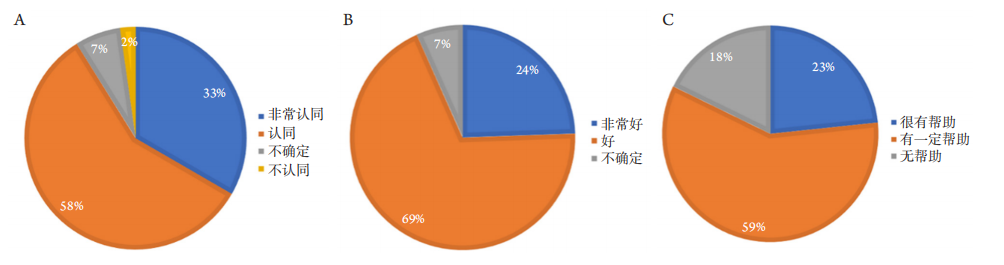
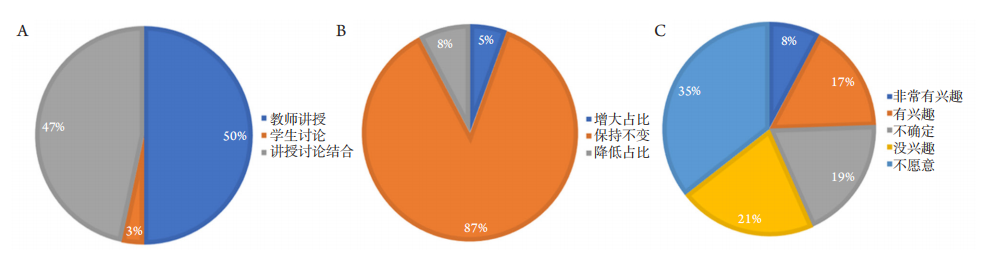
图2 学生对思政元素教学形式与占比的建议
Figure 2 Students’ opinions on the teaching design and proportion of the ideological and political elements
(A)学生倾向的教育形式;(B)学生对思政元素课程占比的建议;(C)学生对课外作业的接受度。
(A) The form of education that students prefer; (B) The student’s recommendation about the proportion of the ideological and political elements; (C) The student’s acceptance of extracurricular assignments.
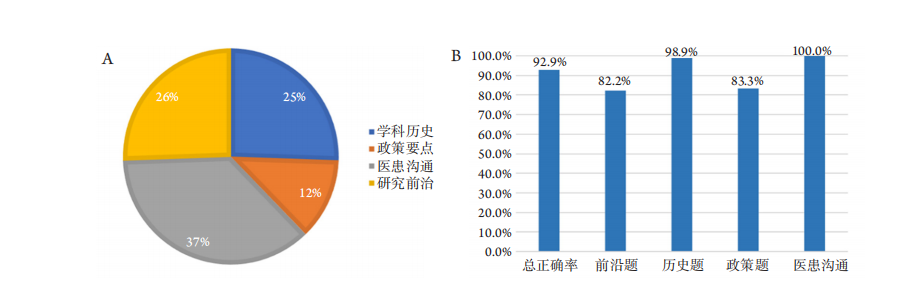
图3 思政元素教学效果评价
Figure 3 Evaluation of the effffectiveness of ideological and political elements in the curriculum.
(A) 学生印象最深刻的思政元素;(B)不同类型思政元素题目的正确率。
(A) The ideological and political elements that the students are most impressed with; (B) The correct rate of different types of ideological and political elements.
1. 中山大学教学改革基金 ( JX3030604024)。This work was supported by the Teaching Reform Fund of Sun Yat-sen University, China ( JX3030604024)
参考文献
1. 王涵 . 高校专业课程思政教学改革与反思 [ J ] . 管理观察 ,2017(30): 138-140.
WANG Han. Reform and reflection on ideological and political teaching of college specialized courses[ J]. Management Observer, 2017(30): 138-140.
2. 胡纵宇, 黄丽亚. 大数据时代大学生思想政治教育面临的问题及应对[ J]. 学校党建与思想教育, 2014(7): 64-66.
HU Zongyu, HUANG Liya. Problems and countermeasures of college students' ideological and political education in era of big data[ J]. The Party Building and Ideological Education in Schools, 2014(7): 64-66.
3. 陆道坤. 课程思政推行中若干核心问题及解决思路——基于专业课程思政的探讨[ J]. 思想理论教育, 2018(3): 64-69.
LU Daokun. Some core problems and solutions in the implementation of curriculum ideological and political education—based on the discussion of ideological and political education in professional courses[ J]. Ideological & Theoretical Education, 2018(3): 64-69.
5. Williams DL. Ocular pathology and the link with systemic disease[ J]. Vet J, 2010, 183(1): 11.
6. Grauslund J, Stokholm L, Ohm Kyvik K, et al. Interactions between ocular and systemic disease using national register-based data in the Danish Excellence Centre in Ophthalmic Epidemiology (DECODE-EYE): study perspective[ J]. Acta Ophthalmol, 2020, 98(6): 573-578.
7. 吕致逸. 新时代思政课教师提升社会思潮引领能力的有效路径[ J]. 佳木斯职业学院学报, 2022, 38(3): 122-124.
Lü Zhiyi. Effective ways for ideological and political teachers to improve the leading ability of social thoughts in the new era[ J]. Journal of Juamjusi Education Institute, 2022, 38(3): 122-124.
8. 成桂英. 推动“课程思政”教学改革的三个着力点[ J]. 思想理论教育导刊, 2018(9): 67-70.
CHENG Guiying. Three key points of promoting the teaching reform of 'Curriculum Ideology and Politics'[ J]. Leading Journal of Ideological & Theoretical Education, 2018(9): 67-70.
9. 张金磊, 王颖, 张宝辉. 翻转课堂教学模式研究[ J]. 远程教育杂志, 2012, 30(4): 46-51.
ZHANG Jinlei, WANG Yin, ZHANG Baohui. Introducing a new teaching model: flipped classroom[ J]. Journal of Distance Education, 2012, 30(4): 46-51.
10. 胡兆华, 郑霞霞, 方仙桃, 等. TBL教学法的学生反馈意见调查与分析[ J]. 西北医学教育, 2010, 18(6): 1143-1145.
HU Zhaohua, ZHENG Xiaxia, FANG Xiantao, et al. Survey and analysis of students' feedback on team-based learning[ J]. Medical Education Research and Practice, 2010, 18(6): 1143-1145.
11. 于述伟, 王玉孝. LBL、PBL、TBL教学法在医学教学中的综合应用[ J]. 中国高等医学教育, 2011(5): 100-102.
YU Shuwei, WANG Yuxiao. Integrated application of LBL, PBL and TBL teaching methods in medical education[ J]. China Higher Medical Education, 2011(5): 100-102.
12. 于珍. 新形势下加强和改进医学院校学生思想政治教育工作的思考[ J]. 经济与社会发展, 2010, 8(12): 161-163.
YU Zhen. Reflections on strengthening and improv ing the ideological and political education for medical college students under the new situation[ J]. Economic and Social Development, 2010, 8(12): 161-163.
13. 高宁, 王喜忠. 全面把握《高等学校课程思政建设指导纲要》的理论性、整体性和系统性[ J]. 中国大学教学, 2020(9): 17-22.
GAO Ning , WANG Xizhong. Comprehensively Grasping the Theoretical, Holistic and Systematic Features of Guiding Outline of Ideological and Political Construction of College Curriculum[ J]. China University Teaching, 2020(9): 17-22.
14. 牛奔. 医学生思想政治教育创新模式研究[D]. 重庆: 重庆医科大学, 2014.
NIU Ben. The study on innovation mode ideological and political education for medical students[D]. Chongqing: Chongqing Medical University, 2014.
15. 许争昱. “微时代”医学生思想政治教育革新的思考[ J]. 现代教育科学, 2016(12): 85-88.
XU Zhengyu. On the ideological and political education of medical students in “Micro Era”[ J]. Modern Education Science, 2016(12): 85-88.
16. 牛临虹. 新时期医学教育模式转变的几点思考[ J]. 山西高等学校社会科学学报, 2003, 15(2): 103-104.
NIU Linhong. Several considerations of transformation of medical education model in the new times[ J]. Social Sciences Journal of Colleges of Shanxi, 2003, 15(2): 103-104.
17. 沈子雯. 新时期医学生思想政治教育工作的挑战与对策[ J]. 黄冈师范学院学报, 2009(S1): 96-97.
SHEN Ziwen. Challenges and countermeasures of medical students’ ideological and political education in the new era[ J]. Journal of Huanggang Normal University, 2009(S1): 96-97.
18. 高德毅, 宗爱东. 从思政课程到课程思政: 从战略高度构建高校思想政治教育课程体系[ J]. 中国高等教育, 2017(1): 43-46.
GAO Deyi, ZONG Aidong. From ideological and political courses to curriculum ideological and political education : constructing the curriculum system of ideological and political education in colleges and universities from a strategic perspective[ J]. China Higher Education, 2017(1): 43-46.
19. 万林艳, 姚音竹. “思政课程”与“课程思政”教学内容的同向同行[ J]. 中国大学教学, 2018(12): 52-55.
WAN Linyan, YAO Yinzhu. ‘Ideological and Political Courses’ and ‘Curriculum Ideological and Political’ teaching content go in the same direction[ J]. China University Teaching, 2018(12): 52-55.
20. 吴晶, 胡浩. 习近平在全国高校思想政治工作会议上强调: 把思想政治工作贯穿教育教学全过程, 开创我国高等教育事业发展新局面[ J]. 中国高等教育, 2016(24): 5-7.
WU Jing, HU Hao. Xi Jinping stressed at the National Conference on Ideological and Political Work in Colleges and Universities: the ideological and political work must permeate the entire education and teaching process, and create a new environment in the development of China's higher education[ J]. China Higher Education, 2016(24): 5-7.
21. 国务院办公厅关于加快医学教育创新发展的指导意见[ J]. 中华人民共和国国务院公报, 2020(28): 27-31.
Guiding opinions of the general office of the state council on accelerating the innovative development of medical education[ J]. Gazette of the StateCouncil of the People's Republic of China, 2020(28): 27-31.

'%20fill='white'%20fill-opacity='0.01'/%3e%3cmask%20id='mask0_3477_29692'%20style='mask-type:luminance'%20maskUnits='userSpaceOnUse'%20x='0'%20y='0'%20width='16'%20height='16'%3e%3crect%20id='&%23232;&%23146;&%23153;&%23231;&%23137;&%23136;_2'%20x='16'%20width='16'%20height='16'%20transform='rotate(90%2016%200)'%20fill='white'/%3e%3c/mask%3e%3cg%20mask='url(%23mask0_3477_29692)'%3e%3cpath%20id='&%23232;&%23183;&%23175;&%23229;&%23190;&%23132;'%20d='M14%205L8%2011L2%205'%20stroke='%23333333'%20stroke-width='1.5'%20stroke-linecap='round'%20stroke-linejoin='round'/%3e%3c/g%3e%3c/g%3e%3c/svg%3e)